


A court in northern China yesterday handed lengthy prison terms to two teenagers for murdering their classmate with a shovel in March, state media reported, in a case that triggered heated public debate on juvenile delinquency.
The male suspects surnamed Zhang (張) and Li (李) were sentenced to life and 12 years in jail respectively for intentional homicide by a court in the city of Handan, China Central Television said, but no motive was given.
The court found the methods of the killing “were particularly cruel, and the circumstances were particularly heinous,” it said.
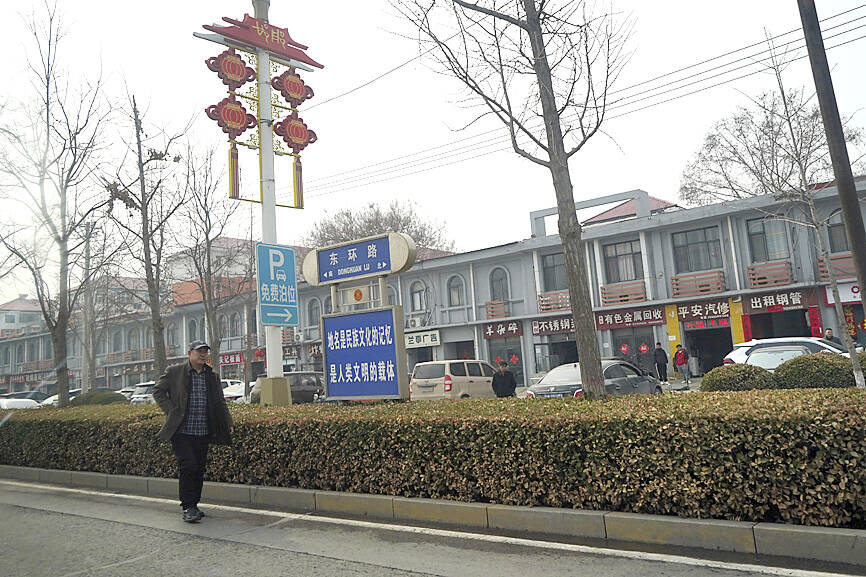
Photo: AP
A third suspect surnamed Ma (馬) escaped with a sentence of “special correctional education,” in line with the law, the broadcaster said.
All three were aged 13 at the time of the murder.
They were detained the day after the body of the 13-year-old victim, surnamed Wang (王), was found on March 10, buried in a shallow pit in an abandoned greenhouse on the city’s outskirts, state media said.
The court said Zhang bore principal responsibility for killing Wang with a shovel and initially devised the murder plan, while Li, his main accomplice, joined in the killing and subsequent burial.
Ma followed the pair to the site of the murder and witnessed the killing, but did not participate.
China in 2021 lowered the age of criminal responsibility to 12 from 14 for certain crimes, but kept minors exempt from the death penalty.
Suspects aged 12 to 14 face criminal responsibility for serious crimes such as intentional homicide if the top prosecutor approves the charges.
At the time of the crime, state media said all four were the offspring of rural migrant workers who spend most of the year working in large cities, leaving grandparents and other relatives to care for their children.
Census data from 2020 shows that such “left-behind” children, as they are called, number nearly 67 million. Academic studies show they are at higher risk of suffering mental health issues, becoming victims of bullying and criminal behavior.
At the time, some people on social media had demanded the death penalty, saying minors were receiving inadequate punishment for serious crimes.

Crowds in Bangladesh are flocking to snap photographs with an unlikely social media star — an albino buffalo with flowing blond hair nicknamed “Donald Trump” that is due to be sacrificed within days. Owner Zia Uddin Mridha, 38, said his brother named the 700kg bull over its flowing helmet of hair resembling the signature look of the US president. “My younger brother picked this name because of the buffalo’s extraordinary hair,” he said at his farm in Narayanganj, just outside the capital, Dhaka. Mridha said that a constant stream of curious visitors — social media fans, onlookers and children — have come throughout

It began as a satirical online project. Now millions of young people in India are flocking to it as an outlet for their frustration. A parody political party called the Cockroach Janta Party, with the insect as its symbol, has exploded across India’s social media by turning absurdist humor into protest. Memes and short videos mocking corruption, joblessness and political dysfunction have flooded social media sites, where millions of users are embracing the cockroach — known for its ability to survive harsh conditions — as a tongue-in-cheek symbol of endurance. The online movement’s rise has been unusually rapid. The Cockroach Janta Party (CJP)
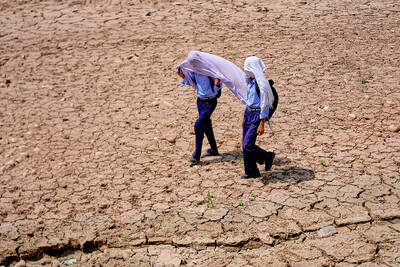
HOTTER: While Indians are accustomed to summer heat, climate change has caused northwestern India to warm faster than other parts of the country, an academic said Roads and markets have emptied during afternoons and some farmers have switched to nighttime work to avoid scorching temperatures as a heat wave grips large parts of India. The India Meteorological Department forecast maximum temperatures for yesterday of about 45°C in the capital, New Delhi, where authorities have opened temporary “cooling zones” to help people cope. The weather department warned that conditions would likely persist across several northern regions in the coming days, with temperatures staying well above seasonal averages. Authorities urged people to stay indoors during the hottest hours and take precautions against heat-related illnesses. India declares a heat wave whenever maximum temperatures

A Hong Kong astronaut is to join a Chinese space mission for the first time as part of a three-person crew launching today, as Beijing edges closer to its goal of landing people on the moon. The Tiangong space station — crewed by teams of three astronauts that are typically rotated every six months — is the crown jewel of China’s space program, boosted by billions in state investment in a bid to catch up with the US and Russia. The Shenzhou-23 mission is to blast off at 11:08pm from the Jiuquan Satellite Launch Center in northwestern China, carrying three astronauts to


 RSS
RSS