


A feud has broken out between the top leaders of the far-right Alternative for Germany (AfD) party on whether to maintain close ties with Russia.
The AfD leader Alice Weidel this week slammed planned visits to Russia by some party lawmakers, while coleader Tino Chrupalla voiced a defense of Russian President Vladimir Putin.
The unusual split comes at a time when mainstream politicians have accused the anti-immigration AfD of acting as stooges for the Kremlin and even spying for Russia.
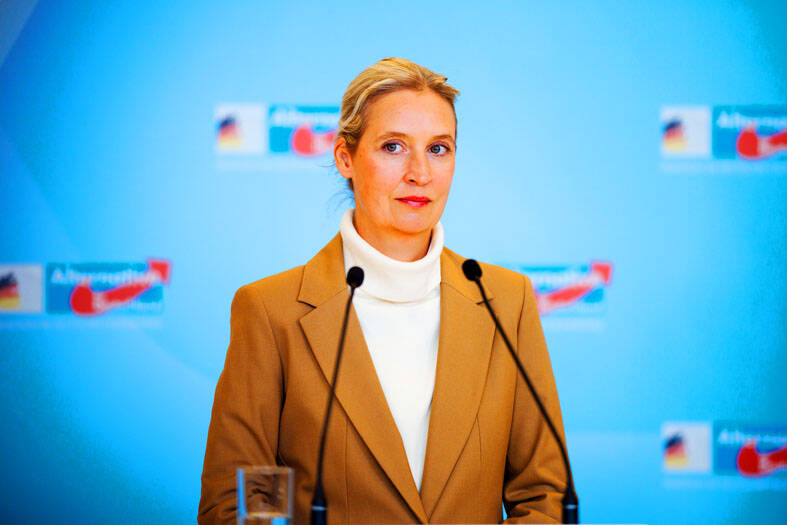
Photo: EPA
The row has also erupted in a year in which the AfD is flying high, often polling above the record 20 percent it won in the February elections which made it Germany’s second-strongest party.
The more than decade-old party’s electoral stronghold is the ex-communist east, where many people hold more favorable views of Russia despite high tensions with NATO over the Ukraine war.
However, the AfD has also been seeking a more polished image, hoping to expand its influence in western Germany. It wants to maintain warm ties with US President Donald Trump, whose team has strongly backed the party, at a time when he has distanced himself from Putin over Moscow’s refusal to negotiate peace in Ukraine.
The Weidel-Chrupalla rift erupted on Tuesday when Weidel denounced a planned trip by several AfD lawmakers to the Russian Black Sea resort of Sochi.
Weidel also banned any meeting with former Russian president Dmitry Medvedev, known for his strong anti-Western rhetoric and nuclear threats.
Weidel in September said she presumed Russia was testing “NATO air defenses” with its drone and fighter jet flights, and urged Putin “to de-escalate.”
Chrupalla was quick to double down on a Moscow-friendly stance, defending Putin.
“He hasn’t done anything to me,” Chrupalla said. “I don’t currently see any danger to Germany from Russia.”
There was no proof that multiple drones sighted in Germany were Russian, he said, adding that neighbor and NATO ally Poland “could also be a danger to us.”
“We must not be warmongers in this country, but finally become peacemakers,” Chrupalla said.
The stark contrast in the AfD’s leadership reflected tensions within the party’s voter base.
More than 44 percent of AfD supporters fear that “Russia could launch a military attack on Germany in the near future,” while 52 percent held the opposite view, an Insa poll showed.
The AfD has since last month faced accusations of using parliamentary questions to collect sensitive details on critical infrastructure, security and military matters.
AfD rejected the accusations, but did not offer justifications for the enquiries.
Insa institute chief Hermann Binkert said a strongly pro-Kremlin stance “could harm the AfD” at home and deepen rifts with other European nationalist parties, which are more inspired by Trump’s Make America Great Again (MAGA) movement than by Putin’s war.
German lawmaker Marc Henrichmann said Weidel “fears that statements like Chrupalla’s will damage the party’s public image, break the support of MAGA hardliners in the US, and thus destroy her chances of electoral success.”

SPEAKING OUT: After Siranudh Scott’s allegations surfaced, celebrities and public figures took to social media to share their own experiences of sexual misconduct and abuse A high-profile alleged sexual abuse case within a wealthy Thai beer brewing family has prompted a wave of painful accounts from survivors of unconnected abuse in the conservative nation. Siranudh Scott, a member of the billionaire Thai family that founded the ubiquitous Singha beer brand, posted an emotional video this month accusing his elder brother Sunit of repeatedly abusing him when he was a teenager. Sunit, who is in his 30s, later denied the allegations in a video posted online, but Singha parent Boonrawd dismissed him from his executive role with the company on Tuesday last week. “I felt I needed to speak

A Hong Kong astronaut is to join a Chinese space mission for the first time as part of a three-person crew launching today, as Beijing edges closer to its goal of landing people on the moon. The Tiangong space station — crewed by teams of three astronauts that are typically rotated every six months — is the crown jewel of China’s space program, boosted by billions in state investment in a bid to catch up with the US and Russia. The Shenzhou-23 mission is to blast off at 11:08pm from the Jiuquan Satellite Launch Center in northwestern China, carrying three astronauts to

UPGRADED ALERT: The risk inside DR Congo is now considered ‘very high,’ while neighboring countries face a ‘high’ threat as the outbreak continues, the WHO said Ebola is spreading faster than responders can track it in eastern Congo, where health workers managed to follow up with barely one in five identified contacts in a single day. Authorities in the Democratic Republic of the Congo (DR Congo) reported 83 confirmed infections, 746 suspected cases and 1,603 identified contacts as of Thursday, but health workers were able to follow up on only 342 contacts that day — about 21 percent of the total under monitoring — data released by the DR Congo Ministry of Public Health on Friday showed. The figures suggest the response is falling behind the outbreak itself,

SEEKING ORDER: Rodrigo Paz said that ‘anyone who wants to destroy the nation will have to deal with this president and the full force of the constitution’ Bolivian President Rodrigo Paz on Wednesday said that the nation was at a “breaking point” after nearly a month of protests that have caused shortages of food, fuel and medicine. Paz, who took office six months ago amid the worst economic crisis there in four decades, is battling a groundswell of fury over his policies. The political capital, La Paz, has been besieged by low-income workers and members of the indigenous majority calling for his resignation. “The country needs order and is reaching breaking point,” the 58-year-old said at a public event in La Paz, renewing his appeal for dialogue. On Tuesday, the Bolivian


 RSS
RSS