


The Thai military said ceasefire talks with Cambodia, set to begin yesterday, are expected to conclude with a meeting of the countries’ defense ministers on Saturday, as the two sides seek to end weeks of deadly clashes.
The talks started at 4pm in Thailand’s Chanthaburi Province, which borders Cambodia.
The Thai Ministry of Defense outlined several demands to be discussed ahead of the bilateral meeting of the General Border Committee (GBC) on Saturday.
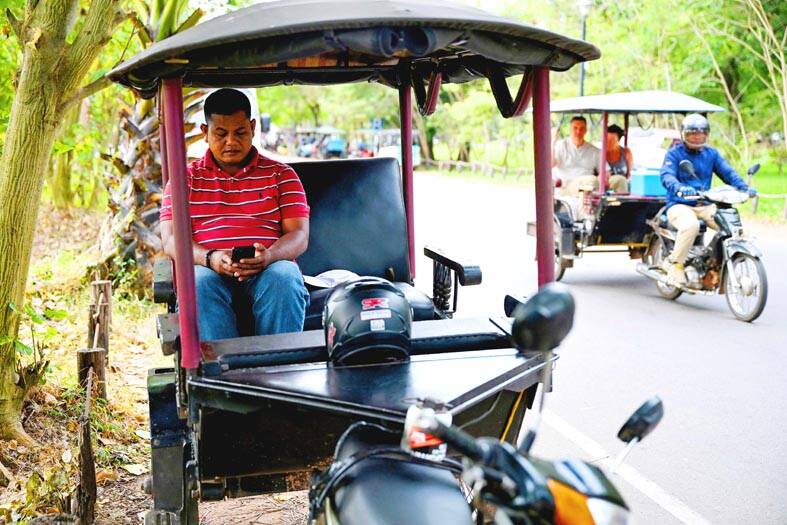
Photo: AFP
If secretariat-level discussions fail to reach agreement on key technical frameworks such as troop deployments, the Thai side would not proceed with the GBC meeting or sign any agreement on Saturday, the ministry said.
The discussions mark the first bilateral dialogue since clashes erupted on Dec. 7, with at least 44 people killed and more than half a million civilians displaced on both sides of their 800km border.
Five days of clashes in July ended with an initial ceasefire agreement mediated by Malaysia and US President Donald Trump.
The Thai military plans to raise several issues at the talks, including the use of anti-personnel landmines, the use of historical sites as military positions, the firing of heavy weapons from civilian communities, and the use of civilian buildings as military positions or weapons storage facilities.
Both sides have denied targeting civilians, claiming they are only attacking military targets.
The Cambodian Mine Action and Victim Assistance Authority has separately condemned what it called Thailand’s military aggression and campaign of misinformation, the Khmer Times reported.
Separately, a Cambodian official accused Thailand of destroying a Hindu statue in a disputed border area.
“The statue was inside our territory in the An Ses area,” said Kim Chanpanha, a government spokesman in the border province of Preah Vihear.
The demolition of the Vishnu statue, which was built in 2014, occurred on Monday about 100m from the border with Thailand, he said.
A Google Maps search showed the statue’s location was about 400m from the border line.
“We condemn the destruction of ancient temples and statues that are worshiped by Buddhist and Hindu followers,” Chanpanha said.
Videos showing the demolition of the Vishnu statue using a back-hoe loader circulated on Thai social media pages on Monday.
A spokesperson for the Thai army had not replied to a request for comment.

Australians were downloading virtual private networks (VPNs) in droves, while one of the world’s largest porn distributors said it was blocking users from its platforms as the country yesterday rolled out sweeping online age restriction. Australia in December became the first country to impose a nationwide ban on teenagers using social media. A separate law now requires artificial intelligence (AI)-powered chatbot services to keep certain content — including pornography, extreme violence and self-harm and eating disorder material — from minors or face fines of up to A$49.5 million (US$34.6 million). The country also joined Britain, France and dozens of US states requiring

Hungarian authorities temporarily detained seven Ukrainian citizens and seized two armored cars carrying tens of millions of euros in cash across Hungary on suspicion of money laundering, officials said on Friday. The Ukrainians were released on Friday, following their detention on Thursday, but Hungarian officials held onto the cash, prompting Ukraine to accuse Hungary’s Russia-friendly government of illegally seizing the money. “We will not tolerate this state banditism,” Ukrainian Minister of Foreign Affairs Andrii Sybiha said. The seven detained Ukrainians were employees of the Ukrainian state-owned Oschadbank, who were traveling in the two armored cars that were carrying the money between Austria and

Kosovar President Vjosa Osmani on Friday after dissolving the Kosovar parliament said a snap election should be held as soon as possible to avoid another prolonged political crisis in the Balkan country at a time of global turmoil. Osmani said it is important for Kosovo to wrap up the upcoming election process and form functional institutions for political stability as the war rages in the Middle East. “Precisely because the geopolitical situation is that complex, it is important to finish this electoral process which is coming up,” she said. “It is very hard now to imagine what will happen next.” Kosovo, which declared

MORE BANS: Australia last year required sites to remove accounts held by under-16s, with a few countries pushing for similar action at an EU level and India considering its own ban Indonesia on Friday said it would ban social media access for children under 16, citing threats from online pornography, cyberbullying, online fraud and Internet addiction. “Accounts belonging to children under 16 on high-risk platforms will start to be deactivated, beginning with YouTube, TikTok, Facebook, Instagram, Threads, X, Bigo Live and Roblox,” Indonesian Minister of Communications and Digital Meutya Hafid said. “The government is stepping in so that parents no longer have to fight alone against the giants of the algorithm. Implementation will begin on March 28, 2026,” she said. The social media ban would be introduced in stages “until all platforms fulfill their


 RSS
RSS