


Republican US lawmakers on Friday criticized US President Joe Biden’s administration after sanctioned Chinese telecoms equipment giant Huawei unveiled a laptop this week powered by an Intel artificial intelligence (AI) chip.
The US placed Huawei on a trade restriction list in 2019 for contravening Iran sanctions, part of a broader effort to hobble Beijing’s technological advances. Placement on the list means the company’s suppliers have to seek a special, difficult-to-obtain license before shipping to it.
One such license, issued by then-US president Donald Trump’s administration, has allowed Intel to ship central processors to Huawei for use in laptops since 2020. China hardliners had urged the Biden administration to revoke that license, but many grudgingly accepted that it would expire later this year and not be renewed.
Photo: AFP
Huawei’s unveiling on Thursday of its first AI-enabled laptop, the MateBook X Pro powered by Intel’s new Core Ultra 9 processor, angered them, because it suggested to them that the US Department of Commerce had approved shipments of the new chip to Huawei.
“One of the greatest mysteries in Washington, DC is why the Department of Commerce continues to allow US technology to be shipped to Huawei” US Representative Michael Gallagher, chairman of the US House of Representatives Select Committee on the Chinese Communist Party, said in a statement.
The chips were shipped under a pre-existing license, a source familiar with the matter said.
They are not covered by recent broad-cased restrictions on AI chip shipments to China, the source and another person said.
The commerce department and Intel declined to comment. Huawei did not immediately respond to requests for comment.
The reaction is a sign of growing pressure on the Biden administration to do more to thwart Huawei’s rise, nearly five years after it was added to a trade restriction list.
In August last year , it shocked the world with a new phone powered by a sophisticated chip manufactured by sanctioned Chinese chipmaker SMIC, becoming a symbol of China’s technological resurgence despite Washington’s efforts to cripple its capacity to produce advanced semiconductors.
At a US Senate subcommittee hearing this week, Kevin Kurland, an export enforcement official, said Washington’s restrictions on Huawei have had a “significant impact” on it access to US technology.
He also stressed that the goal was not necessarily to stop Huawei from growing, but to keep it from misusing US technology for “malign activities.”
However, the remarks did little to stem frustration among Republican China hawks following the news about Huawei’s new laptop.
“These approvals must stop,” US Representative Michael McCaul said in a statement to Reuters. “Two years ago, I was told licenses to Huawei would stop. Today, it doesn’t seem as though the policy has changed.”

Through the noise of rushing papers and whirring belts at a print factory in Kyoto, two creators watch their photo essay come to life in broadsheet form — part of an effort to win new audiences in the age of artificial intelligence (AI). Despite the decline of the publishing industry, self-publication and handmade “zine” magazines are growing in popularity in Japan, reflecting the nation’s enduring love of paper in the digital era. While speaking to Agence France-Presse at the plant, his hands black with ink, one of the creators, Kazuma Obara, said: “I think [paper] is a medium that engages all five
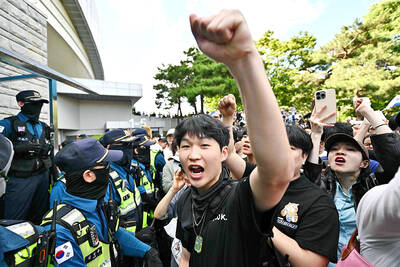
‘ABSURD MISTAKE’: The election commission said that there had been a failure to anticipate turnout after 14 polling stations ran short of ballot papers South Korean riot police yesterday cleared protesters from a Seoul polling station after a 35-hour blockade sparked by a shortage of ballot papers during local elections earlier this week. Wednesday’s election was the first nationwide vote since South Korean President Lee Jae-myung took office following the ouster of Yoon Suk-yeol over his short-lived martial law declaration. Lee’s ruling Democratic Party swept most races, but failed to flip the crucial Seoul mayoral seat. The South Korean National Election Commission apologized, blaming a failure to anticipate turnout after 14 polling stations in Seoul ran short of ballot papers. Some polling stations stayed open until 10pm to

France experienced its hottest spring on record, the French weather service said on Tuesday, after an exceptional early heat wave that also broke highs for the season in England and Wales. Meteo-France said the average nationwide temperature over March to May was 13.8°C — about 1.7°C above the norm, and surpassing records set in 2011 and 2020. “The warmest spring since records began in 1900,” it said in a bulletin. All three months were warmer than average, but the onset of an “unprecedented heatwave” late last month pushed the mercury to highs typically seen at the height of the summer. “Our country had never

A Sherpa guide was found crawling to base camp on Mount Everest a week after he went missing and was reunited with his family, who had given up hope he would return. Dawa Sherpa was last seen on Friday last week descending the mountain, but he did not reach base camp even though his client did. The pair were among the last climbers on the mountain as the climbing season came to an end and the route was dismantled. Dawa was located by a cleaning crew on Thursday morning as he was crawling down the snowy slopes around the Khumbu Icefall, just above


 RSS
RSS