


Harvard University president Claudine Gay on Tuesday resigned amid plagiarism accusations and criticism over testimony at a congressional hearing where she was unable to say unequivocally that calls on campus for the genocide of Jews would contravene the school’s conduct policy.
Gay is the second Ivy League president to resign in the past month following the congressional testimony — Liz Magill, president of the University of Pennsylvania, resigned on Dec. 9.
Gay, Harvard’s first black president, announced her departure just months into her tenure in a letter to the Harvard community.
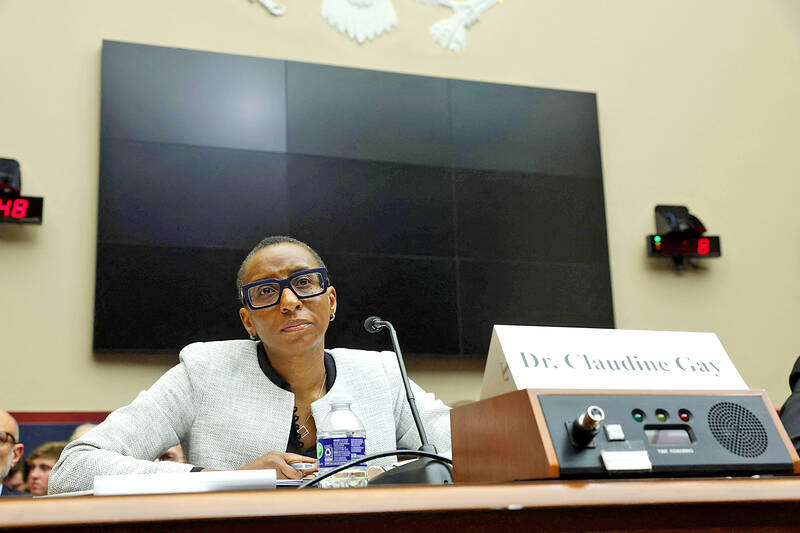
Photo: AFP
Following the congressional hearing, Gay’s academic career came under intense scrutiny by conservative advocates who unearthed several instances of alleged plagiarism in her 1997 doctoral dissertation.
The President and Fellows of Harvard College, the university’s governing board, initially rallied behind Gay, saying a review of her academic work turned up “a few instances of inadequate citation,” but no evidence of research misconduct.
Days later, the board said it found two additional examples of “duplicative language without appropriate attribution,” and that Gay would update her dissertation and request corrections.
Her resignation came “with great sadness,” the board said, thanking her for her “deep and unwavering commitment to Harvard and to the pursuit of academic excellence.”
Alan Garber, university provost and chief academic officer, is to serve as interim president until Harvard finds a replacement, the board said in a statement.
Gay’s resignation was celebrated by conservatives who put her alleged plagiarism in the national spotlight — with additional plagiarism accusations surfacing as recently as Monday in The Washington Free Beacon, a conservative Web site.
Christopher Rufo, an advocate who has helped rally Republicans against higher education, said he is “glad she’s gone.”
“Rather than take responsibility for minimizing anti-Semitism, committing serial plagiarism, intimidating the free press and damaging the institution, she calls her critics racist,” Rufo wrote on social media.
“This is the poison” of diversity, equity and inclusion ideology, Rufo said.
Gay, who is returning to the school’s faculty, wrote in her letter that it has been “distressing to have doubt cast on my commitments to confronting hate and to upholding scholarly rigor — two bedrock values that are fundamental to who I am — and frightening to be subjected to personal attacks and threats fueled by racial animus.”
Supporters of Gay lamented her resignation.
“Racist mobs won’t stop until they topple all Black people from positions of power and influence who are not reinforcing the structure of racism,” award-winning author Ibram X. Kendi, who survived scrutiny of an anti-racist research center he founded at Boston University, wrote in an Instagram post.


Showcasing phallus-shaped portable shrines and pink penis candies, Japan’s annual fertility festival yesterday teemed with tourists, couples and families elated by its open display of sex. The spring Kanamara Matsuri near Tokyo features colorfully dressed worshipers carrying a trio of giant phallic-shaped objects as they parade through the street with glee. The festival, as legend has it, honors a local blacksmith in the Edo Period (1603-1868) who forged an iron dildo to break the teeth of a sharp-toothed demon inhabiting a woman’s vagina that had been castrating young men on their wedding nights. A 1m black steel phallus sits in the courtyard of

JAN. 1 CLAUSE: As military service is voluntary, applications for permission to stay abroad for over three months for men up to age 45 must, in principle, be granted A little-noticed clause in sweeping changes to Germany’s military service policy has triggered an uproar after it emerged that the law requires men aged up to 45 to get permission from the armed forces before any significant stay abroad, even in peacetime. The legislation, which went into effect on Jan. 1 aims to bolster the military and demands all 18-year-old men fill out a questionnaire to gauge their suitability to serve in the armed forces, but stops short of conscription. If the “modernized” model fails to pull in enough recruits, parliament will be compelled to discuss the reintroduction of compulsory service, German

Filipino farmers like Romeo Wagayan have been left with little choice but to let their vegetables rot in the field rather than sell them at a loss, as rising oil prices linked to the Iran war drive up the cost of harvesting, labor and transport. “There’s nothing we can do,” said Wagayan, a 57-year old vegetable farmer in the northern Philippine province of Benguet. “If we harvest it, our losses only increase because of labor, transportation and packing costs. We don’t earn anything from it. That’s why we decided not to harvest at all,” he said. Soaring costs caused by the Middle East

Hungarian Prime Minister Viktor Orban’s officially declared wealth is fairly modest: some savings and a jointly owned villa in Budapest. However, voters in what Transparency International deems the EU’s most corrupt country believe otherwise — and they might make Orban pay in a general election this Sunday that could spell an end to his 16-year rule. The wealth amassed by Orban’s inner circle is fueling the increasingly palpable frustration of a population grappling with sluggish growth, high inflation and worsening public services. “The government’s communication machine worked well as long as our economic situation remained relatively good,” said Zoltan Ranschburg, a political analyst


 RSS
RSS