


Muhammed Bazza has been lining up for gasoline under the blazing sun for four hours, while Alexander Okwori has spent two hours waiting at a cash dispenser.
These days, Awolowo, a main commercial artery of Lagos, Nigeria’s megacity of 20 million people, is constantly blocked by traffic jams worsened by the waits for fuel, spelling further misery for residents.
From north to south, the country of about 215 million people is facing an even higher combination of problems than usual, including fuel shortages and chaos at banks over a new currency swap, in addition to the chronic lack of water and electricity.
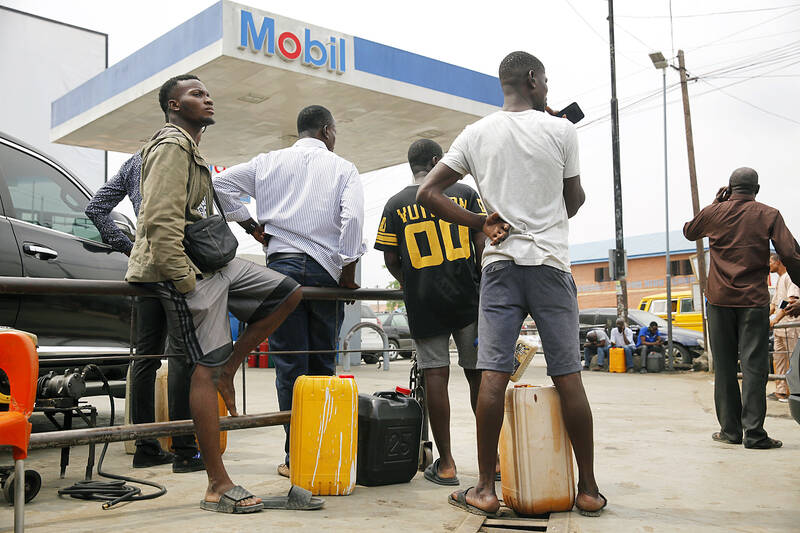
Photo: EPA-EFE
It is a volatile mix as Nigeria gears up for presidential and general elections next month, with Nigerian President Muhammadu Buhari to step down after the two terms allowed by the constitution.
Bazza said that he had woken up at 4:30am to try to avoid the lines for gas, but it did not work. Shortly after 10am, and just 10m from the pump, he was told to leave.
“It’s over. No more fuel,” the station attendant said.
“My day is wasted,” Bazza told reporters. “Every day is the same problem, it’s ridiculous.”
While Nigeria is one of Africa’s largest producers of crude oil, it has almost no refining capacity and imports most of its fuel.
“We are tired,” Bazza said before driving off. “Everywhere people are fighting.”
On the other side of the road, about 50 people were huddled outside a bank, with more people continuously joining the crowd.
Like everyone else, Okwori was trying to get his hands on new bank notes unveiled in October last year to replace the old naira, with a deadline on Tuesday to make the swap.
However, days before the deadline, only a few banks were distributing the new notes, leaving many Nigerians, who are overwhelmingly poor and without bank accounts, without access to cash. Under pressure, the government pushed the deadline back to Friday next week, but on Tuesday, many banks were still unable to distribute the new notes.
“No ATM are giving money. I went to 10 banks, there are no new notes,” said Okwori, who wonders how he will buy food for the day.
His anger has reached the point where he has no intention of casting a vote on Feb. 25.
“To get my PVC [voting card], I have to queue again. For what? They [politicians] are all the same,” the 21-year-old said.
The two main candidates vying to replace Buhari are Bola Tinubu of the president’s governing party and Atiku Abubakar of the main opposition group.
The two are old political hands — wealthy, but also dogged by corruption suspicions in the minds of many voters.
Outside another gas station on Awolowo, a line has completely blocked traffic, leaving Vanessa Ifejitah stuck in her car for three hours with her children on their way to school. Wearing an elegant orange dress, the mother of two stepped out of her vehicle and started shouting at military officers standing nearby.
“You are the cause of our problems,” she said, pointing at their vehicle parked in the middle of the line, making things even worse for those trying to drive through.
Ifejitah started directing the traffic herself to sort out the mess.
“The queue is getting worse every day... I don’t know what is happening in Nigeria,” she said, getting back into her car, on the verge of tears. “My children are two hours late for school.”
Less than a month before voting day, frustrations are growing across the country.
On Monday, protests broke out over the fuel shortages in Benin City in the south, local media reported.
Irate crowds also protested a visit by Buhari to Kano, the biggest city in the north, with many setting fires and hurling stones at police in a city traditionally one of the president’s strongholds.

Kouri Richins, a Utah mother who published a children’s book about grief after the death of her husband is to serve a life sentence for his murder without the possibility of parole, a judge ruled on Wednesday. Richins was convicted in March of aggravated murder for lacing a cocktail given to her husband, Eric Richins, with five times the lethal dose of fentanyl at their home near Park City in 2022. A jury also found her guilty of four other felonies, including insurance fraud, forgery and attempted murder for trying to poison her husband weeks earlier on Feb. 14, 2022, with a
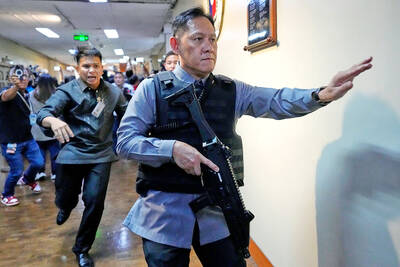
DELA ROSA CASE: The whereabouts of the senator, who is wanted by the ICC, was unclear, while President Marcos faces a political test over the senate situation Philippine authorities yesterday were seeking confirmation of reports that a top politician wanted by the International Criminal Court (ICC) had fled, a day after gunfire rang out at the Philippine Senate where he had taken refuge fearing his arrest. Senator Ronald “Bato” dela Rosa, the former national police chief and top enforcer of former Philippine president Rodrigo Duterte’s “war on drugs,” has been under Senate protection and is wanted for crimes against humanity, the same charges Duterte is accused of. “Several sources confirmed that the senator, Senator Bato, is no longer in the Senate premises, but we are still getting confirmation,” Presidential
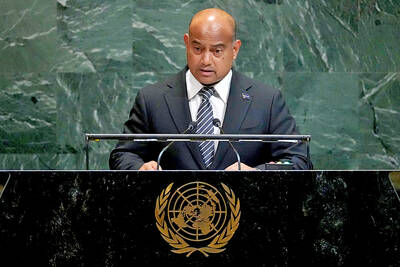
Nauru said it would hold a referendum to change its official name, described as a colonial relic from a time when “foreign tongues” mangled the native language. Nauru would change its name to Naoero to “more faithfully honor our nation’s heritage, our language and our identity,” Nauruan President David Adeang said in a statement on Tuesday. The Pacific island nation’s native language is Dorerin Naoero, which is spoken by the vast majority of its approximately 10,000 inhabitants. “Nauru emerged because Naoero could not be properly pronounced by foreign tongues, and was changed not by our choice, but for convenience,” the government said in
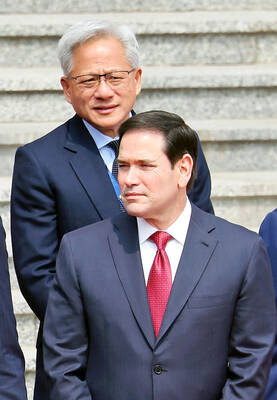
HELP DENIED? The US Department of State said that the Cuban leadership refuses to allow the US to provide aid to Cubans, ‘who are in desperate need of assistance’ US Secretary of State Marco Rubio on Wednesday said that Cuba’s leadership must change, as Washington renewed an offer of US$100 million in aid if the communist nation agrees to cooperate. Cuba has been suffering severe economic tumult led by an energy shortage that plunged 65 percent of the country into darkness on Tuesday. Cuba’s leaders have blamed US sanctions, but Rubio, a Cuban American and critic of the government established by Fidel Castro, said the system was to blame, including corruption by the military. “It’s a broken, nonfunctional economy, and it’s impossible to change it. I wish it were different,” he told


 RSS
RSS