


Beneath the clear waters and pleasure boats by Amsterdam central station is a remarkable feat of engineering: an underwater garage for 7,000 bicycles.
The garage, which is scheduled to open on Thursday next week, is the result of a four-year, 60 million euro (US$65 million) project to clear heaps of rusty bikes left by hasty commuters and install rows of clean, safe parking spaces underground, where bikes can be left free for 24 hours and then at a cost of 1.35 euros per 24 hours.
A moving walkway takes people upward into a train station, where more than 200,000 journeys start and end every day. On the side of the IJ harbor is another new, 25 million euros park for 4,000 more bikes, built on pilings on new land in the IJ, just inches above the North-South metro line.
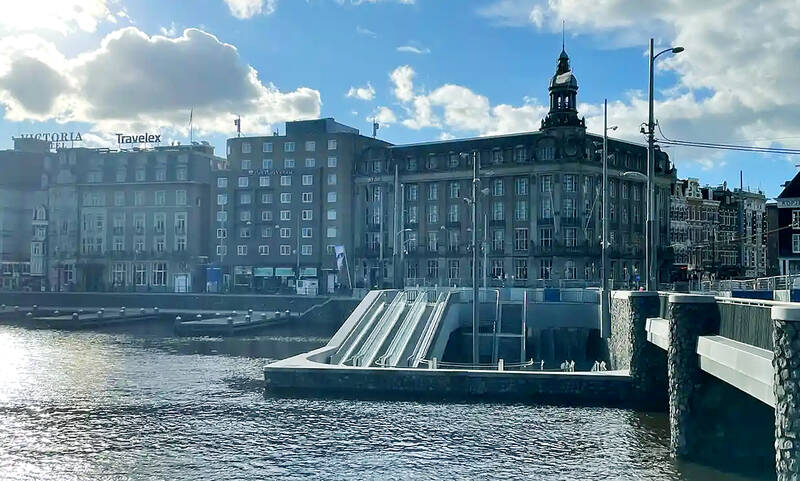
Photo: The Guardian
The construction of the underwater bike garage, documented in an impressive time-lapse video, began in 2019 and involved draining a lake of water by the late 19th-century station — which itself was built on three artificial islands.
There are red and green lights to show if spaces are available, and from April, a dynamic system would start showing commuters which bike park has room and how many spaces are free.
“Central station is one of the busiest places in Amsterdam,” said Pieter Visser, Amsterdam municipality’s bike project manager. “A lot of bikers use this precious public space to bike and park. The municipality chose to facilitate underground bike parking to return the public space to pedestrians, tourists and people with disabilities.”
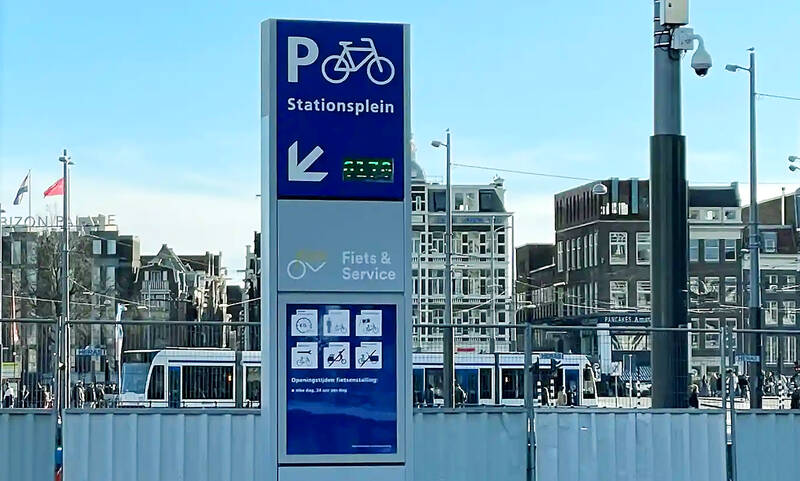
Photo: The Guardian
There are more bicycles in the Netherlands than there are people — an estimated 23.4 million bikes, according to the BOVAG and RAI motor organizations, compared with a population of 17.8 million. Cycling is far and away the top form of transport in cities such as Amsterdam.
According to the capital’s most recent figures, 835,000 Amsterdammers between them make on average 665,000 bike trips a day, and 36 percent of journeys are made by bicycle, compared with 24 percent by car.
For the railways, the project is about making commuting easier and more attractive.
“It’s great that people can jump on their bikes, get to the station and get on their journey seamlessly,” said Jeroen Wienen, a spokesperson for ProRail, the Dutch government organization responsible for the maintenance and extension of the national railway network infrastructure.
“The Netherlands is a real cycling country, a lot of people come to the station by bike, and we and the municipality certainly don’t want all those bikes lying around. You want to offer people a decent place where they can put their bikes safely, so the streets are nice and clean for the neighborhood,” Wienen said.
Cycling experts — and Amsterdammers glad that the city waterfront is no longer a building site — greeted the project with enthusiasm.
Marco te Brommelstroet, a self-styled “cycling professor” and director of the Urban Cycling Institute at Amsterdam University, said the key to its success was in linking up forms of mobility.
“It’s a lovely project, because it’s not a cycling project,” Te Brommelstroet said.
“It makes visible the real success factor in Dutch mobility and spacial policy: the bike-train combination. Before, there was a temporary multistory bike rack, which immediately flowed over. It became one of Amsterdam’s most photographed objects and the municipality was embarrassed about” it, he added.
There are lessons for other countries in encouraging more “last-mile” cycling by providing proper facilities at train stations, said Lucas Snaije, a research and advocacy manager at the cycling advocacy foundation BYCS.
“Prioritizing cycling is an incredible means of making cities more inclusive, and it also promotes community, trust and wellbeing,” he said.
The Bolivian government on Friday struck a deal with protesting miners, but was still grappling with blockades and demonstrations by other workers across La Paz. Other groups are still blocking access roads into the city, which is also the seat of the government. Police on Thursday prevented the miners from entering the main square by using tear gas, while the demonstrators hurled stones and explosives with slingshots. Protests against the policies of Bolivian President Rodrigo Paz have convulsed the Andean nation since early this month, and roadblocks were choking routes into La Paz throughout Friday, the national road authority said. Miners demanded that Paz
The Philippines said it has asked the country’s Supreme Court to allow it to arrest former Philippine president Rodrigo Duterte’s chief drug war enforcer to stand trial in an international tribunal. The International Criminal Court (ICC) last week unsealed an arrest warrant against Philippine Senator Ronald dela Rosa, accusing him along with Duterte and other “coperpetrators” of the “crime against humanity of murder.” Dela Rosa briefly sought refuge in the Philippine Senate last week while asking the Philippine Supreme Court to stop an ongoing attempt by government agents to arrest him. “By his own conduct, he has placed himself outside the protection of

A ship anchored off the United Arab Emirates (UAE) was seized and taken toward Iran and another — a cargo ship near Oman — sank after being attacked, authorities said on Thursday, as tensions escalated near the Strait of Hormuz. It was not immediately clear who was behind these incidents, but they happened as a senior Iranian official reiterated his country’s claim of control over the waterway and another said it had a right to seize oil tankers connected to the US. The turmoil in the strait has been a sticking point for weeks in talks between the US and Iran to

Crowds in Bangladesh are flocking to snap photographs with an unlikely social media star — an albino buffalo with flowing blond hair nicknamed “Donald Trump” that is due to be sacrificed within days. Owner Zia Uddin Mridha, 38, said his brother named the 700kg bull over its flowing helmet of hair resembling the signature look of the US president. “My younger brother picked this name because of the buffalo’s extraordinary hair,” he said at his farm in Narayanganj, just outside the capital, Dhaka. Mridha said that a constant stream of curious visitors — social media fans, onlookers and children — have come throughout


 RSS
RSS