


Guyana’s government on Wednesday said it has formally asked Facebook and Twitter to remove “illegal maps” posted by users showing large parts of Guyana as Venezuelan territory, reflecting a longstanding claim by the neighboring nation.
Venezuela has long laid claim to most of Guyana’s mineral-rich western Essequibo region, disputing the decision of an 1899 international boundaries commission at a time when Guyana was a British territory.
The International Court of Justice in the Netherlands agreed to hear the case in 2020, but a ruling could take years.
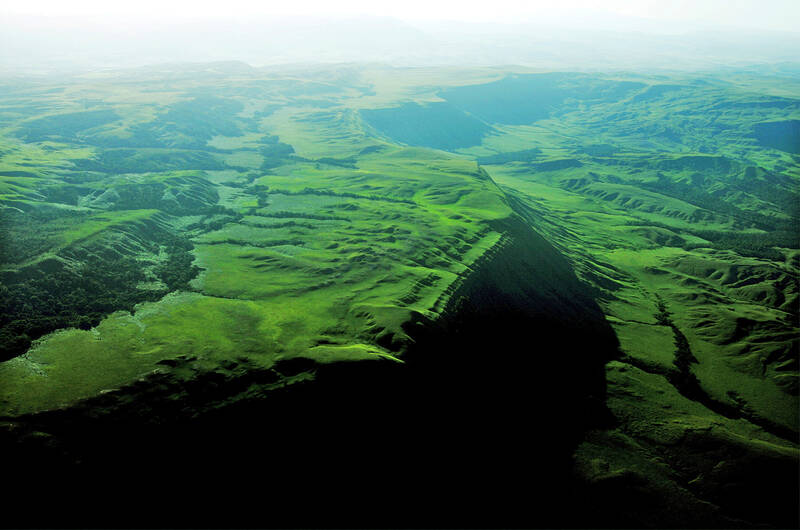
Photo: REUTERS
The area, which covers 40 percent of Guyana’s current territory, is believed to contain billions of barrels of oil and large amounts of gas deposits, in addition to gold, diamonds and other minerals.
Authorities in Guyana believe that the group posting the maps has internet protocol addresses linked to officialdom in Venezuela, Guyanan Foreign Secretary Robert Persaud said.
He said the posts and their comments “have the potential to permanently damage relations between states, incite violence against the territory and people of Guyana, and derail the current adjudication of the matter before the ICJ.”
The social media platforms should be able to trace the posts to determine whether they are from individuals or are part of a campaign by Venezuela to influence the court, he said.
The Associated Press sent messages seeking comment from a group mentioned by Guyana, but did not immediately receive a response. The listed Web site was inactive, and a related GoFundMe page said it was based in Miami.
Venezuela has several times taken military action against Guyana as part of the dispute. In 2013, Venezuelan gunboats arrested and detained the crew of a vessel leased by US oil company Anadarko, expelling them from a disputed offshore area.
In 2019, a military helicopter attempted to land on a rig doing survey work for US oil company ExxonMobil in Guyana’s northwestern region. In 2015 when Exxon declared that it had found a large quantity of oil and gas offshore Guyana, Venezuela issued decrees amending its national map to encompass a large part of coastal Guyana it had not previously disputed.

‘CROSSING THE LINE’: China’s embassy in Seoul criticized US Forces Korea Commander General Xavier Brunson, asking if his ‘hostile’ remarks were authorized by Washington South Korea and the US are in talks over recent public remarks by the commander of US Forces Korea, Seoul’s presidential office said yesterday, after the comments drew sharp criticism from China. In a recent podcast interview, US Forces Korea Commander General Xavier Brunson described South Korea as “the dagger in the heart of Asia” from China’s east coast, prompting the Chinese embassy in Seoul to say that he had “truly crossed the line.” The interview came amid growing speculation that Washington might seek to expand the role of US Forces Korea in countering the growing regional influence of China, a key

SEEKING ORDER: Rodrigo Paz said that ‘anyone who wants to destroy the nation will have to deal with this president and the full force of the constitution’ Bolivian President Rodrigo Paz on Wednesday said that the nation was at a “breaking point” after nearly a month of protests that have caused shortages of food, fuel and medicine. Paz, who took office six months ago amid the worst economic crisis there in four decades, is battling a groundswell of fury over his policies. The political capital, La Paz, has been besieged by low-income workers and members of the indigenous majority calling for his resignation. “The country needs order and is reaching breaking point,” the 58-year-old said at a public event in La Paz, renewing his appeal for dialogue. On Tuesday, the Bolivian

Through the noise of rushing papers and whirring belts at a print factory in Kyoto, two creators watch their photo essay come to life in broadsheet form — part of an effort to win new audiences in the age of artificial intelligence (AI). Despite the decline of the publishing industry, self-publication and handmade “zine” magazines are growing in popularity in Japan, reflecting the nation’s enduring love of paper in the digital era. While speaking to Agence France-Presse at the plant, his hands black with ink, one of the creators, Kazuma Obara, said: “I think [paper] is a medium that engages all five

Australian researchers have trained lab-grown brain cells on a silicon computer chip to play the 1990s shooter game Doom and said they are just scratching the surface of what the neurons could be capable of doing. It is the science-fiction work of biotech boffins at Cortical Labs, who researched and developed the technology that harnesses the workings of the brain’s networking system. Each so-called “biological computer” contains about 200,000 living human brain cells, grown from stem cells that were harvested from blood donations. Having mastered the simple computer game Pong, where a paddle is moved up and down to send a ball


 RSS
RSS