


Newly married and with his first child on the way, auto worker Wang (王) wanted to move into the apartment he bought in Wuhan three years ago, but those hopes were dashed by China’s ballooning property crisis.
Saddled with nearly US$300,000 in debt and with his unit nowhere near completion, the 34-year-old decided he had enough and stopped making mortgage payments.
He is among numerous home buyers across dozens of cities in China who have boycotted payments over fears that their properties will not be completed by cash-strapped, debt-laden developers.
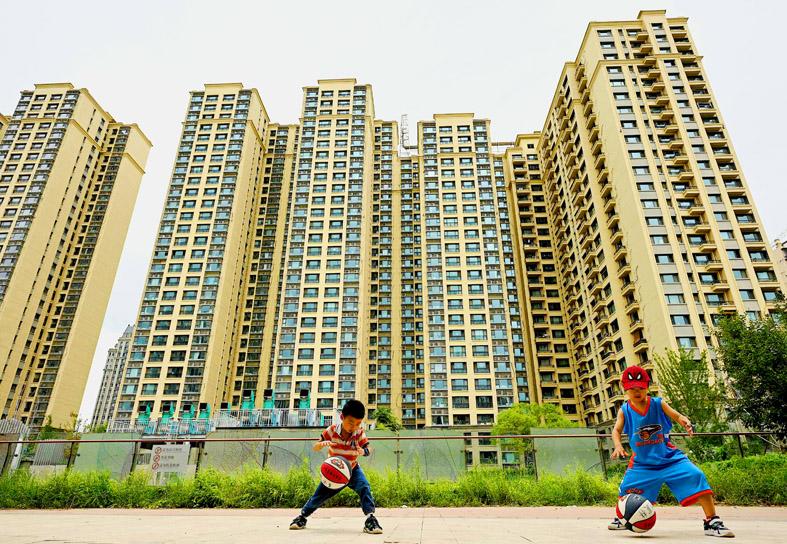
Photo: AFP
“They said construction would resume soon,” Wang said, only giving his surname. “But no workers showed up.”
Beijing-based Wang was planning to start a family after purchasing the home.
“It wasn’t easy for us to buy this home. It all came from my savings,” Wang said. “Now there’s no home, and we still owe 2 million yuan [US$296,608] in mortgage payments.”
After years of explosive growth fueled by easy access to loans, Chinese authorities launched a crackdown on excessive debt in 2020.
That squeezed financing options for property sector giants such as Evergrande, as they struggled to make repayments and restructure mountains of debt.
Now they are facing mortgage boycotts and government pressure to deliver presold homes.
In Wuhan, the capital of Hubei Province, buyers such as Wang said they received multiple postponement notices on their apartments from developer Myhome Real Estate, months past the promised delivery date in late last year.
The builder said in a notice this week that it had managed to release some frozen funds, adding that it expects to complete the Wuhan project late this year.
Wang said he stopped repayments this month, and that complaints to authorities in the city did not make a difference.
“There’s no hope in life, carrying on with payments like this,” he said.
The “crisis of confidence” in China’s housing market points to structural flaws, Gavekal Dragonomics director of China research Andrew Batson wrote in a recent report.
Because of their heavy reliance on selling apartments in advance, developers pursued business models that exposed buyers to the risk of not getting their homes, he said.
As financially stressed firms halt construction on projects, “those risks have dramatically materialized,” he added.
The crisis has left home buyers in limbo.
“I thought it would never happen,” a Wuhan homebuyer surnamed Hu (胡) said of his unfinished home.
The 25-year-old said his family took out loans to help with the down payment for a three-room flat in 2018.
At that time, Wuhan was encouraging college graduates such as Hu to get household registrations in the city, he said.
Known as hukou (戶口), these all-important government registrations allow access to healthcare and schools.
“Everyone was buying property back then ... people were vying for it,” he said.
Another young homebuyer, Xue (薛), said that almost all of his salary now goes to rent and mortgage payments.
“I don’t want to pay any more,” the 24-year-old said. “Our hearts are cold.”
“It’s not that we disregard the law or contracts, but this situation puts us under too much pressure,” he added.
Xue’s family put down 800,000 yuan for the flat, while he took on a 600,000 yuan loan that he has been repaying for two years.
Buyers in Wuhan said there have been protests over unfinished presold homes in the city.
Home buyers in about 100 cities — involving more than 300 housing projects — have boycotted mortgage payments, according to a crowd-sourced document titled “WeNeedHome.”

PHISHING: The con might appear convincing, as the scam e-mails can coincide with genuine messages from Apple saying you have run out of storage For a while you have been getting messages from Apple saying “your iCloud storage is full.” They say you have exceeded your storage plan, so documents are no longer being backed up, and photos you take are not being uploaded. You have been resisting Apple’s efforts to get you to pay a minimum of £0.99 (US$1.33) a month for more storage, but it seems that you cannot keep putting off the inevitable: You have received an e-mail which says your iCloud account has been blocked, and your photos and videos would be deleted very soon. To keep them you need

For two decades, researchers observed members of the Ngogo chimpanzee group of Kibale National Park in Uganda spend their days eating fruits and leaves, resting, traveling and grooming in their tropical rainforest abode, but this stable community then fractured and descended into years of deadly violence. The researchers are now describing the first clearly documented example of a group of wild chimpanzees splitting into two separate factions, with one launching a series of coordinated attacks against the other. Adult males and infants were targeted, with 28 deaths. “Biting, pounding the victim with their hands, dragging them, kicking them — mostly adult males,

The Israeli military has demolished entire villages as part of its invasion of south Lebanon, rigging homes with explosives and razing them to the ground in massive remote detonations. The Guardian reviewed three videos posted by the Israeli military and on social media, which showed Israel carrying out mass detonations in the villages of Taybeh, Naqoura and Deir Seryan along the Israel-Lebanon border. Lebanese media has reported more mass detonations in other border villages, but satellite imagery was not readily available to verify these claims. The demolitions came after Israeli Minister of Defense Israel Katz called for the destruction of

SUPERFAN: The Japanese PM played keyboard in a Deep Purple tribute band in middle school and then switched to drums at university, she told the British rock band Legendary British rock band Deep Purple yesterday made Japanese Prime Minister Sanae Takaichi’s day with a brief visit to their high-profile superfan as they returned to the nation they first toured more than half a century ago. Takaichi’s reputation as an amateur drummer, and a fan of hard rock and heavy metal has been well documented, and she has referred to Deep Purple as one of her favorite bands along with the likes of Black Sabbath and Iron Maiden. “You are my god,” a giddy Takaichi said in English to Deep Purple drummer Ian Paice, presenting him with a set of made-in-Japan


 RSS
RSS