


Germany yesterday marked 30 years since the fall of the Berlin Wall that ushered in the end of communism and national reunification, as the Western alliance that helped secure those achievements is riddled with divisions.
Two days before the date that brought epochal change, French President Emmanuel Macron dropped a bombshell, declaring that transatlantic partnership NATO was suffering from “brain death” and that Europe itself was “on the brink.”
German Chancellor Angela Merkel responded with uncharacteristic sharpness, saying on Thursday that “I don’t think that such sweeping judgements are necessary,” and the ensuing storm over NATO laid bare the growing differences among traditional allies.
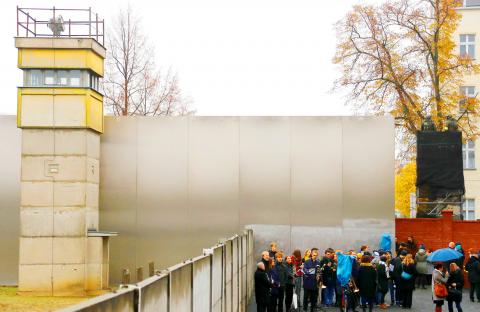
Photo: Reuters
The bad-tempered prelude to the festivities stood in sharp contrast to celebrations five years ago, when former Soviet leader Mikhail Gorbachev and former Polish president and freedom icon Lech Walesa were present.
This time, leaders of former Cold War powers were to be absent, as US President Donald Trump’s “America first” policy, the UK’s Brexit struggles and Russia’s resurgence put a strain on ties.
US Secretary of State Mike Pompeo’s visit ended on Friday, while Macron was only planning a flying visit today, leaving the actual anniversary on Nov. 9 without globally prominent figures.
Pompeo also left behind a stark warning: “As we celebrate, we must also recognize that freedom is never guaranteed.
“Today, authoritarianism is once again rising,” he said, namechecking China and Russia.
Carrying a similar message, incoming European Commission president Ursula von der Leyen said that the euphoric optimism over liberal democracy and freedom that characterized Nov. 9, 1989, has dissipated.
“Today, we have to admit that our complacency was naive,” Von der Leyen said. Russia is “using violence to shift established borders in Europe and is trying to fill every vacuum that the US has left behind.”
Hopes that China would develop closer to the Western liberal democracy model has not been fulfilled, she added.
Beyond the cracks surfacing in the global arena, a new chasm is opening up within Germany, with the far-right gaining a strong foothold in the former communist states.
Underlining the problem herself, Merkel said those who thought the differences between the former communist East and the capitalist West could be ironed out earlier, sees “that it would take half a century or more.”
Debate has also opened up more intensively over the differences between the East and West as “nationalist and protectionist trends have gained ground worldwide, thereby fueling more discussion too form a national perspective,” Merkel told Sueddeutsche Zeitung.
Amid the somber mood, a serious political program was planned for yesterday, with central European presidents to headline the official ceremonies.

An American scientist convicted of lying to US authorities about payments from China while he was at Harvard University has rebuilt his research lab in Shenzhen, China, to pursue technology the Chinese government has identified as a national priority: embedding electronics into the human brain. Charles Lieber, 67, is among the world’s leading researchers in brain-computer interfaces. The technology has shown promise in treating conditions such as amyotrophic lateral sclerosis and restoring movement in paralyzed people. It also has potential military applications: Scientists at the Chinese People’s Liberation Army have investigated brain interfaces as a way to engineer super soldiers by boosting
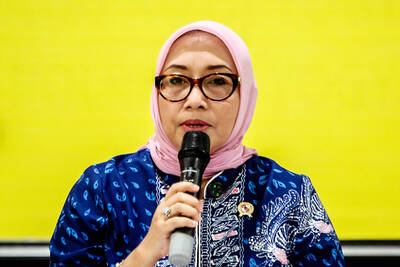
Indonesian police have arrested 13 people after shocking images of alleged abuse against small children at a daycare center went viral, sparking outrage across the nation, officials said on Monday. Police on Friday last week raided Little Aresha, a daycare center in Yogyakarta on Java island, following a report from a former employee. CCTV footage circulating on social media showed children, most younger than two, lying on the floor wearing only diapers, their hands and feet bound with rags. The police have confirmed that the footage is authentic. Police said they also found 20 children crammed into a room just 3m by 3m. “So
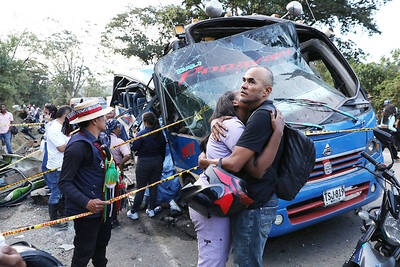
A highway bomb attack in a restive region of southwestern Colombia on Saturday killed 14 people and injured at least 38, the latest spate of violence ahead of next month’s presidential election. Authorities blamed the attack in the Cauca department — a conflict-ridden, coca-growing region — on dissidents of the now-disbanded FARC guerrilla army, who have been sowing violence across the country. “Those who carried out this attack ... are terrorists, fascists and drug traffickers,” Colombian President Gustavo Petro said on social media. “I want our very best soldiers to confront them,” he added. The leftist leader blamed the bombing
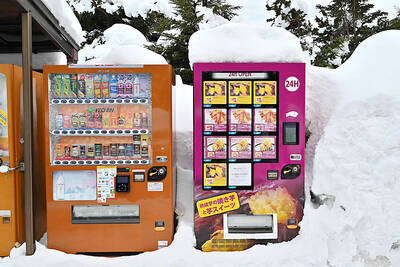
From post offices and parks to stations and even the summit of Mount Fuji, Japan’s vending machines are ubiquitous, but with the rapid pace of inflation cooling demand for their drinks, operators are being forced to rethink the business. Last month beverage giant DyDo Group Holdings announced it would remove about 20,000 vending machines — about 7 percent of their stock nationwide — by January next year, to “reconstruct a profitable network.” Pokka Sapporo Food & Beverage, based in Nagoya, also said last month it would sell its 40,000-machine operation to Osaka-based Lifedrink Co. “The strength of the vending machine


 RSS
RSS