

In China, few activities escape the watchful eye of the state — and soon, that will include square dancing. Ever-growing numbers of enthusiastic dancers — usually damas (大媽) or elderly women — have gathered on the street corners of China’s cities in recent years to gyrate in unison.
Often clad in matching outfits and wielding fans or other props, they gather around dinnertime, performing choreographed moves to sometimes thumping dance music piped through a portable boombox — or even a live band.
However, if the Chinese General Administration of Sport and the Ministry of Culture have their way, the nightly routine will be strictly regulated.
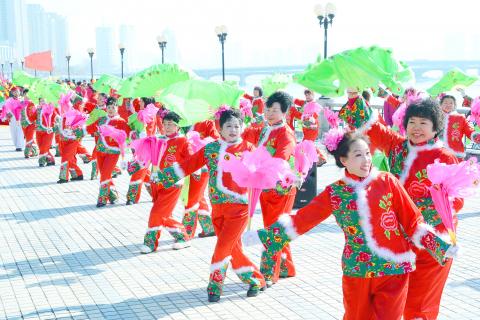
Photo: AFP
“Square dancing represents the collective aspect of Chinese culture, but now it seems that the overenthusiasm of participants has dealt it a harmful blow with disputes over noise and venues,” fitness official Liu Guoyong (劉國永) told the state-run China Daily newspaper on Tuesday.
Liu is the chief of the General Administration of Sport’s mass fitness department.
“So, we have to guide it with national standards and regulations,” he said.
According to the China Daily, authorities have hired an “expert panel” to choreograph 12 state-approved square dances.
The dances “will be introduced to local fitness sites in 31 provinces and municipalities in the next five months,” the newspaper said, adding that authorities have yet to decide standards on music volume, dance times and venues.
Square dancing has become an improbably hot topic in China, with stories on dancing damas — not all of them flattering — lighting up state media.
Some urban dwellers have complained that the elderly groovers blast their music until late at night, disturbing the peace and quiet of local residents.
In Wuhan, a simmering dispute between enthusiastic damas and their irritated neighbors made headlines in 2013 when the residents threw coins, rocks — and ultimately, feces — at the group in a bid to make them stop.
Last year, photographs of a group of middle-aged Chinese women performing a square dance routine outside the Louvre in Paris set off a debate over whether the pastime had gone too far.
A video of women attempting to perform a square dance on board a crowded passenger train in China went viral last year, sparking further controversy.
“All the negative comments on square-dancing are about reckless practicing without caring about the public benefits,” fitness trainer and square dancing expert Peter Wang (王廣成) told the China Daily. “The unified drills will help keep the dancing on the right track where they can be performed in a socially responsible way.”
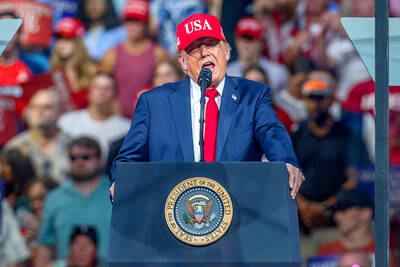
US President Donald Trump on Wednesday threatened to take action against the EU if it moves forward with European Commission President Ursula von der Leyen’s proposal to make Canada the bloc’s first associate member. “If they do that, if I think it’s at all a hostile act; I will put very serious tariffs or stop trading with Europe on many things,” Trump told reporters en route to an event in North Carolina, calling the proposal “laughable.” “If it’s a good intention, that’s fine. If it’s a bad intention, we’ll put very heavy tariffs on Europe,” he said. Von der Leyen made the proposal
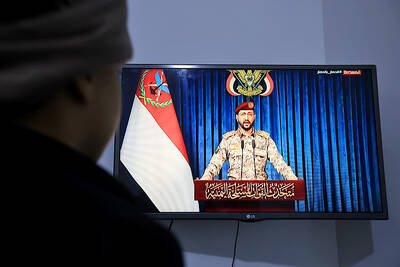
ON THE MOVE: Trump unexpectedly cut short a trip to return to the White House, while the State Department warned Americans to avoid travel to the Middle East The US on Saturday warned that hostilities between Saudi Arabia and Iran-backed Houthis could “escalate rapidly” after a missile attack targeted Riyadh for the first time since the Yemen conflict resumed. US President Donald Trump on Saturday cut short a weekend at Camp David, a secluded presidential complex in rural Maryland, to return unexpectedly to the White House. The White House gave no explanation for the early return, which comes as a new threshold was crossed in the conflict between Saudi Arabia and the Houthis, who control a large part of Yemen and are fighting government forces backed by a coalition led
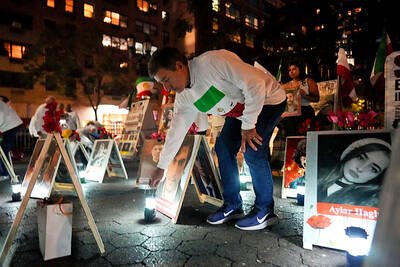
World leaders gather in New York this week for the UN General Assembly, bracing for US President Donald Trump’s return to the rostrum for a second year running, with talks centering on the widening conflicts in the Middle East and Ukraine and the risks of artificial intelligence (AI). Nearly 130 heads of state meet with the post-World War II order under strain and with the UN itself struggling to remain relevant and weathering attacks from Trump, who has slashed the US’ contributions and withdrawn from dozens of UN bodies. Chinese President Xi Jinping (習近平), who last addressed the diplomatic jamboree via video

The US military came close to boarding a Chinese vessel in the Middle East earlier this year based on a flawed intelligence report prepared with the help of artificial intelligence (AI), CNN said on Friday. US intelligence indicated the ship was carrying nuclear weapons-related components, leading US forces to prepare to intercept it, the broadcaster reported, citing four anonymous sources familiar with the incident. However, the operation was called off after officials determined that an AI chatbot used by an analyst had misidentified the material the ship was carrying. The report was “entirely false,” but “almost started a war,” CNN quoted one source


 RSS
RSS