


A sinewy man covered in thick soot stands in a gray cloud of smoke, watching over a slow-burning pile of wood that sustains his life but may also eventually kill him.
Nearby, emaciated children with their bones visible through their skin bet over a game of dice using charcoal instead of money.
More than 1,500 people live in this makeshift charcoal factory in one of the sprawling slums that dominate large chunks of the Philippine capital of Manila.
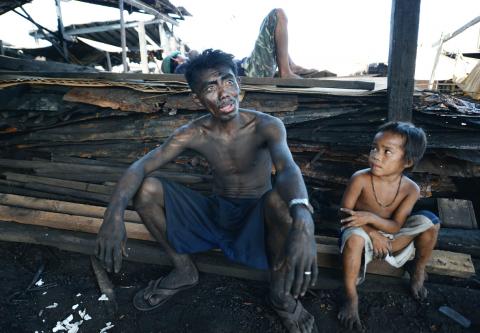
Photo: AFP
They mine a neighboring garbage dump for scraps of wood, which they place into crude furnaces. After a week the charcoal is placed into sacks and hauled off to market.
While the country’s rich enjoy electricity and gas delivered into their homes, charcoal remains a vital source of fuel for the poor masses.
The Philippines, for decades one of the Asia’s economic laggards, has attracted global attention for remarkable growth since Philippine President Benigno Aquino III came to power in 2010.
The stock market has hit record highs, credit agencies have upgraded the country’s risk ratings and new skyrises are being built with speed reminiscent of China’s construction boom.
Yet that has done little to change a huge rich-poor divide that sees roughly a quarter of Manila’s 12 million people surviving on US$1 a day or less.
Nowhere can the chasm be felt as deeply as Ulingan, the squatter community whose residents make their living from charcoal.
Among them is 34-year-old Rose Mingote, whose creases in her tired face are filled with black powder after a night of filling sacks.
“I am not sure if I can bring a child into this kind of world,” says Mingote, who has been married for four years.
“This is as good as it gets for me,” she says.
On a nearby broken bench that alternates as a sleeping space, a mother and her three children share a single plate of rice.
The youngest of the three stares blankly into the distance, with only a ripped tarpaulin providing shade.
Everyone is forced to inhale the smoke that billows from the charcoal pits, turning the dire landscape into an eerie monochrome.
Those who toil here risk contracting a range of health problems, from respiratory illness to skin disease.
Juan Villa, an outreach worker with local charity group Project Pearls, says asthma, bronchitis and lung cancer are major problems at Ulingan. Project Pearls has helped some of the slum dwellers relocate, but most are reluctant to go.
Despite the daily torture, making charcoal can return up to 2,000 pesos (US$50) a week, providing a better existence than for many others in the slums.
“To everyone else, this is dirty, but to poor people like me, it’s our source of life,” says mother-of-three Madelyn Rosales, 33.
“We’ve had different jobs and different homes but it’s only through working here that my children have been able to taste meat and hotdogs” she says.
For gap-toothed 13-year-old Biboy Amores, money earned here goes to his education.
“It’s hard, but I need to pay for school,” he says.


When a hiker fell from a 55m waterfall in wild New Zealand bush, rescuers were forced to evacuate the badly hurt woman without her dog, which could not be found. After strangers raised thousands of dollars for a search, border collie Molly was flown to safety by a helicopter pilot who was determined to reunite the pet and the owner. A week earlier, an emergency rescue helicopter found the woman with bruises and lacerations after a fall at a rocky spot at the waterfall on the South Island’s West Coast. She was airlifted on March 24, but they were forced to
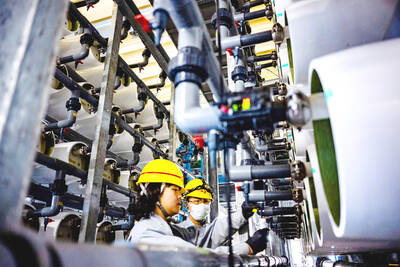
HIGH HOPES: The power source is expected to have a future, as it is not dependent on the weather or light, and could be useful for places with large desalination facilities A Japanese water plant is harnessing the natural process of osmosis to generate renewable energy that could one day become a common power source. The possibility of generating power from osmosis — when water molecules pass from a less salty solution to a more salty one — has long been known. However, actually generating energy from that has proved more complicated, in part due the difficulty of designing the membrane through which the molecules pass. Engineers in Fukuoka, Japan, and their private partners think they might have cracked it, and have opened what is only the world’s second osmotic power plant. It generates

Showcasing phallus-shaped portable shrines and pink penis candies, Japan’s annual fertility festival yesterday teemed with tourists, couples and families elated by its open display of sex. The spring Kanamara Matsuri near Tokyo features colorfully dressed worshipers carrying a trio of giant phallic-shaped objects as they parade through the street with glee. The festival, as legend has it, honors a local blacksmith in the Edo Period (1603-1868) who forged an iron dildo to break the teeth of a sharp-toothed demon inhabiting a woman’s vagina that had been castrating young men on their wedding nights. A 1m black steel phallus sits in the courtyard of

Hundreds of Filipinos and tourists flocked to a sun-bleached field north of Manila yesterday, on Good Friday, to witness one of the country’s most blood-soaked displays of religious fervor, undeterred by rising fuel prices. Scores of bare-chested flagellants with covered faces walked barefoot through the dusty streets of Pampanga Province’s San Fernando as they flogged their backs with bamboo whips in the scorching heat. Agence France-Presse (AFP) journalists said they saw devotees deliberately puncturing their skin with glass shards attached to a small wooden paddle to ensure their bleeding during the ritual, a way to atone for sins and seek miracles from


 RSS
RSS