


US President Barack Obama warned Syria of “enormous consequences” if it resorts to chemical weapons, as regime forces launched a wave of air and ground attacks and a Japanese reporter was killed in Aleppo.
Regime fighter jets and shells struck towns in northern Syria and areas in Damascus yesterday, killing nine people including women and children, the Syrian Observatory for Human Rights said.
Japanese reporter Mika Yamamoto, 45, died after coming under fire from up to 15 apparently pro-government troops as she covered the anti-regime movement in the key northern hub of Aleppo on Monday, a colleague said.

Photo: AFP / Nippon Television Network
Her death brings to four the number of foreign journalists who have lost their lives in last year.
Obama put Syrian President Basher al-Assad’s regime on notice on Monday that although he had not ordered military intervention “at this point,” the US was “monitoring the situation very carefully,” and had drawn up contingency plans.
“There would be enormous consequences if we start seeing movement on the chemical weapons front or the use of chemical weapons ... That would change my calculations significantly,” he told reporters at the White House.
Obama — who has repeatedly called for al-Assad to stand down as the conflict intensified — said the US would regard any recourse by Damascus to its deadly arsenal as crossing a “red line.”
Syria’s admission last month that it has chemical weapons and could use them in case of any “external aggression” added a dangerous new dimension to a conflict that began as a peaceful uprising but has descended into a bitter armed revolt.
Syrian forces yesterday shelled districts in the battered city of Aleppo, killing nine civilians, among them women and children, and pounded the nearby towns of Marea and Tall Rifaat, the Syrian Observatory for Human Rights said.
The Local Coordination Committees (LCC) — a network of opposition activists on the ground — said warplanes were also striking Marea, causing casualties when one building collapsed.
“Residents are trying to pull out the martyrs and the wounded from the rubble,” the LCC said.
Aleppo, the main northern city which lies near the Turkish border, has borne the brunt of the conflict since fighting erupted there a month ago, with the regime warning it would be the scene of the “mother of all battles.”
Yesterday’s violence followed a bloody day in which 167 people were killed across Syria, the Observatory said, with no letup in the bloodshed as Muslims celebrated the Eid al-Fitr holiday which marks the end of the holy month of Ramadan.
The LCC also reported heavy artillery shelling from tanks at a checkpoint in Jdaidet Artuz, southwest of the capital and said warplanes were firing from mounted machineguns on the suburbs of al-Hajar al-Aswad and Babila.
Meanwhile, Yamamoto’s long-time collaborator Kazutaka Sato told Japanese broadcasters he and the veteran war reporter had been with anti-regime forces when they were shot at by what appeared to be a group of about 15 government troops. The TBS network cited Sato as saying she had been shot in the neck.
Abu Raashid, commander of Liwa Asifat al-Shamal (Northern Storm Brigade), one of the myriad that make up the rebel Free Syrian Army, said his group took Yamamoto’s body across the border into Turkey.
“If the international community doesn’t move to help the Syrian people, they have to react to the spilling of their citizens’ blood on Syrian territory,” he said.
Yamamoto worked for the Japan Press news agency and had also covered the war in Afghanistan and the Iraq conflict, according to the company Web site.
The Observatory said three other journalists — a Lebanese woman, an Arab male working for a US media outlet and a Turkish national — were missing.

Kouri Richins, a Utah mother who published a children’s book about grief after the death of her husband is to serve a life sentence for his murder without the possibility of parole, a judge ruled on Wednesday. Richins was convicted in March of aggravated murder for lacing a cocktail given to her husband, Eric Richins, with five times the lethal dose of fentanyl at their home near Park City in 2022. A jury also found her guilty of four other felonies, including insurance fraud, forgery and attempted murder for trying to poison her husband weeks earlier on Feb. 14, 2022, with a
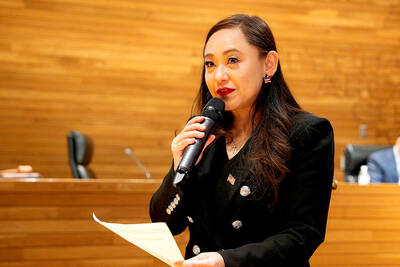
‘PERSONAL MISTAKES’: Eileen Wang has agreed to plead guilty to the felony, which comes with a maximum sentence of 10 years in federal prison A southern California mayor has agreed to plead guilty to acting as an illegal agent for the Chinese government and has resigned from her city position, officials said on Monday. Eileen Wang (王愛琳), mayor of Arcadia, was charged last month with one count of acting in the US as an illegal agent of a foreign government. She was accused of doing the bidding of Chinese officials, such as sharing articles favorable to Beijing, without prior notification to the US government as required by law. The 58-year-old was elected in November 2022 to a five-person city council, from which the mayor is selected
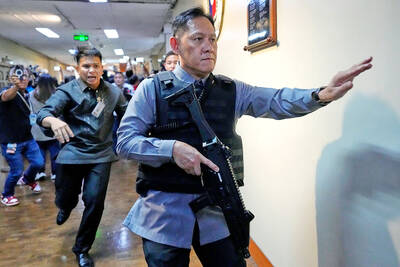
DELA ROSA CASE: The whereabouts of the senator, who is wanted by the ICC, was unclear, while President Marcos faces a political test over the senate situation Philippine authorities yesterday were seeking confirmation of reports that a top politician wanted by the International Criminal Court (ICC) had fled, a day after gunfire rang out at the Philippine Senate where he had taken refuge fearing his arrest. Senator Ronald “Bato” dela Rosa, the former national police chief and top enforcer of former Philippine president Rodrigo Duterte’s “war on drugs,” has been under Senate protection and is wanted for crimes against humanity, the same charges Duterte is accused of. “Several sources confirmed that the senator, Senator Bato, is no longer in the Senate premises, but we are still getting confirmation,” Presidential
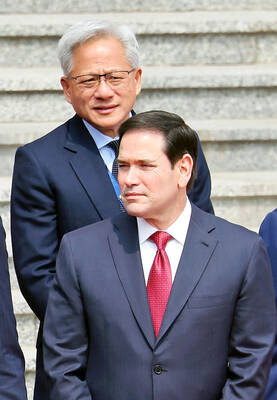
HELP DENIED? The US Department of State said that the Cuban leadership refuses to allow the US to provide aid to Cubans, ‘who are in desperate need of assistance’ US Secretary of State Marco Rubio on Wednesday said that Cuba’s leadership must change, as Washington renewed an offer of US$100 million in aid if the communist nation agrees to cooperate. Cuba has been suffering severe economic tumult led by an energy shortage that plunged 65 percent of the country into darkness on Tuesday. Cuba’s leaders have blamed US sanctions, but Rubio, a Cuban American and critic of the government established by Fidel Castro, said the system was to blame, including corruption by the military. “It’s a broken, nonfunctional economy, and it’s impossible to change it. I wish it were different,” he told


 RSS
RSS