


The storm that ravaged Beijing nearly a week ago and killed at least 77 people remains a sensitive topic in China, with a newspaper ordered to cut its coverage and online discussions curtailed.
Directed by propaganda officials, mainstream media have been focusing on the positive aspects of the storm, such as rescue efforts, heroic civilian acts and sacrifices by uniformed officials. However, those who want to raise questions on the city’s handling of the disaster and its drainage system have come under pressure.
Southern Weekly — an influential newspaper known for its edgy reporting — canceled four pages of storm coverage this week. In addition, the newspaper itself, together with Beijing’s former and acting mayors, and the deaths in Fangshan — the hardest-hit district in Beijing — were all blocked on China’s most popular microblogging site, Sina Weibo, on Friday.
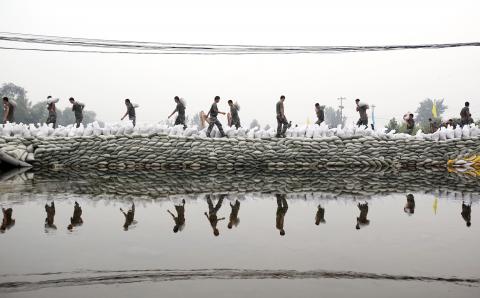
Photo: Reuters
The censorship comes during a personnel reshuffling in the city government of the capital as China braces for the once-in-a-decade power handover to the next generation of leaders. The transfer will take place when the Chinese Communist Party (CCP) holds its congress later this year, with banners around the city already calling for the creation of a stable environment for the event.
Chinese officials have kept information tight, mindful that any failure to cope with the flooding could reflect badly on the country’s leadership. The Chinese government has justified its one-party rule in part by delivering economic growth and maintaining stability and acting quickly to manage disasters like the flooding last year on June 21.
Chinese officials usually limit coverage of disasters, but one media analyst said authorities may have expanded that for the floods because the questions about death tolls are happening against the backdrop of an ill-timed power shift in the city, with both Beijing’s mayor and vice mayor resigning on Wednesday.
The city’s outgoing mayor, Guo Jinlong (郭金龍), who was promoted to the city’s most senior post of CCP secretary, is expected to join the central government’s top 25-member politburo at the party’s fall congress.
“It’s kind of a perfect storm in terms of press control,” said David Bandurski, a researcher at Hong Kong-based China Media Project, about the timing of the disaster so close to the party congress.
A journalist close to the Southern Weekly told foreign media that the newspaper killed four pages of storm coverage this week after provincial propaganda officials and corporate management intervened. He requested anonymity because of the sensitivity of the issue.
The unpublished articles include an obituary page for 25 storm victims, an analysis of the flooding on a Beijing highway where at least three people drowned and a story on Beijing’s drainage system, the journalist said.
A photo of the proof of the obituary page circulated online, showing big crosses in red ink over the stories of the dead. Chinese online users noted the page might have offended the authority because it identified the victims when the government had not done so. Southern Weekly hits the newsstand on Thursdays.
The news that Southern Weekly was forced to cancel some of its storm coverage caused such a big reaction online that the newspaper itself became an unsearchable phrase late on Friday on China’s three most popular microblogging sites: Sina Weibo, Sohu Weibo and Tencent Weibo.
In another sign of stringent control, the journalist said the newspaper group that publishes the paper on Friday issued new rules banning its journalists from speaking to the foreign media.
On the same day, “Guo,” acting mayor “Wang Anshun (王安順)” and “Fangshan death” were also banned search terms on Sina Weibo.
Chinese Internet companies employ censors to scrub their sites clean of posts that may offend the authorities. They also make certain topics unsearchable to stifle online exchange of information.
Chinese authorities on Thursday raised Beijing storm’s death toll to 77 after the public questioned the days-old tally of 37, with some residents even compiling their own totals in a reflection of deep mistrust of the government’s handling of the disaster.
In a rare expression of humility, Beijing’s flood and drought prevention headquarters offered condolences to the families of the victims and pledged that it would “conscientiously sum up and reflect and learn lessons from” the flood and improve the city’s resilience against disasters, the city government said.
Xinhua News Agency said Guo and Wang mourned the victims of the July 21 downpour when they went to Fangshan on Friday to inspect relief work.

Kouri Richins, a Utah mother who published a children’s book about grief after the death of her husband is to serve a life sentence for his murder without the possibility of parole, a judge ruled on Wednesday. Richins was convicted in March of aggravated murder for lacing a cocktail given to her husband, Eric Richins, with five times the lethal dose of fentanyl at their home near Park City in 2022. A jury also found her guilty of four other felonies, including insurance fraud, forgery and attempted murder for trying to poison her husband weeks earlier on Feb. 14, 2022, with a
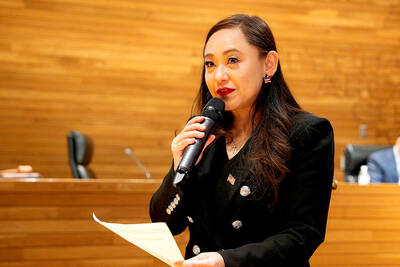
‘PERSONAL MISTAKES’: Eileen Wang has agreed to plead guilty to the felony, which comes with a maximum sentence of 10 years in federal prison A southern California mayor has agreed to plead guilty to acting as an illegal agent for the Chinese government and has resigned from her city position, officials said on Monday. Eileen Wang (王愛琳), mayor of Arcadia, was charged last month with one count of acting in the US as an illegal agent of a foreign government. She was accused of doing the bidding of Chinese officials, such as sharing articles favorable to Beijing, without prior notification to the US government as required by law. The 58-year-old was elected in November 2022 to a five-person city council, from which the mayor is selected

DELA ROSA CASE: The whereabouts of the senator, who is wanted by the ICC, was unclear, while President Marcos faces a political test over the senate situation Philippine authorities yesterday were seeking confirmation of reports that a top politician wanted by the International Criminal Court (ICC) had fled, a day after gunfire rang out at the Philippine Senate where he had taken refuge fearing his arrest. Senator Ronald “Bato” dela Rosa, the former national police chief and top enforcer of former Philippine president Rodrigo Duterte’s “war on drugs,” has been under Senate protection and is wanted for crimes against humanity, the same charges Duterte is accused of. “Several sources confirmed that the senator, Senator Bato, is no longer in the Senate premises, but we are still getting confirmation,” Presidential

HELP DENIED? The US Department of State said that the Cuban leadership refuses to allow the US to provide aid to Cubans, ‘who are in desperate need of assistance’ US Secretary of State Marco Rubio on Wednesday said that Cuba’s leadership must change, as Washington renewed an offer of US$100 million in aid if the communist nation agrees to cooperate. Cuba has been suffering severe economic tumult led by an energy shortage that plunged 65 percent of the country into darkness on Tuesday. Cuba’s leaders have blamed US sanctions, but Rubio, a Cuban American and critic of the government established by Fidel Castro, said the system was to blame, including corruption by the military. “It’s a broken, nonfunctional economy, and it’s impossible to change it. I wish it were different,” he told


 RSS
RSS