

Indian pharmaceutical tycoon Yusuf Hamied revolutionized AIDS treatment more than a decade ago by supplying cut-price drugs to the world’s poor — and now he wants to do the same for cancer.
Hamied, chairman of generic drugs giant Cipla, last month slashed the cost of three medicines to fight brain, kidney and lung cancer in India, making the drugs up to more than four times cheaper.
“I hope we’ll cut prices of many more cancer drugs,” he said, adding that he wants to supply the cheaper drugs to Africa and elsewhere. “Reducing the price of cancer drugs is a humanitarian move.”
Hamied, 76, was pilloried by Western drug giants 11 years ago when he broke their monopoly by offering to supply life-saving triple therapy AIDS drug cocktails for under US$1 a day — one-thirtieth the price set by the multinationals.
The firms branded him an intellectual property thief while he accused them of being “global serial killers” whose high prices were costing the lives of AIDS patients.
“What he did was path-breaking. It has been very important in saving lives, and what he is doing with cancer drugs is the same,” said Leena Menghaney, a lawyer with humanitarian group Medecins sans Frontieres (Doctors Without Borders).
In 1972, India made only the process for making drugs patentable, not the drugs themselves.
This meant firms could “reverse-engineer” or change methods used to make medicines and sell them at up to one-fiftieth of US prices.
The legislation gave a huge leg-up to India’s generics industry and gave the nation the nickname “the pharmacy to the Third World.”
However, in 2005, India brought its law in line with WTO rules recognizing 20-year patents, pushing up the prices of newly launched drugs.
Cipla, India’s fourth-largest pharmaceutical company by sales, has been pressing the government to allow widespread use of “compulsory licenses,” which are permitted under WTO rules.
The licenses allow companies to make existing life-saving drugs to sell in countries where they are otherwise priced out of reach.
India’s first such license was granted in March to Natco Pharma to produce a generic version of Bayer’s blockbuster kidney cancer drug Nexavar, cutting the price from 28,000 rupees (US$500) for a monthly dose to 6,840 rupees.
Ranjit Shahani, who heads the Organisation of Pharmaceutical Producers of India, says widespread compulsory licensing will jeopardize investment in innovative pharmaceuticals.
Bayer has said it will launch a legal challenge to the compulsory license, and global drugmakers have vowed to oppose the spread of such legislation.
Hamied denied that his latest move was simply an attempt to boost his share in the oncology drugs market, insisting business must be linked to “social responsibility.”
However, he said like any other business, his company, which has 23 cancer drugs, also wants sales.
“I owe it to my shareholders to be pragmatic,” he said.
Born in Lithuania to an Indian Muslim father and a Lithuanian Jewish mother, Hamied was two months old when his parents fled Europe in the 1930s under the threat of Nazi Germany.
He was raised in Mumbai and studied for a doctorate in chemistry at Cambridge University in Britain before joining Cipla, which was founded by his father.
“My father never forced me but chemistry was my best subject,” said Hamied, who became chairman of the company in 1989.
His bold step in offering cheap AIDS drugs turned out to be a smart business move.
Cipla is now the world’s largest AIDS antiretroviral drugs supplier and the publicly listed company is valued at nearly US$5 billion, while business magazine Forbes puts Hamied’s personal fortune at US$1.75 billion.
However, Hamied said poverty-racked India “can’t afford to divide people into those who can afford life-saving drugs and those who can’t.”
He believes the pharma giants should let emerging market drugmakers make copycat medicines in exchange for small royalties.
Some 95 percent of Western firms’ profits come from regulated developed markets like Japan, Europe and the US, so the pharmaceutical giants “really won’t lose out,” he added.
Even with the reduced price of generic drugs, such medicines are still beyond the reach of many of the world’s poorest, said Hamied, who confesses he has his eye on his legacy.
“I want it to be said when I leave this world that ‘he was not just a money-making machine,’” he said.
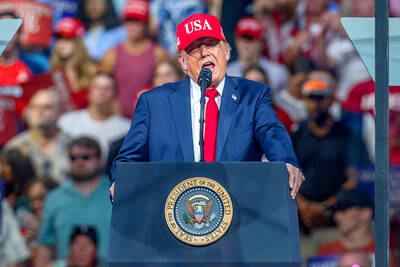
US President Donald Trump on Wednesday threatened to take action against the EU if it moves forward with European Commission President Ursula von der Leyen’s proposal to make Canada the bloc’s first associate member. “If they do that, if I think it’s at all a hostile act; I will put very serious tariffs or stop trading with Europe on many things,” Trump told reporters en route to an event in North Carolina, calling the proposal “laughable.” “If it’s a good intention, that’s fine. If it’s a bad intention, we’ll put very heavy tariffs on Europe,” he said. Von der Leyen made the proposal
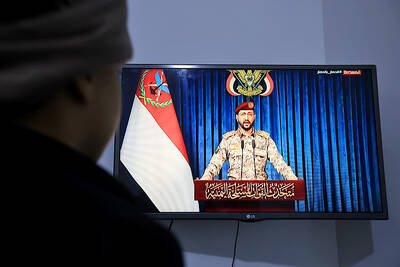
ON THE MOVE: Trump unexpectedly cut short a trip to return to the White House, while the State Department warned Americans to avoid travel to the Middle East The US on Saturday warned that hostilities between Saudi Arabia and Iran-backed Houthis could “escalate rapidly” after a missile attack targeted Riyadh for the first time since the Yemen conflict resumed. US President Donald Trump on Saturday cut short a weekend at Camp David, a secluded presidential complex in rural Maryland, to return unexpectedly to the White House. The White House gave no explanation for the early return, which comes as a new threshold was crossed in the conflict between Saudi Arabia and the Houthis, who control a large part of Yemen and are fighting government forces backed by a coalition led

The US military came close to boarding a Chinese vessel in the Middle East earlier this year based on a flawed intelligence report prepared with the help of artificial intelligence (AI), CNN said on Friday. US intelligence indicated the ship was carrying nuclear weapons-related components, leading US forces to prepare to intercept it, the broadcaster reported, citing four anonymous sources familiar with the incident. However, the operation was called off after officials determined that an AI chatbot used by an analyst had misidentified the material the ship was carrying. The report was “entirely false,” but “almost started a war,” CNN quoted one source
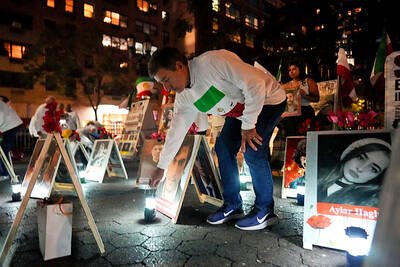
World leaders gather in New York this week for the UN General Assembly, bracing for US President Donald Trump’s return to the rostrum for a second year running, with talks centering on the widening conflicts in the Middle East and Ukraine and the risks of artificial intelligence (AI). Nearly 130 heads of state meet with the post-World War II order under strain and with the UN itself struggling to remain relevant and weathering attacks from Trump, who has slashed the US’ contributions and withdrawn from dozens of UN bodies. Chinese President Xi Jinping (習近平), who last addressed the diplomatic jamboree via video


 RSS
RSS