


Some of the best brains in code-breaking, including cryptographers in the CIA and the National Security Agency and thousands of amateur sleuths worldwide, have been given fresh hope that they may crack one of the world’s toughest puzzles, which has remained unsolved for 20 years.
The riddle is embedded in a work of art that stands outside the main entrance to the CIA’s headquarters in Virginia.
The artist who designed the 1990 sculpture, Jim Sanborn, has become so frustrated by the failure of the code-breaking community to crack his puzzle that he has dangled a six-letter clue in front of them.
The clue offers the hope that a problem that has eluded the finest thinkers in the intelligence community, as well as their high-powered computers, may now be solved.
The riddle has inspired Web sites and user groups and was a theme of Dan Brown’s The Lost Symbol.
Sanborn’s sculpture was commissioned to mark the extension of the agency’s headquarters in Langley, and was itself a play on the intelligence function of the agency: The sculpture’s name, Kryptos, means “hidden” in Greek.
Sanborn, who won the US$250,000 commission to design the work in a competition, embedded four puzzles in the curved copper panels of the sculpture.
He spent four months devising the codes, with the help of a retired CIA cryptographer.
Three of the four puzzles were solved in the first few years by a CIA physicist who cracked the code using just pen and paper, and then by a California-based information-technology specialist using a computer.
The first deciphered sequence was a poetic phrase composed by Sanborn; the second referred to an object that could be buried in the grounds of Langley and to the CIA expert with whom Sanborn shared the secret to all four sequences; and the third was a passage from Howard Carter’s account of opening the tomb of the Egyptian boy pharoh Tutankhamun in 1922.
The fourth and final code involves 97 of the 869 characters carved into the main portion of the sculpture.
Sanborn has now revealed, through the New York Times, a six-letter element of those 97 letters.
He has disclosed that the part of the sculpture that reads “nypvtt” becomes “Berlin” once decoded.
Sanborn says that so far only two of the 97 characters have been deciphered.
He told the New York Times he had become so fed up with Kryptos obsessives contacting him to claim success that he has set up his own Web site to filter out approaches.
However, correspondents will only be awarded access to the Web site if they can show that they have successfully decoded the first 10 letters of the 97-letter puzzle.


When a hiker fell from a 55m waterfall in wild New Zealand bush, rescuers were forced to evacuate the badly hurt woman without her dog, which could not be found. After strangers raised thousands of dollars for a search, border collie Molly was flown to safety by a helicopter pilot who was determined to reunite the pet and the owner. A week earlier, an emergency rescue helicopter found the woman with bruises and lacerations after a fall at a rocky spot at the waterfall on the South Island’s West Coast. She was airlifted on March 24, but they were forced to

HIGH HOPES: The power source is expected to have a future, as it is not dependent on the weather or light, and could be useful for places with large desalination facilities A Japanese water plant is harnessing the natural process of osmosis to generate renewable energy that could one day become a common power source. The possibility of generating power from osmosis — when water molecules pass from a less salty solution to a more salty one — has long been known. However, actually generating energy from that has proved more complicated, in part due the difficulty of designing the membrane through which the molecules pass. Engineers in Fukuoka, Japan, and their private partners think they might have cracked it, and have opened what is only the world’s second osmotic power plant. It generates
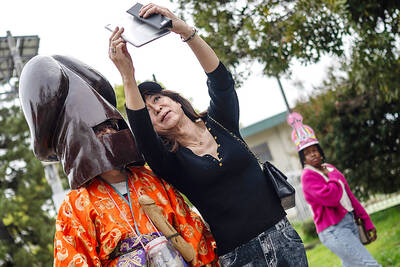
Showcasing phallus-shaped portable shrines and pink penis candies, Japan’s annual fertility festival yesterday teemed with tourists, couples and families elated by its open display of sex. The spring Kanamara Matsuri near Tokyo features colorfully dressed worshipers carrying a trio of giant phallic-shaped objects as they parade through the street with glee. The festival, as legend has it, honors a local blacksmith in the Edo Period (1603-1868) who forged an iron dildo to break the teeth of a sharp-toothed demon inhabiting a woman’s vagina that had been castrating young men on their wedding nights. A 1m black steel phallus sits in the courtyard of

JAN. 1 CLAUSE: As military service is voluntary, applications for permission to stay abroad for over three months for men up to age 45 must, in principle, be granted A little-noticed clause in sweeping changes to Germany’s military service policy has triggered an uproar after it emerged that the law requires men aged up to 45 to get permission from the armed forces before any significant stay abroad, even in peacetime. The legislation, which went into effect on Jan. 1 aims to bolster the military and demands all 18-year-old men fill out a questionnaire to gauge their suitability to serve in the armed forces, but stops short of conscription. If the “modernized” model fails to pull in enough recruits, parliament will be compelled to discuss the reintroduction of compulsory service, German


 RSS
RSS