


Jean Simmons, whose ethereal screen presence and starring roles with Hollywood’s top actors in such films as Spartacus and Elmer Gantry, made her a mid-century film icon, has died at age 80.
The actress, who sang with Marlon Brando in Guys and Dolls and played Ophelia to Laurence Olivier’s Hamlet, died Friday at her home in Santa Monica, her agent Judy Page told the Los Angeles Times. She had lung cancer.
Already a stunning beauty at 14, Simmons made her movie debut in the 1944 British production Give Us the Moon. Several minor films followed before British director David Lean gave the London-born actress her breakthrough role of Estella, companion to the reclusive Miss Havisham in 1946’s Great Expectations. That was followed by the exotic Black Narcissus, and then Olivier’s Oscar-winning Hamlet in 1948, for which Simmons was nominated as best supporting actress.
She would be nominated for another Oscar, for best actress for 1969’s The Happy Ending, before moving largely to television roles in the 1970s, 1980s and 1990s.
She won an Emmy Award for her role in the 1980s miniseries The Thorn Birds. Her other notable films included Until They Sail, The Big Country, This Earth Is Mine, All the Way Home, Mister Buddwing and Rough Night in Jericho.
Simmons had left Britain for Hollywood in 1950, accompanied by her future husband Stewart Granger. There, they were befriended by Howard Hughes, who flew them to Tucson, Arizona, for a surprise wedding.
“When I returned from the honeymoon,” Simmons told a reporter in 1964, “I learned that Hughes owned me — he had bought me from [British producer] J. Arthur Rank like a piece of meat.”
What followed was a string of films that she would later dismiss as terrible, although she took some solace in the fact Hughes, legendary in those days as a womanizer, never bothered her. Simmons finally ended up suing Hughes for the right to make more prestigious films at other studios, and the result was Young Bess, The Robe (the first movie filmed in CinemaScope), The Actress, The Egyptian and Desiree. In the latter film, in 1954, she played the title role opposite Brando’s Napoleon.
She loved the rehearsals for that Guys and Dolls, Simmons recalled in 1988, “especially the dancing routines with Marlon trying not to step on me and choreographer Michael Kidd looking very worried.”
By the 1970s, her career as a lead film actress had ended, but Simmons continued to work regularly on stage and in TV.
She and Granger divorced in 1960 and shortly afterwards, Simmons married film director Richard Brooks.

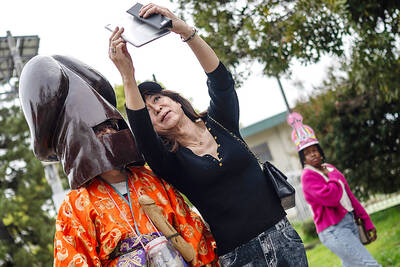
Showcasing phallus-shaped portable shrines and pink penis candies, Japan’s annual fertility festival yesterday teemed with tourists, couples and families elated by its open display of sex. The spring Kanamara Matsuri near Tokyo features colorfully dressed worshipers carrying a trio of giant phallic-shaped objects as they parade through the street with glee. The festival, as legend has it, honors a local blacksmith in the Edo Period (1603-1868) who forged an iron dildo to break the teeth of a sharp-toothed demon inhabiting a woman’s vagina that had been castrating young men on their wedding nights. A 1m black steel phallus sits in the courtyard of

JAN. 1 CLAUSE: As military service is voluntary, applications for permission to stay abroad for over three months for men up to age 45 must, in principle, be granted A little-noticed clause in sweeping changes to Germany’s military service policy has triggered an uproar after it emerged that the law requires men aged up to 45 to get permission from the armed forces before any significant stay abroad, even in peacetime. The legislation, which went into effect on Jan. 1 aims to bolster the military and demands all 18-year-old men fill out a questionnaire to gauge their suitability to serve in the armed forces, but stops short of conscription. If the “modernized” model fails to pull in enough recruits, parliament will be compelled to discuss the reintroduction of compulsory service, German

Filipino farmers like Romeo Wagayan have been left with little choice but to let their vegetables rot in the field rather than sell them at a loss, as rising oil prices linked to the Iran war drive up the cost of harvesting, labor and transport. “There’s nothing we can do,” said Wagayan, a 57-year old vegetable farmer in the northern Philippine province of Benguet. “If we harvest it, our losses only increase because of labor, transportation and packing costs. We don’t earn anything from it. That’s why we decided not to harvest at all,” he said. Soaring costs caused by the Middle East

Hungarian Prime Minister Viktor Orban’s officially declared wealth is fairly modest: some savings and a jointly owned villa in Budapest. However, voters in what Transparency International deems the EU’s most corrupt country believe otherwise — and they might make Orban pay in a general election this Sunday that could spell an end to his 16-year rule. The wealth amassed by Orban’s inner circle is fueling the increasingly palpable frustration of a population grappling with sluggish growth, high inflation and worsening public services. “The government’s communication machine worked well as long as our economic situation remained relatively good,” said Zoltan Ranschburg, a political analyst


 RSS
RSS