


Politics and art don't always mix well, but the combination has yielded a rare chance for Hong Kong residents and visitors to see what is arguably China's most famous painting.
Trying to foster nationalistic pride in China's heritage among Hong Kong residents, the Chinese government has sent 32 artworks for an exhibition to mark the 10th anniversary of Britain's return of Hong Kong to China on July 1, 1997. Among them is Zhang Zeduan's (
Qingming Festival is famous partly for its involvement over centuries in palace intrigues, theft and wars, and partly for its detailed, geometrically accurate images of bridges, wine shops, sedan chairs and boats beautifully juxtaposed with flowing lines for the depiction of mountains and other natural scenery. It is routinely covered in courses on Chinese history, art and culture, across China and in the West.
"The Qingming Festival is probably the single most widely known work in China," said Marc Wilson, a Chinese specialist and the director of the Nelson-Atkins Museum of Art in Kansas City, Missouri.
He added that the painting was "like China's Mona Lisa."
Because of its fragility, the scroll is seldom displayed, even in Beijing, and has never been lent for an overseas exhibition.
It was briefly exhibited in Shanghai in 2003, where it drew lines that snaked for half a kilometer outside the museum, and in Shenyang, China, in 2005.
Qingming Festival and 15 other paintings and examples of calligraphy dating from the 6th to the 14th centuries are to remain on display through July 22. Another 16 works, dating from the 4th to the 16th centuries, will be on view from July 23 to Aug. 11.
Zheng Xinmiao (
"Through all the turmoil of different dynasties, it is remarkable for these pieces to survive," he said.
The purpose of the exhibition is clear from its title: The Pride of China. The Beijing government has sponsored a series of Chinese cultural events this summer to foster Chinese identity in a population where many have seen themselves as citizens of Hong Kong first, and only secondarily as Chinese.
Yet one visitor, Ringo Lau, a 47-year-old consultant who attended the exhibition on Friday, the opening day, remarked: "I have no question I am Chinese. I don't need this to enrich it."
He said that he had studied "Qingming Festival" and recalled that a bank branch near his boyhood home in Hong Kong displayed a large reproduction of part of the painting. Although only allowed to look at the painting itself for five minutes on Friday -- guards enforce time limits for each group of visitors -- he said he was satisfied.
"It's detailed, it's marvelous, it's very colorful," he said.
Like the Mona Lisa, Qingming Festival is to some extent famous for being famous.
The Mona Lisa became a household word partly because it was stolen from the Louvre in August 1911. The theft and subsequent sale of forgeries passed off as the real painting set off a frenzy of news coverage, as well as songs and even cabaret acts, until the original was recovered in Italy in December 1913.
Qingming Festival has been famous since the 14th century, when forgeries began to circulate, said Tang Hing-sun, an assistant curator of the Hong Kong Museum of Art who helped organize the exhibition here.
Forgers could pass off their copies as the original partly because the original was repeatedly stolen or misappropriated from the imperial collection, starting as early as the 1340s. It kept showing up in the hands of wealthy, influential families, from whom emperors repeatedly recovered it when they confiscated estates during disputes.
Qiu Ying (
The Nationalists moved the cream of the imperial collection to Taiwan shortly before losing the civil war to the communists in 1949. But through a quirk of history, Qingming Festival had been separated from the rest of the collection and stayed in China.
The last emperor, Pu Yi (溥儀), took the painting with him when forced to leave the Forbidden City in 1924. The Japanese military later installed him as the puppet ruler of Manchuria; at the end of World War II, he still had the painting.
The Soviets handed over the painting to a bank in northeastern China for safekeeping. It stayed there until 1950, when it was transferred to a nearby museum and later to Beijing.

Kouri Richins, a Utah mother who published a children’s book about grief after the death of her husband is to serve a life sentence for his murder without the possibility of parole, a judge ruled on Wednesday. Richins was convicted in March of aggravated murder for lacing a cocktail given to her husband, Eric Richins, with five times the lethal dose of fentanyl at their home near Park City in 2022. A jury also found her guilty of four other felonies, including insurance fraud, forgery and attempted murder for trying to poison her husband weeks earlier on Feb. 14, 2022, with a
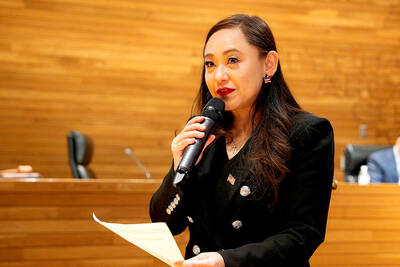
‘PERSONAL MISTAKES’: Eileen Wang has agreed to plead guilty to the felony, which comes with a maximum sentence of 10 years in federal prison A southern California mayor has agreed to plead guilty to acting as an illegal agent for the Chinese government and has resigned from her city position, officials said on Monday. Eileen Wang (王愛琳), mayor of Arcadia, was charged last month with one count of acting in the US as an illegal agent of a foreign government. She was accused of doing the bidding of Chinese officials, such as sharing articles favorable to Beijing, without prior notification to the US government as required by law. The 58-year-old was elected in November 2022 to a five-person city council, from which the mayor is selected

DELA ROSA CASE: The whereabouts of the senator, who is wanted by the ICC, was unclear, while President Marcos faces a political test over the senate situation Philippine authorities yesterday were seeking confirmation of reports that a top politician wanted by the International Criminal Court (ICC) had fled, a day after gunfire rang out at the Philippine Senate where he had taken refuge fearing his arrest. Senator Ronald “Bato” dela Rosa, the former national police chief and top enforcer of former Philippine president Rodrigo Duterte’s “war on drugs,” has been under Senate protection and is wanted for crimes against humanity, the same charges Duterte is accused of. “Several sources confirmed that the senator, Senator Bato, is no longer in the Senate premises, but we are still getting confirmation,” Presidential
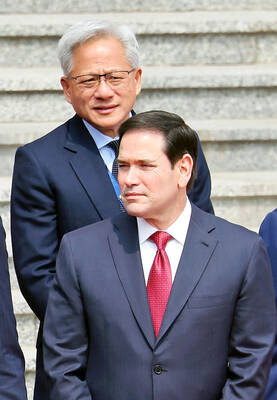
HELP DENIED? The US Department of State said that the Cuban leadership refuses to allow the US to provide aid to Cubans, ‘who are in desperate need of assistance’ US Secretary of State Marco Rubio on Wednesday said that Cuba’s leadership must change, as Washington renewed an offer of US$100 million in aid if the communist nation agrees to cooperate. Cuba has been suffering severe economic tumult led by an energy shortage that plunged 65 percent of the country into darkness on Tuesday. Cuba’s leaders have blamed US sanctions, but Rubio, a Cuban American and critic of the government established by Fidel Castro, said the system was to blame, including corruption by the military. “It’s a broken, nonfunctional economy, and it’s impossible to change it. I wish it were different,” he told


 RSS
RSS