


"Explore the World," promised the signboard outside.
Inside Norling Cyberworld, in a second-floor corner of a busy shopping arcade, Dorji Wangchuk rolled up the sleeve of his Puma sweatshirt and offered a glimpse of his worldly explorations. Inscribed in blue-black ink on the pale inside of his left forearm was the image of a dragon, a tattoo that he had drawn himself, with instructions from the Internet.
On this night he was surfing www.tattoodles.com and plotting to draw a new one on himself -- another dragon, the national symbol of Bhutan. Never mind that tattoos are a taboo here.
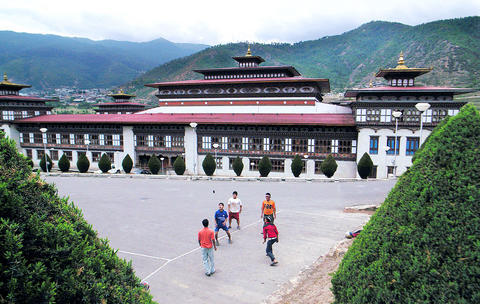
PHOTO: NY TIMES NEWS SERVICE
"According to our culture, it's not good," Wangchuk, 24, conceded, only to add with a grin: "It's my hobby. I can't help it."
Once, Bhutan had guarded itself from the world outside so ardently that it allowed in satellite TV only seven years ago. Today, globalization is officially sanctioned, and it is rushing in fast.
Wangchuk is part of the first generation here to come of age with all the trappings of global youth culture: unrestricted Internet, nearly unrestricted satellite TV, basketball, brand-name sneakers and, as it turns out, tattoos.
Today, at least here in the capital, outside and inside coexist. Tall white prayer flags grace the side of a hill as offerings of good will to what Buddhists call sentient beings, even as the naughty rhymes of Snoop Dogg throb at the disco.
The government has on occasion found the dissonance disconcerting. A sports channel, called Ten Sports, was taken off the air shortly after the introduction of satellite TV, because its wrestling programs had become so popular that boys across Bhutan were mimicking them and upsetting the authorities.
MTV was quietly taken off the air too, along with Fashion TV, which Karma Ura, a prominent academic here, described as antithetical to Bhutanese Buddhist tradition.
Fashion TV, as he put it, had "no suffering alleviation value."
He disconnected his own TV set altogether, having discovered that despite the occasional stimulation, it was ruining his eyes and his mind.
"You basically give away your consciousness," said Ura, director of the Center for Bhutan Studies, a government-funded organization that cogitates on issues of culture and identity.
Young people dominate Bhutan. Of its roughly 700,000 people, 49 percent are under 21, according to the census, and what they will do to support themselves when they are fully grown is an emerging concern.
The unemployment rate among Bhutanese youth, which comprises those 15 to 24, hovers at 5.5 percent, nearly twice the national average, which has also sharply risen in recent years. How to address unemployment has become a subject of regular hand-wringing in newspapers articles and the legislature.
It is hardly surprising, considering how quickly Bhutanese are gaining education. The literacy rate has soared from 20 percent in 1992 to close to 60 percent today, making it that much more important to offer Bhutan's youth something other than farming rice.
Like many people, Wangchuk attended college abroad. The country has very few colleges.
More surprising, perhaps, than the sentiments Ura expressed is the ambivalence of Nyema Zam, an Indian-educated 26-year-old who runs the satellite TV unit for state-owned Bhutan Broadcasting Service. She took pains to note the benefits of opening up to foreign media.
"Television has been the medium through which our people get to find out about other cultures," she said.
At the same time, foreign TV has wrought changes that make her deeply uncomfortable. Her grandparents now watch Indian soap operas in Hindi, a language that would have been foreign to their ears a few years ago.
"Before we would sit together at home and eat dinner ... Now everyone is watching television," Zam said. "In the long run ... it may not be good for the culture that we have worked so hard to protect."
Clearly, the strange riches of the world outside have reached only a small portion of Bhutan's people. Only 33,000 TV sets are in the entire country, and more than half are estimated to have satellite connections that offer up to 30 channels, Zam said. As for the Internet, the universe is even smaller.
Nationwide, the number of Internet users is estimated at 25,000, according to Druknet, the state-owned Internet service provider.
To Singye Dema, 17, the Internet has proved irresistible. Her page on the chat Web site www.hi5.com, is a sparkling pink creation, with a cheerful photograph of her and a description of her interests, including "playing with kids." Her page is festooned with family pictures and a string of conversations she has been having with friends from home and strangers abroad.
Dema, an 11th-grader, finds herself coming back for these online chats almost daily -- and on the weekends, she confessed half disgustedly, sometimes twice a day, for up to three hours at a time.

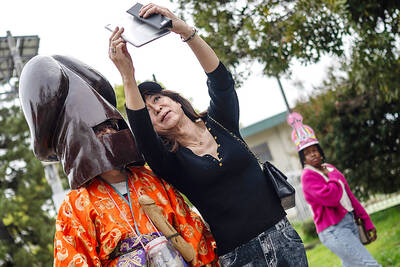
Showcasing phallus-shaped portable shrines and pink penis candies, Japan’s annual fertility festival yesterday teemed with tourists, couples and families elated by its open display of sex. The spring Kanamara Matsuri near Tokyo features colorfully dressed worshipers carrying a trio of giant phallic-shaped objects as they parade through the street with glee. The festival, as legend has it, honors a local blacksmith in the Edo Period (1603-1868) who forged an iron dildo to break the teeth of a sharp-toothed demon inhabiting a woman’s vagina that had been castrating young men on their wedding nights. A 1m black steel phallus sits in the courtyard of

JAN. 1 CLAUSE: As military service is voluntary, applications for permission to stay abroad for over three months for men up to age 45 must, in principle, be granted A little-noticed clause in sweeping changes to Germany’s military service policy has triggered an uproar after it emerged that the law requires men aged up to 45 to get permission from the armed forces before any significant stay abroad, even in peacetime. The legislation, which went into effect on Jan. 1 aims to bolster the military and demands all 18-year-old men fill out a questionnaire to gauge their suitability to serve in the armed forces, but stops short of conscription. If the “modernized” model fails to pull in enough recruits, parliament will be compelled to discuss the reintroduction of compulsory service, German
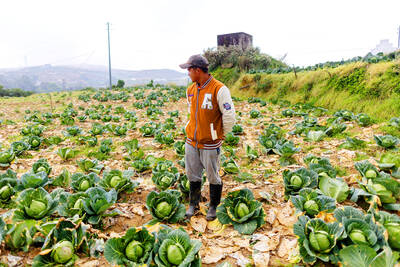
Filipino farmers like Romeo Wagayan have been left with little choice but to let their vegetables rot in the field rather than sell them at a loss, as rising oil prices linked to the Iran war drive up the cost of harvesting, labor and transport. “There’s nothing we can do,” said Wagayan, a 57-year old vegetable farmer in the northern Philippine province of Benguet. “If we harvest it, our losses only increase because of labor, transportation and packing costs. We don’t earn anything from it. That’s why we decided not to harvest at all,” he said. Soaring costs caused by the Middle East

Hungarian Prime Minister Viktor Orban’s officially declared wealth is fairly modest: some savings and a jointly owned villa in Budapest. However, voters in what Transparency International deems the EU’s most corrupt country believe otherwise — and they might make Orban pay in a general election this Sunday that could spell an end to his 16-year rule. The wealth amassed by Orban’s inner circle is fueling the increasingly palpable frustration of a population grappling with sluggish growth, high inflation and worsening public services. “The government’s communication machine worked well as long as our economic situation remained relatively good,” said Zoltan Ranschburg, a political analyst


 RSS
RSS