


Improving ties with Beijing does not require being anti-US, while Taiwan's survival depends on stable relations with China, Chinese Nationalist Party (KMT) Chairwoman Cheng Li-wun (鄭麗文) said yesterday.
Cheng won election as chair of Taiwan’s largest opposition party in October last year, and has signaled a swing toward even closer ties with Beijing than her predecessor, former KMT chairman Eric Chu (朱立倫), who did not visit China during his term as chairman, which began in 2021.
China refuses to speak to the government of President William Lai (賴清德), who it calls a "separatist," but regularly welcomes senior KMT officials, though Cheng has yet to visit since being elected.
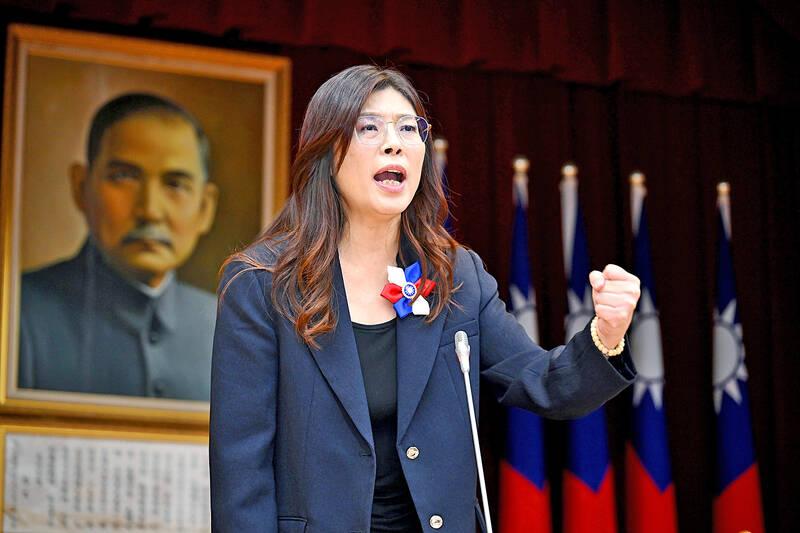
Photo: Chen Yi-kuan, Taipei Times
That has opened her up to criticism from Lai's Democratic Progressive Party, which says the KMT wants to sell out Taiwan's freedoms and democracy to Beijing, and is taking orders from China to block defense spending and pull Taipei away from Washington.
Speaking to the Taiwan Foreign Correspondents' Club, Cheng said the party has been subject to "misunderstanding and prejudice" about its positions.
She reiterated her support for buying arms from the US, while adding that such proposals had to be properly costed.
"In terms of the overall narrative, the KMT has long maintained very good relations with the United States. This does not affect our desire to improve relations with the mainland," she said.
"There is no contradiction between the two, and there is no need to choose one over the other," Cheng said. "Why does improving relations with mainland China have to mean being less pro-American?"
It is all the more important to have good ties with China, “whose relationship with Taiwan directly affects Taiwan's survival,” she said.
Cheng has expressed a desire to meet Chinese President Xi Jinping (習近平), though did not directly answer when asked how those plans were progressing.
The KMT and its smaller ally, the Taiwan People's Party, hold a majority in the Legislative Yuan, giving them an outsized political role in blocking government plans and advancing their own proposals.
All three main political parties are gearing up for local elections on Nov. 28, a key gauge of support ahead of the next presidential election in early 2028.
China has stepped up its military pressure on Taiwan and has never renounced the use of force to bring the nation under its control.
Asked about her attitude to any possible future union across the Taiwan Strait, Cheng said that the time is still far from ripe for discussing an ultimate solution.
"What we need to deal with now is how to create peaceful and stable cross-strait relations,” she said.

SPACE VETERAN: Kjell N. Lindgren, who helps lead NASA’s human spaceflight missions, has been on two expeditions on the ISS and has spent 311 days in space Taiwan-born US astronaut Kjell N. Lindgren is to visit Taiwan to promote technological partnerships through one of the programs organized by the US for its 250th national anniversary. Lindgren would be in Taiwan from Tuesday to Saturday next week as part of the US Bureau of Educational and Cultural Affairs’ US Speaker Program, organized to celebrate the 250th anniversary of the signing of the Declaration of Independence, the American Institute in Taiwan (AIT) said in a statement yesterday. Lindgren plans to engage with key leaders across the nation “to advance cutting-edge technological partnerships and inspire the next generation of scientists and engineers,”

The Chinese Nationalist Party (KMT) caucus yesterday said it opposes the introduction of migrant workers from India until a mechanism is in place to prevent workers from absconding. Minister of Labor Hung Sun-han (洪申翰) on Thursday told the Legislative Yuan that the first group of migrant workers from India could be introduced as early as this year, as part of a government program. The caucus’ opposition to the policy is based on the assessment that “the risk is too high,” KMT caucus secretary-general Lin Pei-hsiang (林沛祥) said. Taiwan has a serious and long-standing problem of migrant workers absconding from their contracts, indicating that

UNREASONABLE SURVEILLANCE: A camera targeted on an road by a neighbor captured a man’s habitual unsignaled turn into home, netting him dozens of tickets The Taichung High Administrative Court has canceled all 45 tickets given to a man for failing to use a turn signal while driving, as it considered long-term surveillance of his privacy more problematic than the traffic violations. The man, surnamed Tseng (曾), lives in Changhua County and was reported 45 times within a month for failing to signal while driving when he turned into the alley where his residence is. The reports were filed by his neighbor, who set up security cameras that constantly monitored not only the alley but also the door and yard of Tseng’s house. The surveillance occurred from July

TRADE-OFF: Beijing seeks to trade a bowl of tempura for a Chinese delicacy, an official said, while another said its promises were attempts to interfere in the polls The government must carefully consider the national security implications of building a bridge connecting Kinmen County and Xiamen, China, the Public Construction Commission (PCC) said yesterday. PCC Commissioner Derek Chen (陳金德), who is also a minister without portfolio, made the remarks in a meeting of the legislature’s Transportation Committee, after Democratic Progressive Party Legislator Hsu Fu-kuei (徐富癸) asked about China’s proposal of new infrastructure projects to further connect Kinmen and Lienchiang (Matsu) counties with Xiamen. China unveiled the bridge plan, along with nine other policies for Taiwan, on Sunday, the last day of Chinese Nationalist Party (KMT) Chairwoman Cheng Li-wun’s (鄭麗文) visit


 RSS
RSS