


A elderly man diagnosed with severe fever with thrombocytopenia syndrome (SFTS) was the third locally acquired case since the tick-borne infectious disease was first reported in Taiwan in 2019, the Centers for Disease Control (CDC) said yesterday.
The man, in his 70s, lives in northern Taiwan, did not travel abroad recently and usually stayed near his home, CDC Epidemic Intelligence Center Director Guo Hung-wei (郭宏偉) said.
He began experiencing extreme fatigue late last month and was rushed to a hospital for emergency treatment. He had a fever and thrombocytopenia, or low platelet count, and further tests confirmed his diagnosis as SFTS on March 2, Guo said.
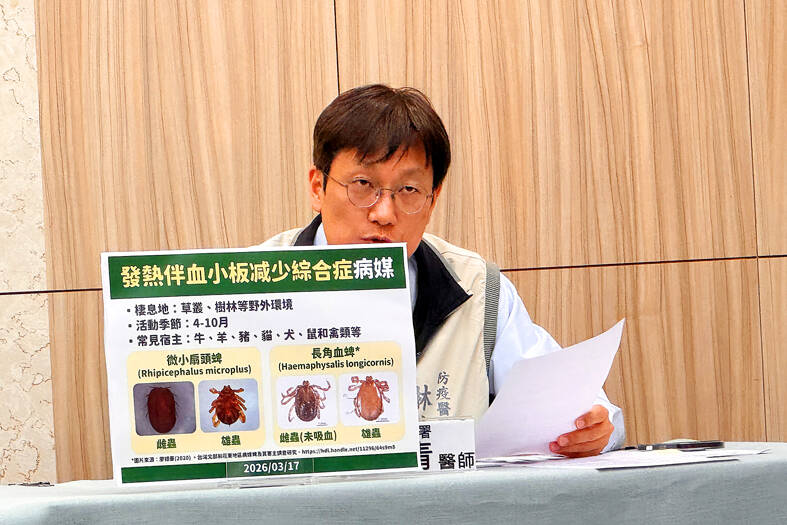
Photo: Chiu Chih-jou, Taipei Times
The first SFTS in Taiwan was detected in 2019 and the second in 2022, he said, adding that SFTS was listed as a category 4 notifiable communicable disease in 2020.
SFTS was first identified in China in 2009, and it has been spreading in East Asia since then, he said.
China reported about 3,000 to 5,000 cases per year, with the number of cases reaching 5,060 in 2023, and the disease spreading in 27 Chinese provinces, Guo said.
In South Korea, SFTS incidence has increased slightly in the past few years, with 280 cases reported last year, he said.
A study found that the Haemaphysalis tick species, the main vector of the SFTS virus, can be active all year round in South Korea, so the increase in human SFTS prevalence is associated with the ticks’ increased infection rate, he said.
Japan has also seen a growing trend of SFTS cases, with 191 reported last year, most of which were concentrated in the west, he said.
CDC physician Lin Yung-ching (林詠青) said the medical record of the latest case in Taiwan showed that the man has cardiovascular disease and had a stroke before he was hospitalized for atypical infection.
As contact tracing found that he lives in a rural area frequented by wild animals and he often visits a vegetable garden near his home, doctors suspected his infection might be related to SFTS, which was later confirmed through a polymerase chain reaction test, Lin said.
A survey of his local environment was conducted last week, and signs of mice visiting his vegetable garden were found, but none were caught by traps, he said.
No ticks were found on the man’s pet cat and dog, and 16 ticks collected from bushes near his home tested negative for the SFTS virus, so the source of his infection is still unknown, he said.
Ticks are the main vector of the SFTS virus and are most active between April and October, he said.
People can prevent tick bites by avoiding resting on grass or in the forest for long periods, he said.
They should also avoid contact with wild animals or unknown pets, wear light-colored long sleeves and pants or other protective garment in the wilderness, use insect repellents and checking for insect bites after returning home, he added.
The general population’s risk of SFTS infection is relatively low, but infected ticks can be brought into Taiwan by migratory birds or imported animals, Guo said.
If left untreated, SFTS can have fatal consequences, so the CDC defines it as a “moderate risk,” he added.

SPACE VETERAN: Kjell N. Lindgren, who helps lead NASA’s human spaceflight missions, has been on two expeditions on the ISS and has spent 311 days in space Taiwan-born US astronaut Kjell N. Lindgren is to visit Taiwan to promote technological partnerships through one of the programs organized by the US for its 250th national anniversary. Lindgren would be in Taiwan from Tuesday to Saturday next week as part of the US Bureau of Educational and Cultural Affairs’ US Speaker Program, organized to celebrate the 250th anniversary of the signing of the Declaration of Independence, the American Institute in Taiwan (AIT) said in a statement yesterday. Lindgren plans to engage with key leaders across the nation “to advance cutting-edge technological partnerships and inspire the next generation of scientists and engineers,”

The Chinese Nationalist Party (KMT) caucus yesterday said it opposes the introduction of migrant workers from India until a mechanism is in place to prevent workers from absconding. Minister of Labor Hung Sun-han (洪申翰) on Thursday told the Legislative Yuan that the first group of migrant workers from India could be introduced as early as this year, as part of a government program. The caucus’ opposition to the policy is based on the assessment that “the risk is too high,” KMT caucus secretary-general Lin Pei-hsiang (林沛祥) said. Taiwan has a serious and long-standing problem of migrant workers absconding from their contracts, indicating that

UNREASONABLE SURVEILLANCE: A camera targeted on an road by a neighbor captured a man’s habitual unsignaled turn into home, netting him dozens of tickets The Taichung High Administrative Court has canceled all 45 tickets given to a man for failing to use a turn signal while driving, as it considered long-term surveillance of his privacy more problematic than the traffic violations. The man, surnamed Tseng (曾), lives in Changhua County and was reported 45 times within a month for failing to signal while driving when he turned into the alley where his residence is. The reports were filed by his neighbor, who set up security cameras that constantly monitored not only the alley but also the door and yard of Tseng’s house. The surveillance occurred from July

TRADE-OFF: Beijing seeks to trade a bowl of tempura for a Chinese delicacy, an official said, while another said its promises were attempts to interfere in the polls The government must carefully consider the national security implications of building a bridge connecting Kinmen County and Xiamen, China, the Public Construction Commission (PCC) said yesterday. PCC Commissioner Derek Chen (陳金德), who is also a minister without portfolio, made the remarks in a meeting of the legislature’s Transportation Committee, after Democratic Progressive Party Legislator Hsu Fu-kuei (徐富癸) asked about China’s proposal of new infrastructure projects to further connect Kinmen and Lienchiang (Matsu) counties with Xiamen. China unveiled the bridge plan, along with nine other policies for Taiwan, on Sunday, the last day of Chinese Nationalist Party (KMT) Chairwoman Cheng Li-wun’s (鄭麗文) visit


 RSS
RSS