


The Taichung District Prosecutors’ Office today searched the Chinese Nationalist Party (KMT) Taichung city chapter office and other locations and took away at least eight KMT staffers on suspicion of forged documents being used in recall campaigns.
Recall campaigns targeting Democratic Progressive Party (DPP) Legislators Tsai Chi-chang (蔡其昌) and Ho Hsin-chun (何欣純), and KMT Legislators Yen Kuan-heng (顏寬恒), Liao Wei-hsiang (廖偉翔) and Huang Chien-hao (黃健豪) are suspected to have involved the use of signatures from deceased people, according to local media.
The Taichung District Prosecutors’ Office said in a press release today that they are investigating recall campaigns targeting the five legislators regarding allegations of violating the Personal Data Protection Act (個人資料保護法) and using forged signatures after receiving reports from the Central Election Commission (CEC).
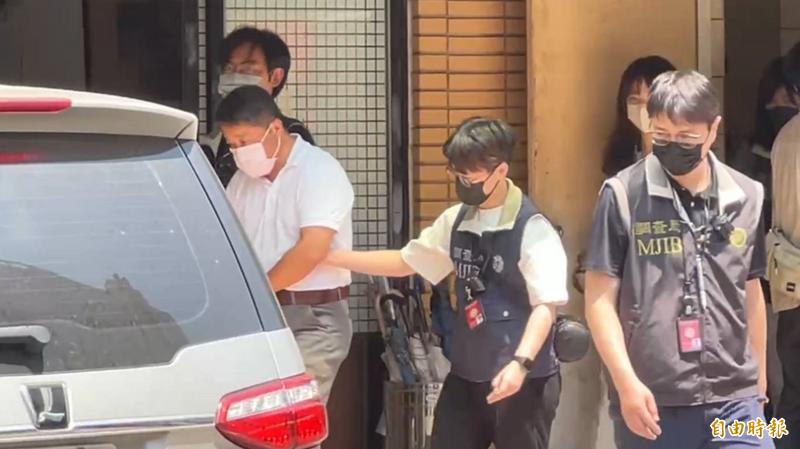
Photo: Liao Yao-tung, Taipei Times
Eight locations, including residences, offices and local branches of a political party, have been searched today, with more than ten people, including suspects and witnesses, being questioned, prosecutors said.
KMT Taichung chapter director Yen Wen-cheng (顏文正) confirmed the search took place today and said the party is cooperating with the investigation.
Wu Kang-lung (伍康龍), Yang Ta-wei (楊大緯) and Chen Chien-feng (陳建鋒), secretary-generals representing the first, second and third KMT Taichung city party committees respectively, were taken away.
Five other staffers were taken away, Taiping District (太平) director Wang Chung-hui (王忠輝), deputy director Cheng Yi-chuan (程翌全), Fengyuan District (豐原) director Yu Chueh-an (余爵安), Tanya District (潭雅) director Chiu Shih-yi (邱仕誼) and Dali District (大里) director Hung Li-hsiang (洪麗香).
Volunteers of civil groups leading recall campaigns targeting the three KMT Legislators, Yen, Liao and Huang, were also reportedly summoned for questioning.
Regarding the campaign targeting Tsai, the number of forged signatures made up more than half of the total, he said.
Tsai called on the prosecutors’ office and the CEC to clarify and investigate the issue given how unreasonable the situation is, he said.
In the petition against Ho, there were 66 signatures from deceased people, she said, adding that she has faith in the judicial process’ ability to uncover the truth.
Taichung Mayor Lu Shiow-yen (盧秀燕) did not comment on the matter when asked by media today, only saying “thank you.”
The recall conveners are inexperienced and so some flaws were expected, Yen said.
However, the signatures were collected in person, he added.
In an official statement, the KMT Taichung branch said that the judicial process should remain fact-based and impartial, calling on investigators to act fairly and avoid political persecution.
The party will continue to monitor the situation, safeguard justice and work with other like-minded people to defend the rule of law and civil rights.
DPP Taichung City Councilor Wang Li-jen (王立任) said that there should be an investigation if there are suspicions of fraud, expressing confidence that if the accused are innocent they would be cleared.
This is similar to KMT tactics in other alleged recall forgery cases in other counties, he added.

FUKUOKA SITUATION: Japanese media reported that the pathogen is expected to be identified by the summer, while the CDC downplayed the idea that it was hMPV A “mysterious cold-like illness” reported in Japan’s Fukuoka Prefecture does not seem to be a new disease, but Japanese authorities have been asked about the situation, the Centers for Disease Control (CDC) said yesterday. The Fukuoka Prefectural Medical Association on Wednesday told a news conference that a “mystery cold” that has become a hot topic on social media is “highly likely to be caused by some kind of viral infection,” Japan’s KBC News reported. “Many people are experiencing symptoms starting with a sore throat, followed by a runny nose, phlegm and a severe cough,” KBC News reported, citing association officials. Health authorities are

Nvidia Corp CEO Jensen Huang (黃仁勳) arrived in Taiwan yesterday ahead of upcoming AI and technology events, saying he plans to meet with clients and Taiwan Semiconductor Manufacturing Co Chairman C.C. Wei (魏哲家) during his visit. After landing at Taipei Songshan Airport, Huang posed for photos with fans and handed out Yakult drinks to reporters and supporters waiting at the scene, saying he has “a lot to do” during the trip. Asked about reports that Nvidia’s planned headquarters site in Taipei’s Beitou Shilin Technology Park could break ground on May 27, Huang said that if the company holds an event, he would

The Ministry of Finance this afternoon announced the winning numbers for the March-April uniform invoice lottery. The winning number for the NT$10 million (US$318,060) special prize is 19531471, and the winning number for the NT$2 million grand prize is 85941329. Three numbers were drawn for the NT$200,000 first prize: 07225810, 20231230 and 83518781. Those with receipts matching the last seven digits of any of the first-prize numbers will win the NT$40,000 second prize, while those matching the last six digits will win the NT$10,000 third prize. Those whose receipts match the last five digits of the first-prize numbers can claim the NT$4,000 fourth prize,
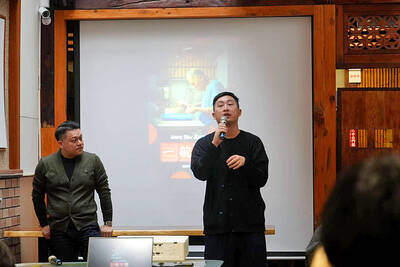
Taiwan Travelogue (臺灣漫遊錄), which earlier this week became the first Taiwanese novel to win the International Booker Prize, is to be adapted into a television series through a Taiwan-Japan coproduction, producer Chang Chen-yu (張辰漁) said yesterday. Chang, a producer at World Softest Production Film Co, wrote on Facebook that the company had been searching for projects with international appeal that retain a strong Taiwanese identity after colleagues and Japanese partners strongly recommended the novel. After reading the book, Chang said he immediately decided to pursue the screen rights. “A great story has the power to transcend time and borders, and connect countless people,”


 RSS
RSS