


The German city of Hamburg on Oct. 14 named a bridge “Kaohsiung-Brucke” after the Taiwanese city of Kaohsiung.
The footbridge, formerly known as F566, is to the east of the Speicherstadt, the world’s largest warehouse district, and connects the Dar-es-Salaam-Platz to the Brooktorpromenade near the Port of Hamburg on the Elbe River.
Timo Fischer, a Free Democratic Party member of the Hamburg-Mitte District Assembly, in May last year proposed the name change with support from members of the Social Democratic Party and the Christian Democratic Union.
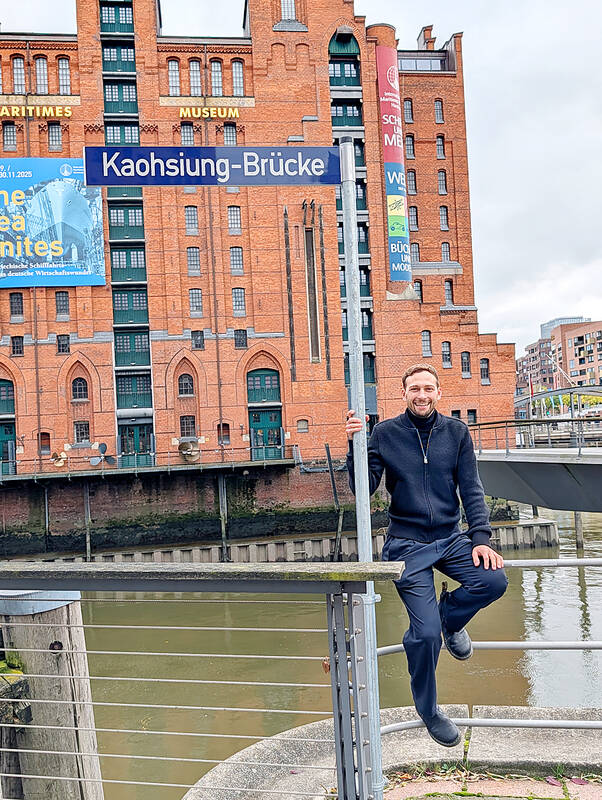
Photo courtesy of Timo Fischer via CNA
Kaohsiung and Hamburg in 1999 inked a sister city agreement, but despite more than a quarter-century of ties, most of Hamburg’s residents do not know that relationship exists, Fischer told the Central News Agency in an interview.
“It was time to let the people of Hamburg know about the relationship and to let them see it,” he said.
Hamburg is known as a city with many bridges — more than 2,500, according to city statistics, Fischer said, adding that bridges are more than a means to cross obstacles, but “symbolize a connection between two places separated by water, as well as means to unite cultures and bridge political divides.”
While the Kaohsiung-Brucke is small, it has helped shorten the distance between Taiwan and Germany, he said, adding that he hoped the name would instill in residents who cross it a sense of curiosity and prompt them to learn more about Taiwan.
An initial plan had been to rename a local street after Kaohsiung, but the review process rejected that proposal because the name was not in line with German road-naming conventions, Fischer said, adding that the program then turned its sights on the then-unnamed F566 pedestrian bridge.
“The year-long process from proposal to formal naming was fraught with challenges, including opposition from far-right parties,” he said.
Kaohsiung and Hamburg are port cities that are shaped by the economy, the ocean and culture, Fischer said.
Interaction between democratic countries should not stop at the diplomatic level — local city representatives should also take part, Fischer said, adding that connections with countries that value the democratic way of government, such as Taiwan, should be sought through more friendly actions like the bridge renaming.
Asked about his impressions of Taiwan, Fischer said that most Taiwanese he knows are friendly, curious about the world and enthusiastic about delicious gastronomy.
His deepest impressions when visiting Taiwan was that people would not only pick up their own litter, but would also pick up the litter of others, demonstrating a healthy respect for the public domain, he said.

Kenting National Park service technician Yang Jien-fon (楊政峰) won a silver award in World Grand Prix Photography Awards Spring Season for his photograph of two male rat snakes intertwined in combat. Yang’s colleagues at Kenting National Park said he is a master of nature photography who has been held back by his job in civil service. The awards accept entries in all four seasons across six categories: architectural and urban photography, black-and-white and fine art photography, commercial and fashion photography, documentary and people photography, nature and experimental photography, and mobile photography. Awards are ranked according to scores and divided into platinum, gold and

More than half of the bamboo vipers captured in Tainan in the past few years were found in the city’s Sinhua District (新化), while other districts had smaller catches or none at all. Every year, Tainan captures about 6,000 snakes which have made their way into people’s homes. Of the six major venomous snakes in Taiwan, the cobra, the many-banded krait, the brown-spotted pit viper and the bamboo viper are the most frequently captured. The high concentration of bamboo vipers captured in Sinhua District is puzzling. Tainan Agriculture Bureau Forestry and Nature Conservation Division head Chu Chien-ming (朱健明) earlier this week said that the
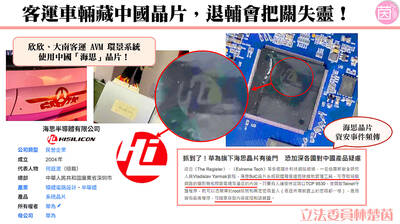
BREACH OF CONTRACT: The bus operators would seek compensation and have demanded that the manufacturer replace the chips with ones that meet regulations Two bus operators found to be using buses with China-made chips are to demand that the original manufacturers replace the systems and provide compensation for breach of contract, the Veterans Affairs Council said yesterday. Democratic Progressive Party Legislator Michelle Lin (林楚茵) yesterday said that Da Nan Bus Co and Shin-Shin Bus Co Ltd have fielded a total of 82 buses that are using Chinese chips. The bus models were made by Tron-E, while the systems provider was CYE Electronics, Lin said. Lin alleged that the buses were using chips manufactured by Huawei subsidiary HiSilicon Co, which presents a national security risk if the

The National Immigration Agency has banned two Chinese from returning to Taiwan, after they published social media content it described as disrespectful to national sovereignty. The agency imposed a two-month ban on a Chinese man surnamed Liang (梁) and a permanent ban on a woman surnamed Yang (楊), an influencer with 23 million followers, in October last year and last week respectively. Minister of the Interior Liu Shyh-fang (劉世芳) yesterday said on the sidelines of a legislative meeting that Chinese visitors to Taiwan are required to comply with the rules and regulations governing their entry permits. The government has handled the ban and


 RSS
RSS