


The Ministry of National Defense is to conduct the computer-simulated component of this year’s annual Han Kung military exercises from April 19 to April 26 — three days longer than the war game’s past iterations.
The computer part of the drill would make use of the Joint Theater Level Simulation system, the ministry said in a report submitted to the Legislative Yuan.
The simulations would test the military’s ability to conduct joint warfare operations and integrate civilian capabilities for defense, focusing on countering China’s gray-zone tactics, operational procedures at headquarters and command skills, it said.
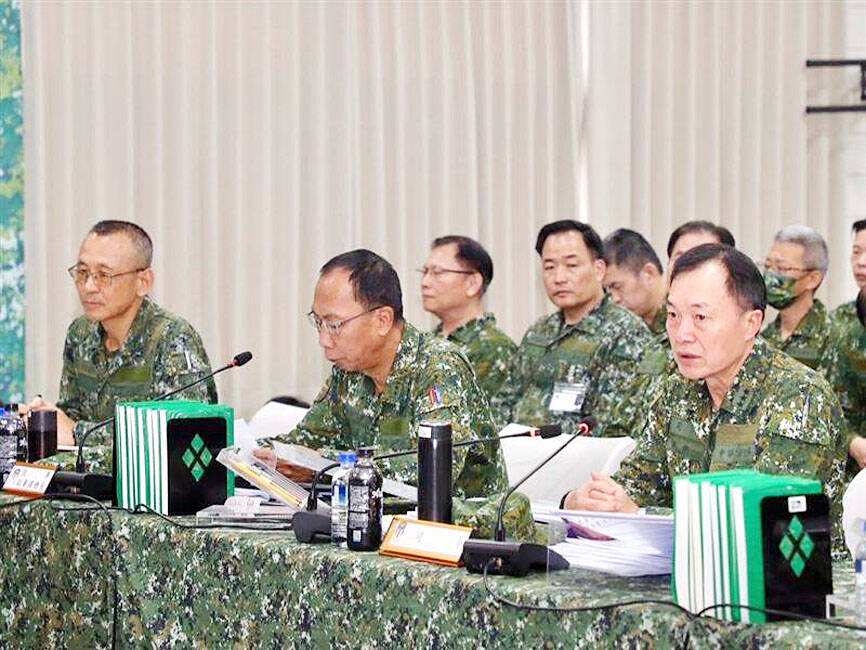
Photo courtesy of the Republic of China Army via Military News Agency
On Thursday, the military commenced a tri-service joint operations tabletop wargame, starting with the Second Combat Theater Command, whose area of responsibility covers Hualien and Taitung, the ministry-run Military News Agency said in a report.
This series of drills is likely a precursor to set the stage for the computer-assisted component of the annual exercises next month.
It is intended to enable the armed forces to anticipate potential large-scale actions by the enemy, Lieutenant General Yu Wen-cheng (俞文鎮), commander of Second Combat Theater Command, was cited as saying by the Military News Agency.
Military leaders are to participate in field tours to familiarize themselves with key terrain features and exploitable assets in their area of responsibility, form a common operational picture and devise battle plans, it quoted him as saying.
The Third, Fourth and Fifth Combat Theater Commands, assigned to defend the western part of Taiwan proper, joined the exercise later that day, it said.
Tabletop games are conducted to allow top officers to form a whole-of-battlefield view and an understanding of enemy forces, order of battle, intent, effective strength and tactics, Army Commander General Chung Shu-ming (鍾樹明) was cited as saying during a tour of the Third Combat Theater Command.
Senior officers must be able to use scientific and systematic methods of analysis to assess the threat and formulate an appropriate response that follows the principles of joint warfare, he said.

Yangmingshan National Park authorities yesterday urged visitors to respect public spaces and obey the law after a couple was caught on a camera livestream having sex at the park’s Qingtiangang (擎天崗) earlier in the day. The Shilin Police Precinct in Taipei said it has identified a suspect and his vehicle registration number, and would summon him for questioning. The case would be handled in accordance with public indecency charges, it added. The couple entered the park at about 11pm on Thursday and began fooling around by 1am yesterday, the police said, adding that the two were unaware of the park’s all-day live

Fast food chain McDonald's is to raise prices by up to NT$5 on some products at its restaurants across Taiwan, starting on Wednesday next week, the company announced today. The prices of all extra value meals and sharing boxes are to increase by NT$5, while breakfast combos and creamy corn soup would go up by NT$3, the company said in a statement. The price of the main items of those meals, if ordered individually, would remain the same. Meanwhile, the price of a medium-sized lemon iced tea and hot cappuccino would rise by NT$3, extra dipping sauces for chicken nuggets would go up

Yangmingshan National Park’s Qingtiangang (擎天崗) nature area has gone viral after a park livestream camera observed a couple in the throes of intimate congress, which was broadcast live on YouTube, drawing large late-night crowds and sparking a backlash over noise, bright lights and disruption to wildlife habitat. The area’s livestream footage appeared to show a couple engaging in sexual activity on a picnic table in the park on Friday last week, with the uncensored footage streamed publicly online. The footage quickly spread across social media, prompting a tide of visitors to travel to the site to “check in” and recreate the

Minister of Digital Affairs Lin Yi-ching (林宜敬) yesterday cited regulatory issues and national security concerns as an expert said that Taiwan is among the few Asian regions without Starlink. Lin made the remarks on Facebook after funP Innovation Group chief executive officer Nathan Chiu (邱繼弘) on Friday said Taiwan and four other countries in Asia — China, North Korea, Afghanistan and Syria — have no access to Starlink. Starlink has become available in 166 countries worldwide, including Ukraine, Malaysia, the Philippines and Vietnam, in the six years since it became commercial, he said. While China and North Korea block Starlink, Syria is not


 RSS
RSS