


The Chinese Nationalist Party (KMT) applauded former president Ma Ying-jeou’s (馬英九) planned visit to China from Monday next week to April 11, and would be glad if Ma happens to meet with “old friend” Chinese President Xi Jinping (習近平), KMT Vice Chairman Andrew Hsia (夏立言) told a meeting of the KMT’s Central Standing Committee yesterday.
The KMT said it has always supported cross-strait interactions to promote regional peace, and greatly commended Ma, who holds no official position within the party, for being willing to visit China amid fraught cross-strait tensions.
Ma’s choice to visit around International Youth Day is significant as it connotes passing the torch between generations, Hsia said.
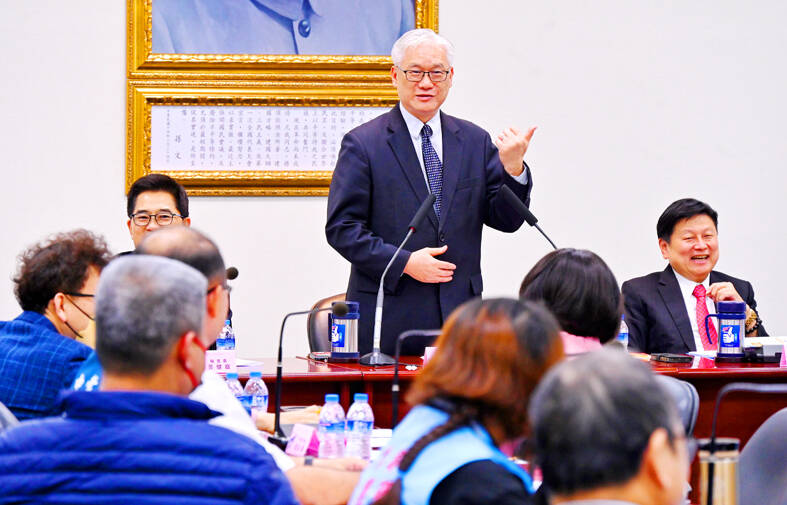
Photo: Liu Hsin-de, Taipei Times
It is hoped that Ma’s trip runs smoothly and helps stabilize cross-strait relations, Hsia said.
Asked for comment at a weekly news conference yesterday, China’s Taiwan Affairs Office (TAO) spokesman Chen Binhua (陳斌華) said that the TAO would ensure that “Mr Ma’s” visit is arranged appropriately.
It hoped that his trip would be fruitful, Chen said.
China welcomes members from all political parties and other sectors to visit China and jointly maintain regional peace on the basis that they support the “1992 consensus” and oppose Taiwanese independence, Chen said.
The “1992 consensus” — a term that former Mainland Affairs Council chairman Su Chi (蘇起) in 2006 admitted making up in 2000 — refers to a tacit understanding between the KMT and the Chinese Communist Party (CCP) that both sides of the Taiwan Strait acknowledge that there is “one China,” with each side having its own interpretation of what “China” means.
Ma enjoys stipends and other benefits as a former head of state, but has always touted the so-called “1992 consensus” and has rarely spoken up for Taiwan, Democratic Progressive Party (DPP) Legislator Wang Mei-hui (王美惠) said.
If Ma finds China to be so good, he should move there instead of making a spectacle of himself and cheapening Taiwan’s democracy and liberties, Wang said.
Premier Chen Chien-jen (陳建仁) on Tuesday urged Ma to tell Xi that “Taiwan is a sovereign independent nation.”
Chen Chien-jen’s comments advocate Taiwanese independence and run counter to the Constitution of the Republic of China, Ma Ying-jeou Foundation director Hsiao Hsu-tsen (蕭旭岑) said yesterday.
“Taiwan is not a country; it is part of the Republic of China,” he said.
Hsiao said the greatest danger facing Taiwan is that the DPP refuses to follow the Constitution, constantly saying that it is preserving the “status quo,” but secretly passes policies supporting an independent Taiwan while being unwilling to amend the Constitution to legalize its own actions.
Taiwan will continue to live in chaos as long as the DPP is unwilling to amend the Constitution and continues to issue unconstitutional comments to sway public opinion, he added.
The military has spotted two Chinese warships operating in waters near Penghu County in the Taiwan Strait and sent its own naval and air forces to monitor the vessels, the Ministry of National Defense (MND) said. Beijing sends warships and warplanes into the waters and skies around Taiwan on an almost daily basis, drawing condemnation from Taipei. While the ministry offers daily updates on the locations of Chinese military aircraft, it only rarely gives details of where Chinese warships are operating, generally only when it detects aircraft carriers, as happened last week. A Chinese destroyer and a frigate entered waters to the southwest

The eastern extension of the Taipei MRT Red Line could begin operations as early as late June, the Taipei Department of Rapid Transit Systems said yesterday. Taipei Rapid Transit Corp said it is considering offering one month of free rides on the new section to mark its opening. Construction progress on the 1.4km extension, which is to run from the current terminal Xiangshan Station to a new eastern terminal, Guangci/Fengtian Temple Station, was 90.6 percent complete by the end of last month, the department said in a report to the Taipei City Council's Transportation Committee. While construction began in October 2016 with an

NON-RED SUPPLY: Boosting the nation’s drone industry is becoming increasingly urgent as China’s UAV dominance could become an issue in a crisis, an analyst said Taiwan’s drone exports to Europe grew 41.7-fold from 2024 to last year, with demand from Ukraine’s fight against Russian aggression the most likely driver of growth, a study showed. The Institute for Democracy, Society and Emerging Technology (DSET) in a statement on Wednesday said it found that many of Taiwan’s uncrewed aerial vehicle (UAV) sales were from Poland and the Czech Republic. These countries likely transferred the drones to Ukraine to aid it in its fight against the Russian invasion that started in 2022, it said. Despite the gains, Taiwan is not the dominant drone exporter to these markets, ranking second and fourth

Japanese Prime Minister Sanae Takaichi’s comment last year on Tokyo’s potential reaction to a Taiwan-China conflict has forced Beijing to rewrite its invasion plans, a retired Japanese general said. Takaichi told the Diet on Nov. 7 last year that a Chinese naval blockade or military attack on Taiwan could constitute a “survival-threatening situation” for Japan, potentially allowing Tokyo to exercise its right to collective self-defense. Former Japan Ground Self-Defense Force general Kiyofumi Ogawa said in a recent speech that the remark has been interpreted as meaning Japan could intervene in the early stages of a Taiwan Strait conflict, undermining China’s previous assumptions


 RSS
RSS