


Despite a crushing election defeat, Abbygail Wu (吳伊婷), Taiwan’s first transgender legislative candidate, has vowed to continue fighting to eliminate the burden of undergoing gender reassignment surgery placed on those wanting to legally change their gender.
In the Jan. 13 election, Wu’s Green Party Taiwan secured 0.85 percent of the vote, totaling 117,298 ballots, making it the sixth-largest party.
The rookie candidate was not discouraged and said she would continue holding activities, workshops and lectures to raise awareness of the challenges faced by transgender people.

Photo: George Tsorng, Taipei Times
“I’m running for those who are marginalized, overlooked and discriminated against,” she said in an interview on Jan. 8. “I want them to know that they are not alone and that they have rights and are supported.”
The 37-year-old transitioned in 2012 after undergoing gender reassignment surgery in Thailand.
Wu said that if elected, she would continue working toward abolishing Taiwan’s surgery requirement for legally changing one’s gender.
To change gender identity on a national identification card, applicants need to submit a diagnosis certificate evaluated by two psychiatrists and a certificate from a qualified medical institution confirming that gender reassignment surgery has been completed.
The surgery requires either the removal of the breasts, uterus and ovaries, or of the penis and testicles.
The cost for the former is NT$380,000 (US$12,130), while the latter costs NT$1.2 million.
In addition to the financial burden, there is a need for thorough psychological preparation before undergoing such surgery, Wu said.
“Surgery involving the removal of breasts, uterus, ovaries or testicles, as well as the penis, is high risk and poses significant recovery challenges,” Wu said.
For years, human rights advocates have been campaigning for the abolition of the surgery requirement.
A debate on the matter in 2021 gained momentum following a groundbreaking court decision that permitted a transgender woman known as Xiao E (小E) to alter the gender on her national identification card without providing proof of surgery in the first instance of its kind in the nation.
Wu Wei-ting (伍維婷), a gender studies expert, said that those who oppose the change primarily argue that some people might falsely assert their gender identity and pose potential harm to others.
“What I often observe online is the concern that without undergoing surgery, some people might choose to say they are a woman to gain access to female-only spaces, for example bathrooms,” Wu Wei-ting said.
“We need to ask why gender is still classified based on reproductive organs,” she said, proposing that societies globally reassess their classifications, citing the evolving understanding of gender, specifically a 2017 National Geographic report that said there were 57 genders.
Sharing her experiences as a transgender woman, Abbygail Wu said that she has received support from some, but encountered intolerance from many others, including her estranged mother.
She said she started to realize in sixth grade that certain male characteristics, such as a deep voice, did not align with her true identity.
After transitioning, she started living as a woman, but she found it tough to land a job.
“[Potential] employers would consistently focus on gender-related issues, comment on my appearance and directly ask about my gender during interviews, which I found quite absurd,” she said, adding that unfriendly glances or remarks were also common.
Out of frustration, she sent e-mails to major media outlets detailing her struggle to find employment. Soon after, she finally landed a job.
Although these experiences date back more than a decade, she said the nature of the discrimination she and those like her face has not changed much.
Abbygail Wu said she has heard about numerous incidents of domestic violence affecting transgender people, for example a case last year involving a transgender man in his 20s who had his phone and identification documents confiscated by his parents because they disapproved of his identity.
The Taiwan Tongzhi (LGBTQ+) Hotline Association has reported that 32 percent of transgender people, to avoid unfriendly glances, prefer holding off the urge to urinate rather than using public restrooms, resulting in both mental and physical stress.

The military has spotted two Chinese warships operating in waters near Penghu County in the Taiwan Strait and sent its own naval and air forces to monitor the vessels, the Ministry of National Defense (MND) said. Beijing sends warships and warplanes into the waters and skies around Taiwan on an almost daily basis, drawing condemnation from Taipei. While the ministry offers daily updates on the locations of Chinese military aircraft, it only rarely gives details of where Chinese warships are operating, generally only when it detects aircraft carriers, as happened last week. A Chinese destroyer and a frigate entered waters to the southwest
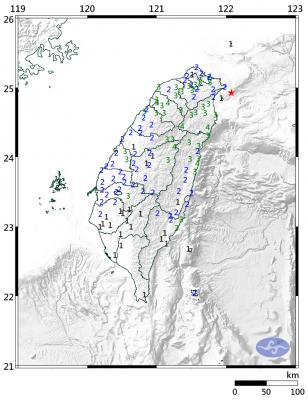
A magnitude 6.1 earthquake struck off the coast of Yilan County at 8:39pm tonight, the Central Weather Administration (CWA) said, with no immediate reports of damage or injuries. The epicenter was 38.7km east-northeast of Yilan County Hall at a focal depth of 98.3km, the CWA’s Seismological Center said. The quake’s maximum intensity, which gauges the actual physical effect of a seismic event, was a level 4 on Taiwan’s 7-tier intensity scale, the center said. That intensity level was recorded in Yilan County’s Nanao Township (南澳), Hsinchu County’s Guansi Township (關西), Nantou County’s Hehuanshan (合歡山) and Hualien County’s Yanliao (鹽寮). An intensity of 3 was

Instead of focusing solely on the threat of a full-scale military invasion, the US and its allies must prepare for a potential Chinese “quarantine” of Taiwan enforced through customs inspections, Stanford University Hoover fellow Eyck Freymann said in a Foreign Affairs article published on Wednesday. China could use various “gray zone” tactics in “reconfiguring the regional and ultimately the global economic order without a war,” said Freymann, who is also a nonresident research fellow at the US Naval War College. China might seize control of Taiwan’s links to the outside world by requiring all flights and ships entering or leaving Taiwan
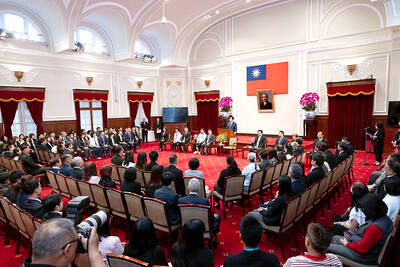
The next minimum wage hike is expected to exceed NT$30,000, President William Lai (賴清德) said yesterday during an award ceremony honoring “model workers,” including migrant workers, at the Presidential Office ahead of Workers’ Day today. Lai said he wished to thank the awardees on behalf of the nation and extend his most sincere respect for their hard work, on which Taiwan’s prosperity has been built. Lai specifically thanked 10 migrant workers selected for the award, saying that although they left their home countries to further their own goals, their efforts have benefited Taiwan as well. The nation’s industrial sector and small businesses lay


 RSS
RSS