


The military has tested one of its classified missiles, a source said yesterday, without confirming if the missile was the Hsiung Feng IIE (HF-2E) that can reach targets well inside China.
In a story published yesterday morning, the Chinese-language United Daily News said that the air force launched a domestically made HF-2E surface-to-surface cruise missile with a range of 1,000km to 1,200km during a drill earlier the same day.
The newspaper included a video on its Web site of what it said was an HF-2E, adding that it flew for more than an hour from a base in Pingtung County.
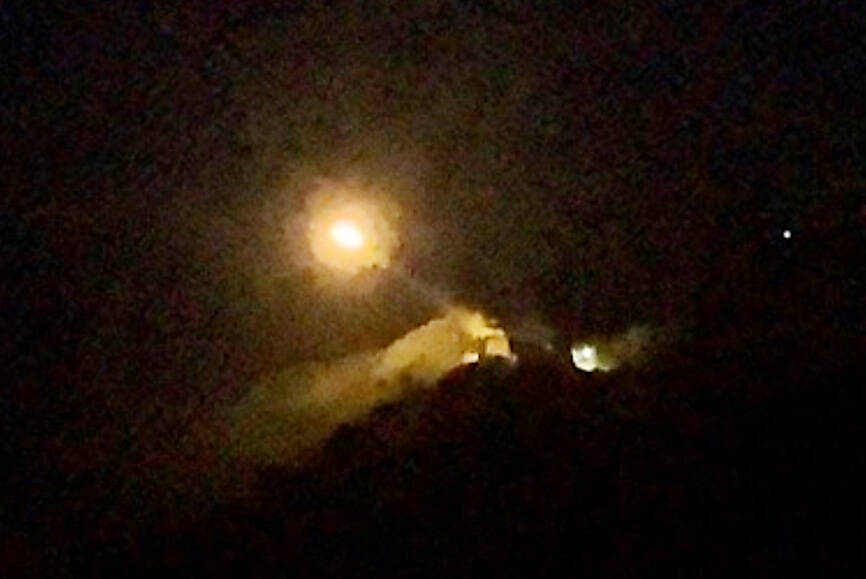
Photo: Tsai Tsung-hsien, Taipei Times
An unnamed military source confirmed that the air force fired a classified missile as part of an ongoing three-day live-fire drill off Pingtung’s Jioupeng Military Base from Tuesday to today.
The source would not confirm if the missile was an HF-2E.
They added that the air force’s main fighter jets, including Mirage-2000s, Indigenous Defense Fighters and F-16Vs, participated in the exercises and fired a number of missiles, such as French-made MICA missiles, indigenous Sky Sword II air-to-air missiles and US-made AIM-120 advanced medium range air-to-air missiles.
Naval and coast guard vessels also participated in the drills, they said.
Institute of National Defense and Security Research fellow Su Tzu-yun (蘇紫雲) said he believed that the fired missile was the HF-2E.
Su said that he based his opinion on the video clip released by the United Daily News, which showed that the missile had a two-stage ignition process, and the report that the missile flew for about an hour.
Taiwan’s military started developing the HF-2E missile in the early 2000s to be used similarly to the US Navy’s Tomahawk cruise missile.
It had never been publicly acknowledged until March last year, when the missile was mentioned in a report sent to lawmakers.
The extended-range version of the HF-2E can hit targets of up to 1,200km away, but the military has never released any photographs or videos of the missile, the report said.
The Ministry of National Defense report did not say exactly how many HF-2Es it has produced, but it said that it would be capable of making 131 HF-2s and HF-2Es annually after next year, following the expansion of its manufacturing facilities.
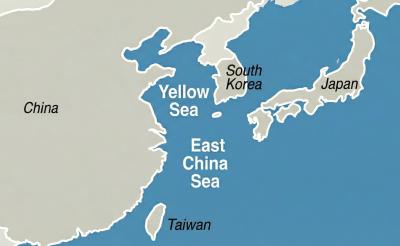
China has reserved offshore airspace in the Yellow Sea and East China Sea from March 27 to May 6, issuing alerts usually used to warn of military exercises, although no such exercises have been announced, the Wall Street Journal (WSJ) reported yesterday. Reserving such a large area for 40 days without explanation is an “unusual step,” as military exercises normally only last a few days, the paper said. These alerts, known as Notice to Air Missions (Notams), “are intended to inform pilots and aviation authorities of temporary airspace hazards or restrictions,” the article said. The airspace reserved in the alert is

NAMING SPAT: The foreign ministry called on Denmark to propose an acceptable solution to the erroneous nationality used for Taiwanese on residence permits Taiwan has revoked some privileges for Danish diplomatic staff over a Danish permit that lists “Taiwan” as “China,” Eric Huang (黃鈞耀), head of the Ministry of Foreign Affairs’ Department of European Affairs, told a news conference in Taipei yesterday. Reporters asked Huang whether the Danish government had responded to the ministry’s request that it correct the nationality on Danish residence permits of Taiwanese, which has been listed as “China” since 2024. Taiwan’s representative office in Denmark continues to communicate with the Danish government, and the ministry has revoked some privileges previously granted to Danish representatives in Taiwan and would continue to review
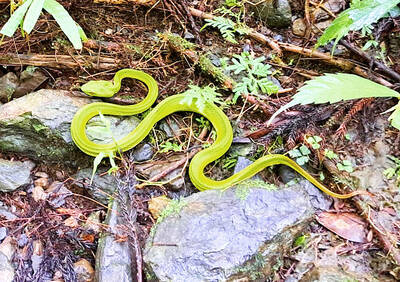
More than half of the bamboo vipers captured in Tainan in the past few years were found in the city’s Sinhua District (新化), while other districts had smaller catches or none at all. Every year, Tainan captures about 6,000 snakes which have made their way into people’s homes. Of the six major venomous snakes in Taiwan, the cobra, the many-banded krait, the brown-spotted pit viper and the bamboo viper are the most frequently captured. The high concentration of bamboo vipers captured in Sinhua District is puzzling. Tainan Agriculture Bureau Forestry and Nature Conservation Division head Chu Chien-ming (朱健明) earlier this week said that the
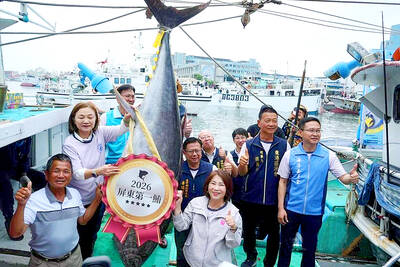
The first bluefin tuna of the season, brought to shore in Pingtung County and weighing 190kg, was yesterday auctioned for NT$10,600 (US$333.5) per kilogram, setting a record high for the local market. The auction was held at the fish market in Donggang Fishing Harbor, where the Siaoliouciou Island-registered fishing vessel Fu Yu Ching No. 2 delivered the “Pingtung First Tuna” it had caught for bidding. Bidding was intense, and the tuna was ultimately jointly purchased by a local restaurant and a local company for NT$10,600 per kilogram — NT$300 ,more than last year — for a total of NT$2.014 million. The 67-year-old skipper


 RSS
RSS