

Taiwan does not exclude the possibility of having formal diplomatic relations with countries that also have formal ties with China, regardless of Beijing’s stance, Minister of Foreign Affairs Joseph Wu (吳釗燮) said on Sunday.
There was speculation in 2012 that Honduras was attempting to have simultaneous diplomatic relations with Taiwan and China, an idea that then-minister of foreign affairs David Lin (林永樂) rejected.
Honduras severed formal ties with Taiwan on Sunday morning after establishing diplomatic relations with Beijing.
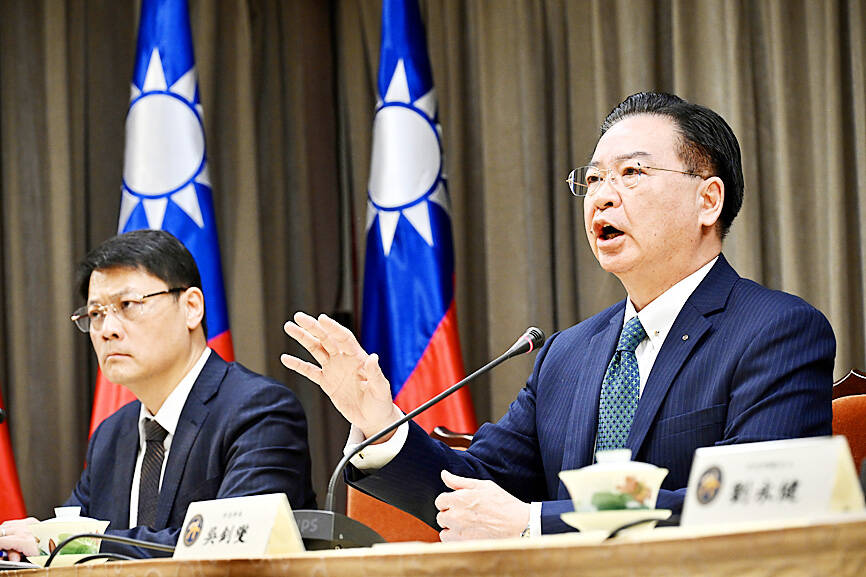
Photo: Lo Pei-de, Taipei Times
President Tsai Ing-wen’s (蔡英文) administration has taken a more practical approach to relations with like-minded countries since assuming government in 2016. Previous administrations took the position that the two sides could not “stand together” regarding their formal ties with other countries.
Taiwan is resisting China’s attempts to isolate the nation by becoming an important economic, cultural and technological partner of Latin American countries such as Argentina, Brazil, Chile and Mexico, in the fields of economics, culture and technology, Vice Minister of Foreign Affairs Alexander Yui (俞大?) told the Spanish-language online news outlet Infobae.
Taiwan would not ask other countries to sever diplomatic ties with China, but rather welcomes the idea of forming relations with both countries, Yui said.
Countries should consider whether Beijing’s Taiwan exclusion demand is reasonable, he added.
“We will not rule out any possibility,” Wu said when asked on Sunday whether the ministry encourages dual recognition.
If any country wants to bolster relations with Taiwan, whether in politics, diplomacy, culture or trade, Taipei would not consider their relations with Beijing as a factor, he said.
China’s suppression of Taiwan’s global participation “is not just toward a political party or certain people, but a problem for our country,” Wu said.
The government is working to expand Taiwan’s “breathing room” internationally, such as with a group of Czech lawmakers visiting Taiwan this week, he added.
Chinese Nationalist Party (KMT) Chairman Eric Chu (朱立倫) yesterday said Wu’s remark would result in more diplomatic losses, as accepting dual recognition “creates ambiguity.”
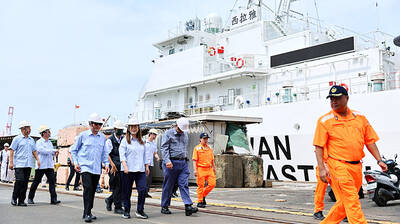
Ocean Affairs Council (OAC) Minister Kuan Bi-ling (管碧玲) on Wednesday said decommissioned coast guard vessels were given to the Philippines to enhance regional rescue capacity and would not affect Taiwanese fishers’ rights and benefits. Kuan made the remarks after confirmation on Tuesday that a 500-tonne Coast Guard Administration (CGA) patrol and rescue vessel would be given to the Philippine Coast Guard. The donation ceremony was reportedly done in Manila, but whether the vessel — previously numbered “CG123” and named Kinmen (金門) — has been handed over has yet to be confirmed. China’s Taiwan Affairs Office (TAO) on Wednesday criticized the donation for “taking
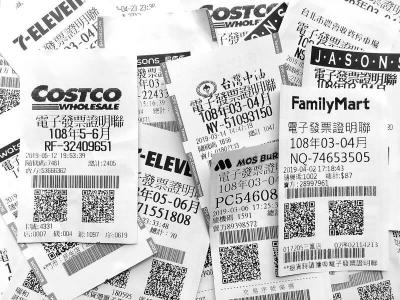
The Ministry of Finance today announced the winning numbers for the July-August uniform invoice lottery. The winning number for the NT$10 million (US$314,663) special prize is 89996565, while the winning number for the NT$2 million grand prize is 91098182. Three numbers were drawn for the NT$200,000 first prize: 54348835, 44991397 and 06595111. Those with receipts matching the last seven digits of any of the first-prize numbers can claim the NT$40,000 second prize, while those matching the last six digits qualify for the NT$10,000 third prize. Those whose receipts match the last five digits of the first-prize numbers are eligible for the NT$4,000 fourth prize,
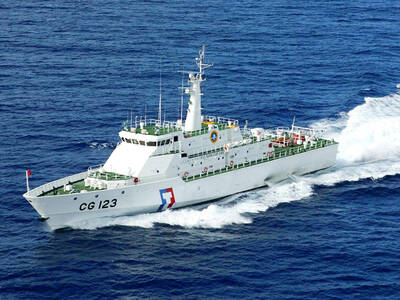
A decommissioned 500-tonne Kinmen-class patrol vessel recently donated by Taiwan’s Coast Guard Administration (CGA) has been delivered to the Philippine Coast Guard (PCG), a source said yesterday. The source said the vessel transferred to the PCG at a ceremony organized by the Philippine Non-government WPS Foundation on Monday was donated by the CGA. The CGA confirmed the donation on Wednesday last week following a United Daily News (UDN) report of a Philippine law enforcement vessel registered as "BLINGNO.1" setting sail for sea trials from Kaohsiung Port that day, citing tracking data from

The National Police Agency’s Third Special Police Corps yesterday said that from May to July, it intercepted five smuggling operations from China, seizing more than 70,000 counterfeit Beyblades with an estimated infringement value of NT$34.45 million (US$1.08 million). It added that any bootleg unit that reached the local market could present hidden health hazards to players. Beyblades, a line of spinning toy tops used in competitive gaming and developed in Japan by toy company Takara Tomy, have become popular in Taiwan, making them a target for fraudsters. The Third Special Police Corps, dedicated to safeguarding maritime borders and trade lines,


 RSS
RSS