


People with links to victims of the White Terror era yesterday called on President Tsai Ing-wen (蔡英文) to reflect more on a Taiwanese perspective of history and not cater to minority views that glorify former president Chiang Ching-kuo (蔣經國).
Taiwan Association of University Professors chairman Hsu Wen-tang (許文堂) and others told an academic conference titled “Transitional Justice and Assessing Historic Roles of Chiang Ching-kuo” in Taipei that Tsai should examine history more closely.
At an event on Jan. 22 to open a memorial park for Chiang, Tsai called for solidarity and mutual understanding, saying that the former leader’s “staunch defense of Taiwan is a stance that unites a large part of Taiwanese society, especially as Beijing applies ever greater pressure against the country.”
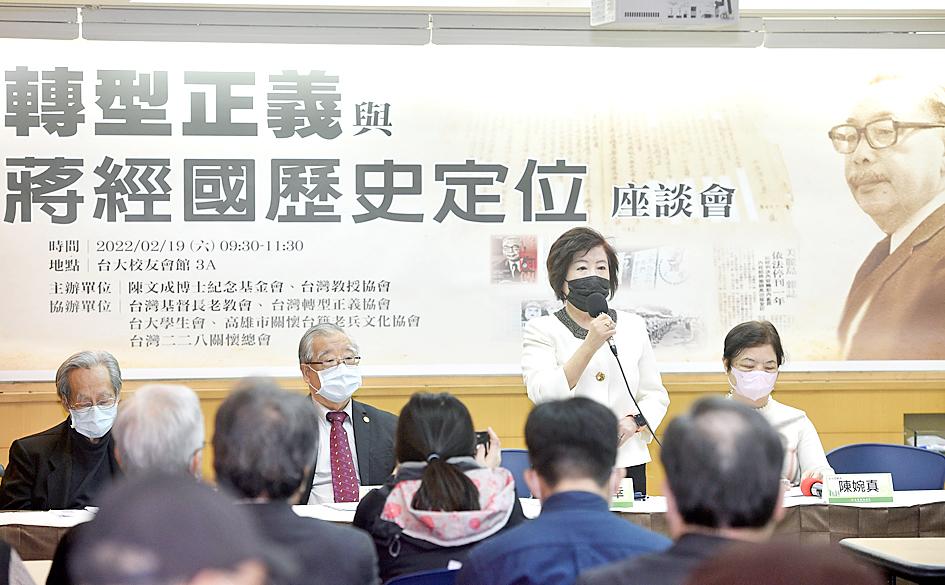
Photo: George Tsorng, Taipei Times
Foundation chairwoman Yang Huang Mei-hsing (楊黃美幸) told the conference, hosted by the Chen Wen-chen Memorial Foundation, that “Taiwan came under the Chinese Nationalist Party’s (KMT) state rule, during which Chiang Kai-shek (蔣介石) was a brutal dictator, while Chiang Ching-kuo had other roles.”
“The most prominent of Chiang Ching-kuo’s roles was heading the secret police and state intelligence agencies,” Yang Huang said.
During the White Terror era, many people were executed, most without a trial, she said, adding that this led to untold pain and suffering, broken homes and poverty for the families of those who were killed.
“Chiang Ching-kuo ran the anti-communism policies,” which served the interests of the KMT and the Chiang family, but “Taiwanese became embroiled in the Chinese Civil War, which extended White Terror oppression and the atrocities in Taiwan,” she said.
Taiwan 228 Care Association director Wang Wen-hung (王文宏) said that Chiang Ching-kuo had no concept of democracy or human rights, which his diary and other written records show.
“Chiang Ching-kuo, along with his father, bear most of the responsibility for the brutal suppression and the 228 Incident,” Wang said.
Tsai Kun-lin (蔡焜霖), a former political prisoner who is in his 90s, was incarcerated for 10 years in the 1950s on Green Island (綠島).
“However, White Terror against me and other political prisoners did not end when we were released,” he told the conference.
“People feared to be associated with you, and we were treated with disdain and had difficulty attending school, finding jobs and undertaking other social activities,” he said.

Yangmingshan National Park authorities yesterday urged visitors to respect public spaces and obey the law after a couple was caught on a camera livestream having sex at the park’s Qingtiangang (擎天崗) earlier in the day. The Shilin Police Precinct in Taipei said it has identified a suspect and his vehicle registration number, and would summon him for questioning. The case would be handled in accordance with public indecency charges, it added. The couple entered the park at about 11pm on Thursday and began fooling around by 1am yesterday, the police said, adding that the two were unaware of the park’s all-day live

A former soldier and an active-duty army officer were yesterday indicted for allegedly selling classified military training materials to a Chinese intelligence operative for a total of NT$79,440. The Taipei District Prosecutors’ Office indicted Chen Tai-yin (陳泰尹) and Lee Chun-ta (李俊達) for contravening the National Security Act (國家安全法) and the Anti-Corruption Act (貪污治罪條例). Chen left the military in September 2013 after serving alongside then-staff sergeant Lee, now an army lieutenant, at the 21st Artillery Command of the army’s Sixth Corps from 2011 to 2013, according to the indictment. Chen met a Chinese intelligence operative identified as “Wang” (王) through a friend in November

Minister of Digital Affairs Lin Yi-ching (林宜敬) yesterday cited regulatory issues and national security concerns as an expert said that Taiwan is among the few Asian regions without Starlink. Lin made the remarks on Facebook after funP Innovation Group chief executive officer Nathan Chiu (邱繼弘) on Friday said Taiwan and four other countries in Asia — China, North Korea, Afghanistan and Syria — have no access to Starlink. Starlink has become available in 166 countries worldwide, including Ukraine, Malaysia, the Philippines and Vietnam, in the six years since it became commercial, he said. While China and North Korea block Starlink, Syria is not
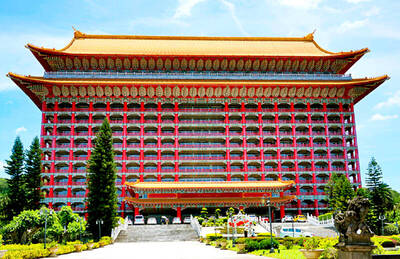
The Grand Hotel Taipei has rejected media reports claiming that the hotel had prevented CBS from broadcasting coverage of the Beijing summit between U.S. President Donald Trump and Chinese President Xi Jinping (習近平) on its premises. Media reports alleging that the hotel owner, dissatisfied with CBS’s coverage, prohibited the network from broadcasting political content on the hotel premises, are not true, the hotel said in a statement issued last night. The reports were “inconsistent with how the hotel actually handled the matter,” it said. The hotel said it received a refund request from a


 RSS
RSS