


Poland sees considerable potential to strengthen cooperation with Taiwan, especially in the fields of trade and technology, Poland’s top envoy to Taiwan said.
“Taiwan is an attractive trade partner for Poland and, I believe, for other countries in central and eastern Europe,” Bartosz Rys, acting head of the Polish Office in Taipei, said in an interview with the Central News Agency.
Poland could be a great fit for Taiwanese companies looking to relocate their manufacturing or business operations to Europe due to its strategic location, good infrastructure, large domestic market, strong consumption and highly skilled workers, Rys said.
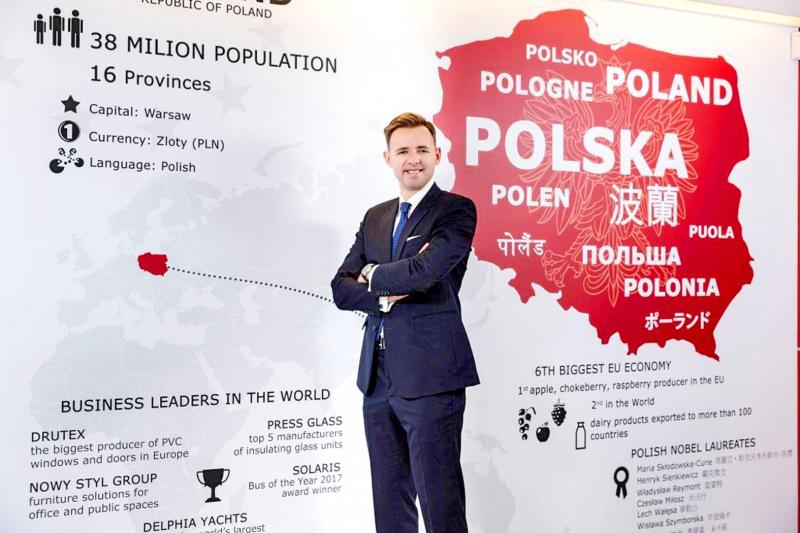
Photo courtesy of the Polish Office in Taipei via CNA
The potential for cooperation between Poland and Taiwan on electric vehicles (EV) could be particularly fruitful, he said.
“Poland is the biggest supplier of lithium-ion car batteries or their components in Europe. Overall, the prospects for cooperation between Polish and Taiwanese companies in the EV industry look very promising,” he said.
Rys also suggested that Taiwan could participate in the Three Seas Initiative and the Three Seas Initiative Investment Fund to strengthen its cooperation with nations bordering the Adriatic, Baltic and Black seas, in the development of infrastructure in the energy, transport and digital economy sectors.
The initiative is a forum of 12 EU states — Poland, Austria, Bulgaria, Croatia, the Czech Republic, Estonia, Hungary, Latvia, Lithuania, Romania, Slovakia and Slovenia.
The initiative welcomes nations and enterprises that share the same basic values and principles to participate in specific projects, Rys said.
The acting representative also sees potential for Polish products in the Taiwanese market, ranging from beverages to chocolates and cosmetics to ceramics.
“Taiwanese consumers have shown great interest in Polish products and we are also receiving more queries from Polish companies on doing business in Taiwan,” he said. “I hope this growing mutual interest will result in new trade opportunities and ultimately more Polish products being available in Taiwan.”
In the areas of education and people-to-people exchanges, Rys said that more than 1,000 Taiwanese students are enrolled at Polish universities.
In addition, as many as 1,000 Taiwanese doctors who graduated from Polish medical universities have been on the front line fighting the COVID-19 outbreak in Taiwan, he said.
Poles are also now more aware of Taiwan’s rich culture and beautiful landscapes than they were several years ago, when most primarily saw Taiwan as a manufacturer of computers and consumer electronics, he added.
Rys also announced that Poland would be the Guest of Honor at the Taipei International Book Exhibition in 2023.
“This will be a great opportunity to delve into Polish culture and literature, and hopefully meet Polish writers in person,” Rys said. “We also expect a high-level delegation from Poland at the opening ceremony.”
Rys said Poland’s donation of COVID-19 vaccine shots to Taiwan “reflects our solidarity and desire to help those in need.”
A shipment of 400,000 doses of the AstraZeneca vaccine donated by Poland arrived in Taiwan on Sept. 5, making the European nation Taiwan’s third-largest vaccine donor after Japan and the US.
“I personally hope our donation will help Taiwan speed up the vaccination rollout” and ensure more people are protected against COVID-19, he said.

Yangmingshan National Park authorities yesterday urged visitors to respect public spaces and obey the law after a couple was caught on a camera livestream having sex at the park’s Qingtiangang (擎天崗) earlier in the day. The Shilin Police Precinct in Taipei said it has identified a suspect and his vehicle registration number, and would summon him for questioning. The case would be handled in accordance with public indecency charges, it added. The couple entered the park at about 11pm on Thursday and began fooling around by 1am yesterday, the police said, adding that the two were unaware of the park’s all-day live

Fast food chain McDonald's is to raise prices by up to NT$5 on some products at its restaurants across Taiwan, starting on Wednesday next week, the company announced today. The prices of all extra value meals and sharing boxes are to increase by NT$5, while breakfast combos and creamy corn soup would go up by NT$3, the company said in a statement. The price of the main items of those meals, if ordered individually, would remain the same. Meanwhile, the price of a medium-sized lemon iced tea and hot cappuccino would rise by NT$3, extra dipping sauces for chicken nuggets would go up

Yangmingshan National Park’s Qingtiangang (擎天崗) nature area has gone viral after a park livestream camera observed a couple in the throes of intimate congress, which was broadcast live on YouTube, drawing large late-night crowds and sparking a backlash over noise, bright lights and disruption to wildlife habitat. The area’s livestream footage appeared to show a couple engaging in sexual activity on a picnic table in the park on Friday last week, with the uncensored footage streamed publicly online. The footage quickly spread across social media, prompting a tide of visitors to travel to the site to “check in” and recreate the

Minister of Digital Affairs Lin Yi-ching (林宜敬) yesterday cited regulatory issues and national security concerns as an expert said that Taiwan is among the few Asian regions without Starlink. Lin made the remarks on Facebook after funP Innovation Group chief executive officer Nathan Chiu (邱繼弘) on Friday said Taiwan and four other countries in Asia — China, North Korea, Afghanistan and Syria — have no access to Starlink. Starlink has become available in 166 countries worldwide, including Ukraine, Malaysia, the Philippines and Vietnam, in the six years since it became commercial, he said. While China and North Korea block Starlink, Syria is not


 RSS
RSS