


Pipi already dines well. The plump, black-and-white street cat lives near a night market in a Taipei neighborhood where volunteers have fed and taken care of strays for years.
However, Pipi and his fellow street cats have received an upgrade of their dining situation with the “Midnight Cafeteria” project.
Launched in September last year, the “cafeteria” is actually 45 small wooden houses painted by Taiwanese artists and scattered across Taipei. The idea is to give the cats a place to rest while making the process of feeding them less messy.

Photo: Chiang Ying-ying, AP
It began in math teacher Hung Pei-ling’s neighborhood, where about 20 neighbors are helping stray cats in addition to working their full-time jobs.
“We want to push forward this philosophy that you don’t have to be part of a very top-level association or something that takes up all of your time,” she said. “You can just be one person doing something a little bit at a time, a little bit, and taken all together, you can achieve a lot.”
Hung began volunteering after a good friend rescued and raised a stray cat. For five years, she has worked with other cat lovers in the neighborhood who buy the cats food, help clean the houses and coordinate with residents who might have complaints.
Hung also helps capture injured cats and those that need spaying, taking them to receive veterinary attention and returning them to their haunts.
The wooden houses in Hung’s neighborhood were hand-painted by local artist Stefano Misesti and feature smiling felines as well as popular street food such as stinky tofu.
In addition to food bowls, one houses basic medicine for the cats. Neighbors have brought small cushions as well as decorated cardboard boxes to add to the houses.
Started by Chen Chen-yi (陳宸億), a researcher at the Taiwan Animal Equality Association, the cat houses help ensure stray cats are fed well and local residents do not have to deal with a mess. They also raise awareness about the spaying program and the condition of strays.
“In Taiwan, there are a lot of people who feed strays, but often they leave a mess, and then the public becomes annoyed by it and they become annoyed with strays as well,” he said.
The cat houses were a multi-team effort.
Chen applied for a grant from the Taipei City Government to fund the project, and connected with a local ward leader as well as volunteers to carry it out.
On a recent Sunday, Pipi and two of his friends were enjoying attention from Hung and another volunteer who came to feed them. After eating at the cafeteria, they settled in for a lazy morning nap.

EXCUSES: Beijing is using government and research vessels as a pretext to harass the nation and enter its EEZ, and engage in ‘hegemonic expansion,’ the coast guard said The Coast Guard Administration yesterday said it drove away Chinese oceanographic research vessel Xiang Yang Hong 22 (向陽紅33) from restricted waters after warning it that it was in Taiwan’s exclusive economic zone (EEZ). The Chinese vessel entered restricted waters off the coast of Yilan County’s Suao (蘇澳) at 11:35pm on Thursday, the coast guard said, adding that it dispatched the Lanyu patrol vessel and the boat PP-10077 to shadow the Chinese ship and issue radio warnings ordering it to leave. China has no sovereignty over waters off Taiwan’s east coast, Lanyu’s crew told Xiang Yang Hong 22 over the radio, and demanded

BAIT AND SWITCH: Allowing KMT-run counties to sell to China while the threat of abrupt cancelations hangs overhead is another form of coercion, officials said Beijing is using agricultural purchase offers announced during the Straits Forum to deepen Taiwan’s dependence on the Chinese market, a Taiwanese official said yesterday as they criticized the Taitung County commissioner’s participation in the initiative. During the Straits Forum held in Xiamen on Saturday, Chinese officials announced a sales and purchase agreement for agricultural products from some counties led by the Chinese Nationalist Party (KMT). Taitung County Commissioner Yao Ching-ling (饒慶鈴), who was barred from attending the event in person by the Mainland Affairs Council, participated via video. Under the agreement, China would purchase atemoyas, pomeloes, tea and grouper harvested in Taitung,

Four Taiwanese universities have been ranked among the world's top 200 institutions in the Quacquarelli Symonds (QS) World University Rankings for next year, the highest Taiwan has ever placed in the category, with National Taiwan University (NTU) achieving its best performance at 54th globally and 17th in Asia. The four Taiwanese institutions in the global top 200 are NTU (54th), National Tsing Hua University (142nd), National Yang Ming Chiao Tung University (177th) and National Cheng Kung University (191st), the rankings showed. All four universities achieved their highest-ever global rankings this year, QS data showed. National Cheng Kung University entered the top 200 for
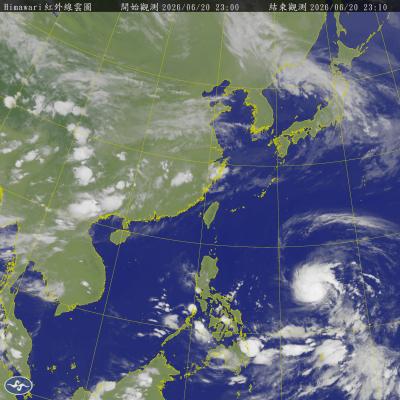
Tropical Storm Mekkhala is forecast to strengthen into a typhoon tomorrow and could come close enough to Taiwan later in the week to prompt a sea warning, the Central Weather Administration (CWA) said yesterday. As of 2 pm, the storm was located 1,870 kilometers southeast of Taiwan's southern tip and moving west- northwest at 23 km per hour. CWA forecaster Cheng Chieh-jen (鄭傑仁) said Mekkhala is expected to continue moving west-northwest through Tuesday under the influence of the Pacific high- pressure system before gradually turning north toward waters east of Taiwan or south of the Ryukyu Islands. The timing and angle of the


 RSS
RSS