


An easing of the nation’s COVID-19 outbreak might persuade more people to take short-distance road trips during the Dragon Boat Festival holiday next month, creating freeway congestion, the National Freeway Bureau said yesterday.
The festival is on the fifth day of the fifth month on the lunar calendar.
“It generally falls between the end of May and mid-June, but because this year the fourth month of the lunar calendar is a leap month, the festival is later than usual.
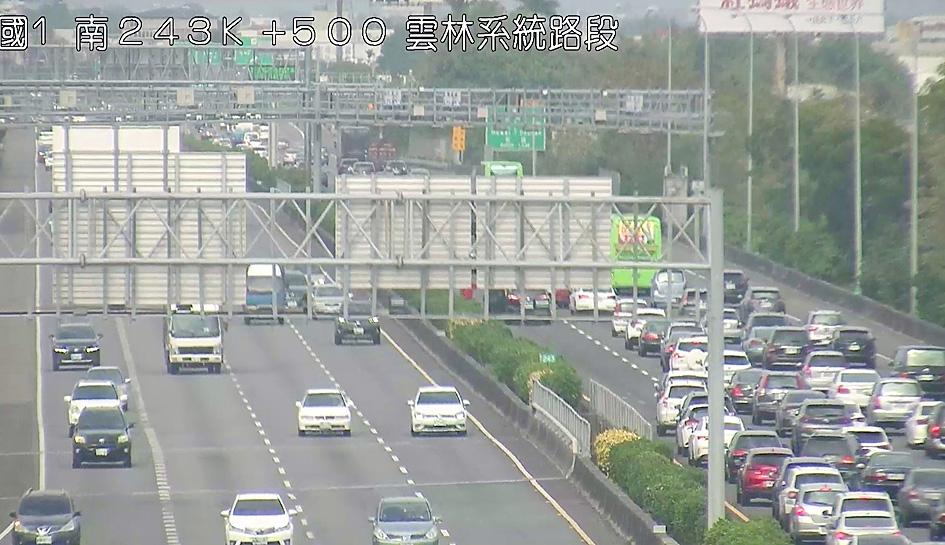
Photo courtesy of the Freeway Bureau
The holiday weekend is to run from June 25 to 28.
“Because the festival this year is a four-day holiday and the COVID-19 outbreak has greatly eased, more people might be willing to travel home for the holiday or go on tours with family members,” bureau Deputy Director-General Wu Mu-fu (吳木富) said. “The traffic volume on all freeways during the holiday could reach 1 to 1.2 million vehicle kilometers traveled.”
However, as the Advanced Subjects Test for high-school students was postponed until July 3 to July 5 due to the COVID-19 outbreak, some families might avoid traveling over the holiday, Wu said.
Most freeway traffic would come from short-distance travel and the greatest congestion would likely occur on the first day of the holiday, bureau section chief Tsai Ming-che (蔡明哲) said, adding that the traffic on the first day would be similar to the first day of the Lunar New Year holiday.
All those driving on freeways during the four-day holiday would be charged a toll rate of NT$0.9 per kilometer, while long-distance drivers choosing Formosa Freeway (Freeway No. 3) over National Sun Yat-sen Freeway (Freeway No. 1) would receive an additional 20 percent discount on tolls.
Toll-free hours would be from 12am to 5am between June 25 and June 27, but on the last day of the holiday, they would be from 12am to 10am.
On June 25, the high-occupancy vehicle (HOV) policy would be in place from 7am to 12pm at southbound entrances to interchanges between Neihu (內湖) and Toufen (頭份) on Freeway No. 1, and between Mucha (木柵) and Siangshan (香山) on Freeway No. 3.
From June 25 to June 26, the HOV hours would be in place at southbound entrances to the Nangang (南港), Shiding (石碇) and Pinglin (坪林) interchanges on the Chiang Wei-shui Freeway (Freeway No. 5).
On June 27 and 28, the HOV policy would be in place from 2pm to 9pm at northbound entrances to Suao (蘇澳), Luodong (羅東), Yilan and Toucheng (頭城) interchanges on Freeway No. 5, the bureau said, adding that the HOV hours on Freeway No. 5 during the last two days of the holiday might be adjusted, depending on the traffic.
To limit freeway traffic, southbound entrances to the Pingcheng (平鎮) and Puyen (埔鹽) interchanges on Freeway No. 1 are to be closed on June 25 and 26.
Northbound entrances to the Huwei (虎尾) and Puyen interchanges on Freeway No. 1, as well as the northbound entrance to the Sibin (西濱) Interchange on Freeway No. 3 are to be closed on June 27 and 28.
As part of disease prevention efforts during the holiday, “freeway drivers will be required to wear masks and have their temperatures measured when entering food courts at rest areas. In compliance with the Central Epidemic Command Center’s (CECC) social distancing guidelines for indoor activities, diners will be separated by plastic spacing barriers or will be asked to leave an empty seat between them,” Tsai said, adding that the number of diners would also be capped.
Measures are to be adjusted to match any new instructions from the CECC and the Ministry of Transportation and Communications, Wu said.

UNREASONABLE SURVEILLANCE: A camera targeted on an road by a neighbor captured a man’s habitual unsignaled turn into home, netting him dozens of tickets The Taichung High Administrative Court has canceled all 45 tickets given to a man for failing to use a turn signal while driving, as it considered long-term surveillance of his privacy more problematic than the traffic violations. The man, surnamed Tseng (曾), lives in Changhua County and was reported 45 times within a month for failing to signal while driving when he turned into the alley where his residence is. The reports were filed by his neighbor, who set up security cameras that constantly monitored not only the alley but also the door and yard of Tseng’s house. The surveillance occurred from July

Actor Darren Wang (王大陸) was sentenced to six months in prison, commutable to a fine, by the New Taipei District Court today for contravening the Personal Data Protection Act (個人資料保護法) in a case linked to an alleged draft-dodging scheme. Wang allegedly paid NT$3.6 million (US$114,380) to an illegal group to help him evade mandatory military service through falsified medical documents, prosecutors said. He transferred the funds to Chen Chih-ming (陳志明), the alleged mastermind of a draft-evasion ring, although he lost contact with him as he was already in detention on fraud charges, they said. Chen is accused of helping a

SECURITY: Starlink owner Elon Musk has taken pro-Beijing positions, and allowing pro-China companies to control Taiwan’s critical infrastructure is risky, a legislator said Starlink was reluctant to offer services in Taiwan because of the nation’s extremely high penetration rates in 4G and 5G services, the Ministry of Digital Affairs said yesterday. The ministry made the comments at a meeting of the legislature’s Transportation Committee, which reviewed amendments to Article 36 of the Telecommunications Management Act (電信管理法). Article 36 bans foreigners from holding more than 49 percent of shares in public telecommunications networks, while shares foreigners directly and indirectly hold are also capped at 60 percent of the total, unless specified otherwise by law. The amendments, sponsored by Chinese Nationalist Party (KMT) Legislator Ko
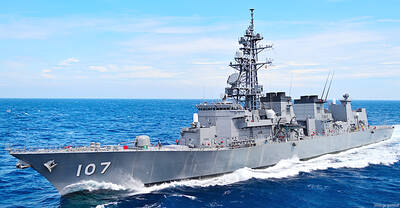
A Japan Self-Defense Forces vessel entered the Taiwan Strait yesterday, Japanese media reported. After passing through the Taiwan Strait, the Ikazuchi was to proceed to the South China Sea to take part in a joint military exercise with the US and the Philippines, the reports said. Japan Self-Defense Force vessels were first reported to have passed through the strait in September, 2024, with two further transits taking place in February and June last year, the Asahi Shimbun reported. Yesterday’s transit also marked the first time since Japanese Prime Minister Sanae Takaichi took office that a Japanese warship has been sent through the Taiwan


 RSS
RSS