

Bereaved parents yesterday held a posthumous ghost wedding in Greater Taichung’s Dongshih District (東勢) for their beloved daughter and son, a young couple killed last week by a mudslide caused by torrential rain.
With a Chinese love song playing in the background, the parents of Su Cheng-hung (蘇正紘) and Teng Hsin-ning (鄧心寧) bore witness to the couple’s love in a wedding ceremony held at a mortuary designed to bring their spirits together for eternity.
Su, a conscientious forest ranger at the Dongshih Forest District Office, was at work at Chiayang forestry station on Monday last week, where Teng was visiting him, when a landslide caused by heavy rains in the mountains of Lishan (梨山) smashed into the station and buried them.
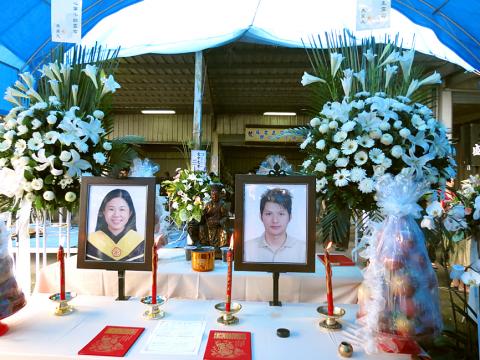
Photo: Hsieh Feng-chiu, Taipei Times
Despite being rushed to a hospital, the couple were soon pronounced dead.
Prior to the marriage ceremony, Su’s family asked the forest district office to issue an “order of task release,” which was burned and passed on to Su in the afterlife, telling him to “stand down” and go home.
The posthumous wedding ceremony, presided over by Forestry Bureau director-general Lee Tao-sheng (李桃生) and officiated by the fathers of the deceased was almost identical to a normal wedding.
A range of traditional items were prepared, including gift money, 16 boxes of wedding cakes, golden necklaces and new clothes.
The main difference with a ghost wedding was that a paper mache mansion is burned as a gift to the couple as was a composite -wedding -photograph made by Su’s colleagues.
Holding back their tears, Su’s parents, Su Ming-hsien (蘇明賢) and Ho Yu-tzu (何佑慈), said they had long regarded Teng as their daughter-in-law.
“They were both born on 16th day of the fourth month of the lunar calendar, with [Su] Cheng-hung being three years older than [Teng.] We hope that they follow hand-in-hand in the footsteps of Buddha and live happily ever after in heaven,” they said.
Su Cheng-hung’s high school and college classmate, Hsieh Kuang-pu (謝光普), also addressed the ceremony and shared with the attendees how the couple met and fell in love.
“They met at school because of their passion for sports. They started a long-distance relationship after [Su] Cheng-hung graduated from college and started his military service. Only after [Teng] Hsin-ning was admitted to a postgraduate program at National Chung Hsing University did they get to spend more time together,’’ Hsieh said.
“I hope they have a wonderful life in the next world,” he said.
Translated by Stacy Hsu, Staff Writer
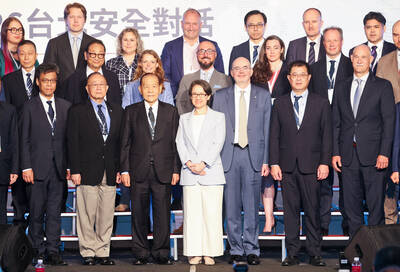
Taiwan’s growing defense preparations might be sending a stronger signal to the US than to Beijing, highlighting the need for Taipei to tailor its deterrence efforts to different audiences, a US security academic said yesterday. Stanford University Freeman Spogli Institute for International Studies fellow Oriana Skylar Mastro made the comment during a Taipei Security Dialogue panel examining lessons Taiwan could draw from the wars in Ukraine and the Middle East. Mastro said she was impressed by Taiwan’s increased defense spending, emphasis on asymmetric capabilities and efforts to prepare society for conflict, but questioned whom those initiatives were influencing. She said when she asked
A total of 400 foreign “high- level” professionals have been naturalized as Republic of China (Taiwan) citizens over the past decade as the government has eased nationality rules to attract talent from a wider range of fields, the Ministry of the Interior said yesterday. The 400th high-level professional, who works in the electronics industry, was approved for ROC citizenship on Aug. 26, the MOI said. The MOI quoted the newly naturalized citizen as saying that Taiwan is a leader in fields such as semiconductors, electronics manufacturing, artificial intelligence development and energy technology. He also said
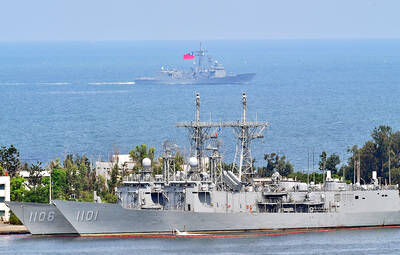
SIZE MATTERS: Large ships are politically attractive as visible symbols of national defense, but small surface combatants are more likely to survive an initial strike Taiwan needs to restructure its naval fleet from focusing on large warships, which are “sitting ducks” for China’s advanced tracking technology, to smaller, stealthy corvettes that are harder to detect but retain sufficient firepower to deter a Chinese invasion, a Taiwanese academic and a former US military commander said in an article published on Friday in the journal Foreign Affairs. Taiwan does not need a fleet capable of competing with the Chinese navy for traditional control of the Taiwan Strait, but rather “sea denial” capabilities that would prevent China from freely using the waterway, Taiwanese aerospace and security expert Holmes Liao
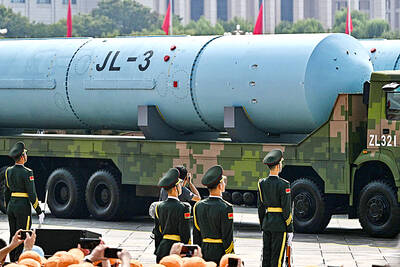
SUB-LAUNCHED SUBOPTIMAL: The JL-3, an upgraded version of the missile test-fired earlier in the summer, would have the range to strike at much of the country Refits to Chinese nuclear submarines to carry JL-3 intercontinental ballistic missiles would put much of the US in striking distance, Taiwanese defense analysts said in a report commissioned by the Mainland Affairs Council. Researchers from National Defense University’s Graduate Institute of China Military Affairs Studies said that the Chinese People’s Liberation Army Navy (PLAN) in July test-fired a missile with a training warhead. Chinese state media reported without elaborating that a PLAN nuclear-powered ballistic missile submarine (SSBN) launched a missile with a training warhead, which accurately hit the designated target area in the Pacific, the report said. The launch was a rare display


 RSS
RSS