


Watching the excavator reduce her work place to rubble, 65-year-old Cheng Pao-yueh (
Cheng has sold rice porridge at the Chien-Cheng Circle (
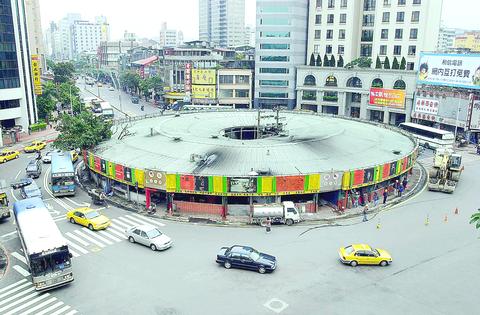
PHOTO: CHIANG YING-YING, TAIPEI TIMES
"I don't know what I'm going to do now. My heart just aches to see it torn down like that," she said.
The NT$600 million, 16-month project is part of Taipei Mayor Ma Ying-jeou's (馬英九) ongoing efforts to revitalize the city's older districts.
Supervising the demolition project yesterday, William Chen (
"As soon as the demolition and clean-up project is complete, which may take about a week, we will plant trees and lay out lawns. The reconstruction project itself, however, may not begin until May," he said.
The Chien-Cheng Circle, located at the intersection of Chungching North Road and Nanking West Road, has been one of the city's better-known landmarks since the Japanese colonial era. At its peak during the 1960s and 1970s, there were about 100 booths selling such popular Taiwanese snacks as glutinous rice dumplings, oyster omelettes (蚵仔煎), and meatballs.
Two devastating fires in 1993 and 1999, however, prompted the city government to ponder the future of the time-honored food market.
Cheng said the 1999 fire, which started in the kitchen of her booth, had cost her a lot, both financially and emotionally.
"I had to spend more than NT$3 million on renovations after putting up with being harassed by other vendors whose booths were damaged in the fire. The city government should at least have found me a suitable place to continue my business before it tore this place down," she said.
Chen Chen-sheng (
"It's because the city has set aside 25 booths for those who are interested in moving back. Also, we could continue our business at the nearby Yung Le Fabric Market (永樂市場) in the meantime. But, to be honest, it's a bad choice because the market is closed after 2:30pm and the vendors over there are very hostile to us," said Chen, 62, a second generation oyster omelette seller at the circle and one of the 25 vendors planning to move back.
Chen said that at first he opposed the revitalization project but eventually gave in.
"Reconstruction costs much more than remodeling. The land alone cost the city NT$450 million, not to mention the NT$160 million in reconstruction costs and the NT$50 million cost of compensation. I just hope that the revitalization project will work and bring back more customers," he said.

The Tourism Administration yesterday announced that it would reward repeat international visitors with incentives of up to NT$8,000 to boost inbound tourism. The incentives are available to all international tourists, it said, adding that repeat visitors would be rewarded with NT$5,000 and would receive an additional NT$3,000 if they bring travel companions. The nation received 2,990,657 inbound visitors during the first quarter, marking a 3.8 percent increase from the same period last year, agency data showed. Japanese nationals are among groups visiting Taiwan the most. About 1.48 million Japanese tourists arrived last year, a year-on-year increase of more than 12
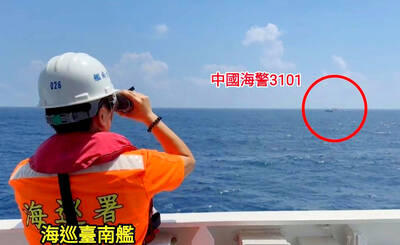
‘BRAZEN’: The holiday did not stop China from activities that infringe on Taiwan’s maritime jurisdiction, but the CGA is ready to defend the nation, Kuan Bi-ling said Beijing is intensifying maritime pressure on Taiwan, but the nation will never yield, Ocean Affairs Council Deputy Minister Sung Chen-en (宋承恩) said. The Coast Guard Administration (CGA) has adopted a “shadowing and monitoring” approach to avoid falling into a Chinese trap to escalate tensions and deepen the conflict, Sung said in an interview published yesterday in the Chinese-language Liberty Times (the Taipei Times’ sister newspaper). China Coast Guard formations patrolling waters east of Taiwan, as well as official Chinese vessels entering areas around Itu Aba Island (Taiping Island, 太平島) and Pratas Islands (Dongsha Islands, 東沙群島) show Beijing’s attempts to significantly step up
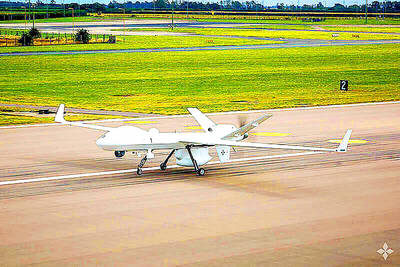
BOOST: By operating the same advanced systems as the US military, Taiwan would be better positioned to share and integrate intelligence with partners, an expert said The first batch of MQ-9B SkyGuardian drones has arrived in Taiwan, and is being assembled and tested by drone manufacturer General Atomics and the military ahead of flight trials as part of the air force’s acquisition to bolster its aerial surveillance capabilities, a source said yesterday. The air force allocated a budget of NT$21.7 billion (US$687 million) from 2022 to 2029 to procure four MQ-9B uncrewed aerial vehicles (UAVs) manufactured by General Atomics along with associated equipment such as ground control stations. The US has agreed to deliver the four MQ-9Bs to Taiwan in two batches this year and next

Taiwanese firms’ China investments have dwindled to less than 1 percent of their total foreign investments, putting China-based investments on track for a record low this year, Ministry of Economic Affairs data showed. Taiwan’s investments abroad in the first five months of this year reached US$35.92 billion, Department of Investment Review data showed. Investments outside China totaled US$35.61 billion, up 133.94 percent year-on-year, while investments in China totaled US$310.3 million, down 32.3 percent and about 0.86 percent of the total, data showed. Major overseas projects included Taiwan Semiconductor Manufacturing Co’s (TSMC, 台積電) US$30 billion capital injection into an overseas subsidiary,


 RSS
RSS