


The central bank has launched a comprehensive redesign of New Taiwan dollar banknotes to enhance anti-counterfeiting measures, improve accessibility and align the bills with global sustainability standards, Governor Yang Chin-long (楊金龍) told a meeting of the legislature’s Finance Committee yesterday.
The overhaul would affect all five denominations — NT$100, NT$200, NT$500, NT$1,000 and NT$2,000 notes — but not coins, Yang said.
It would be the first major update to the banknotes in 24 years, as the current series, introduced in 2001, has remained in circulation amid rapid advances in printing technology and security standards.
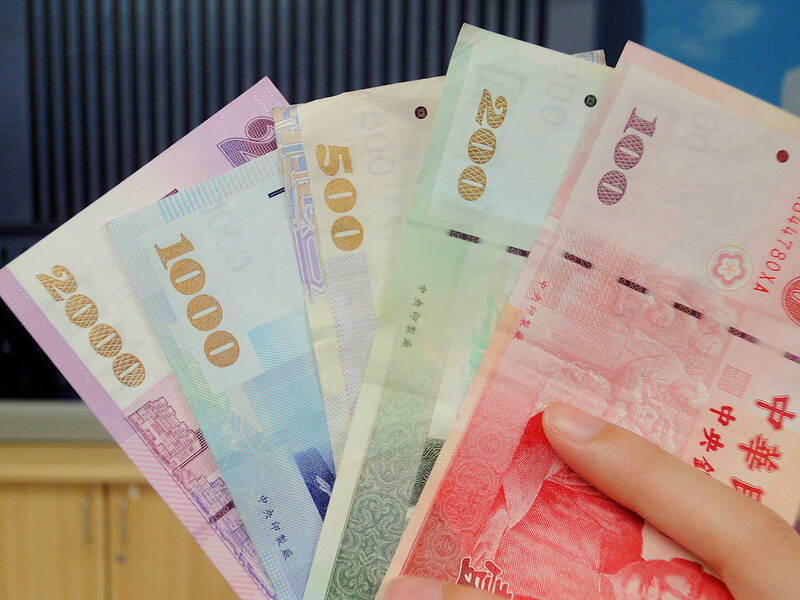
Photo: Lu Kuan-cheng, Taipei Times
“Updating the notes is essential to safeguard the integrity of the national currency and ensure transaction safety,” Yang said.
The new series would feature dynamic and visually distinct security elements such as color-shifting inks and motion effects, allowing the notes’ authenticity to be verified more easily, while significantly raising the barrier for counterfeiting, he said.
The notes would include larger numerals and enhanced tactile marks to help visually impaired users more easily identify denominations, he added.
In keeping with global trends in issuing “green banknotes” and the government’s net zero transition policy, the redesigned notes would use more environmentally friendly materials and production processes to improve sustainability, Yang said.
Recognizing that currency design carries symbolic meaning, the central bank would establish a “New Taiwan Dollar Banknote Theme Advisory Committee” to gather input from experts and the public, the governor said.
The committee would select themes and visual motifs that reflect the nation’s identity, values and spirit of the times to foster a sense of unity and shared pride, he said.
The first redesigned note is expected to be issued about two-and-a-half years after the completion of the theme selection process, with other denominations to follow in stages, he said.
The old and new notes would circulate concurrently for several years, in line with international practice to ensure a smooth transition, he said.
The redesigned series would not feature political figures, and the Formosan sika deer — currently depicted on the back of the NT$500 note — would be replaced, he said.
“Once a protected species, the sika deer has since seen its population rebound, making its original ecological symbolism less relevant,” Yang said.
The final imagery would be determined by the advisory committee, he said.
As for coins, the central bank has no plans for a redesign, as their low value and high circulation volume make an overhaul unnecessary, the governor said.
He emphasized that the project is not political, and focuses instead on technological modernization, sustainability and cost efficiency.
“If we do not update now, the future cost will only be higher,” Yang said.

A signaling system malfunction disrupted high-speed rail (HSR) services beginning at 8am today, with trains temporarily reduced to three northbound and three southbound trains per hour as authorities conduct inspections. The malfunction occurred on a section of track in Miaoli County during pre-operation checks early this morning, forcing northbound and southbound trains to use a single track, the HSR operator said. The regular schedule has been replaced with three hourly trains offering only nonreserved seating in each direction, stopping at every station, it said, adding that business class cars would still have reserved seating. Departures from terminal stations are scheduled at the top

Taiwan is still in the process of assessing the possibility of recruiting workers from Eswatini, the Ministry of Foreign Affairs said yesterday, adding that its goal is to help Eswatini upgrade its vocational training centers. If there are plans to recruit workers from Eswatini, safeguarding national security, protecting public health and ensuring the employment rights of Taiwanese would be prerequisites, Department of West Asian and African Affairs Director-General Yen Chia-liang (顏嘉良) told a news conference. Key considerations would also include filling labor shortages in specific industries, and fostering bilateral professional and technical exchanges, he said. Yen was asked about the progress of labor

VERBOSE VESSELS: A CGA cutter and a China Coast Guard exchanged verbal barbs for more than a day in Taiwanese-controlled waters before the Chinese vessel left The Taiwanese and Chinese coast guards had a standoff near the strategically located Pratas Islands (Dongsha Islands, 東沙群島) in the north of the South China Sea, the Coast Guard Administration (CGA) said yesterday. The two sides engaged in intense radio exchanges over sovereignty claims during the 33-hour standoff. China Coast Guard vessel 3501 eventually left the restricted waters, 26.6 nautical miles (49.2km) west of the Pratas Islands, at 5pm yesterday, the CGA said. Lying approximately between southern Taiwan and Hong Kong, the Taiwan-controlled Pratas are seen by some security experts as vulnerable to Chinese attack due to their distance — more than
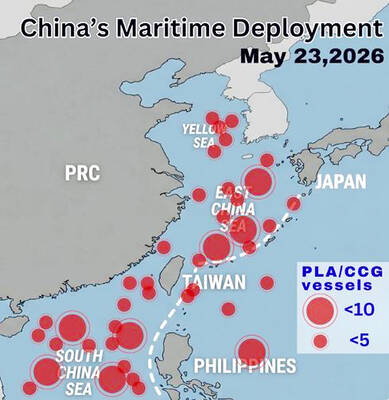
WARNING: China should stop engaging in actions that undermine regional peace and stability, as it would only build resentment among people across the Strait, the CGA said China has deployed more than 100 navy, coast guard and other vessels in waters from the Yellow Sea to the South China Sea and the western Pacific since US President Donald Trump and Chinese President Xi Jinping (習近平) met in Beijing, National Security Council Secretary-General Joseph Wu (吳釗燮) said yesterday. “In this part of the world, #China is the one & only PROBLEM wrecking the #StatusQuo & threatening regional peace & stability,” Wu wrote on X. In a separate post, he said Beijing was coercing Taiwan’s maritime domain, calling it illegal and provocative, after the Coast Guard Administration (CGA) expelled a


 RSS
RSS