


Taiwan has successfully developed a short-range ballistic missile capable of reaching China's southeastern coast, a move arousing both doubt and worry on the part of the Chinese military.
The mixed feelings held by the leadership of the People's Liberation Army (PLA) toward Taiwan's ballistic missile development are reflected in an article printed yesterday in the Chinese military's mouthpiece, the PLA Daily.
In the article "Taiwan kicks off new weapons development projects," the PLA Daily said one of the top priorities of Taiwan's military over the next decade is to own and operate ballistic missiles.
"Three years ago, the Taiwan military started planning the upgrade of the domestically built Tien Kung-IIA air defense missile to a simplified ballistic missile. They named the missile `Tien Chi,'" the article said.
"The initial development of Tien Chi did not proceed well because criticism from inside the military over the limited effectiveness of the missile. But in 1999, Taiwan's military somehow acquired the know-how to produce ballistic missiles," the report said.
The report indicated that the PLA leadership -- though still mocking Taiwan's achievements in ballistic missile development -- cannot ignore the fact that Taiwan is steadily progressing in the field.
In response to the PLA Daily report, the Ministry of National Defense said yesterday that the military has indeed made some breakthroughs in the development of missile technology in recent years.
"The new weapons systems we are developing are based on existing systems. The Chung Shan Institute of Science and Technology has progressed a lot in these areas over the past two years," a spokesman for the defense ministry said.
Eleven Jan (詹皓), editor in chief of Defense Technology Monthly magazine, connected the so-called missile technology breakthrough with the Tien Chi development project.
"Chung Shan should have solved the most difficult technical problems relating to the production of the Tien Chi. The Tien Chi is based on the Tien Kung-II missile, but it has a two-stage booster, while the Tien Kung has only a one-stage booster," Jan said.
"The difficulty with a two-stage booster is that you have to precisely control the ignition time for the second-stage booster once it becomes disconnected from the first-stage booster. It cannot be one second early or one second late," he said.
"What we know is that Chung Shan has overcome the problem. Now they have only one major problem to tackle -- what kind of warhead they want to use on the missile," Jan said. "Since the Tien Chi is a variant of the Tien Kung-II, it has much the same payload as the latter. The Tien Kung-II has a small payload of only 100kg. Such a payload will not cause too much harm to a ground target if the warhead is made of conventional high explosives," he said.
According to the 2000-2001 edition of Land-based Air Defense, published by Jane's Information Group, Taiwan's Tien Chi was developed as a response to China's deployment of ballistic missiles along its southeastern coast.
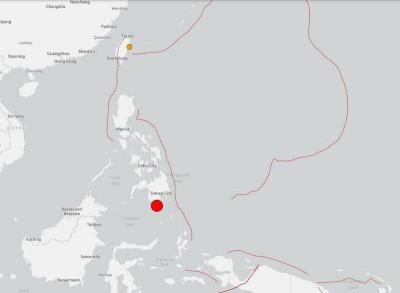
A magnitude 7.8 earthquake struck off the southern coast of Mindanao in the Philippines at 7:38am today, prompting the US Tsunami Warning System to issue an alert for neighboring countries, including Taiwan. The system issued a purple alert indicating a "tsunami threat." The potential threat zone includes Taiwan, the Philippines, Papua New Guinea, Yap and Palau. Philippine authorities were assessing the damage from the quake, with the office of civil defense seeking to verifying initial reports that 15 people had been killed and 129 injured in the region, mostly from falling debris. Arlene Hollero, disaster chief of Maasim town in the Philippines' Sarangani Province,
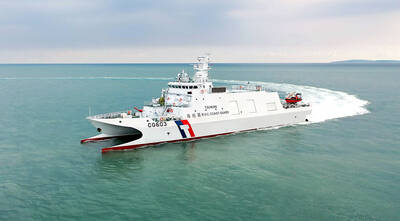
‘GRAY ZONE’ PRESSURE: Beijing’s activities are intended to create the deceitful impression that China has jurisdiction over the area around Taiwan, the CGA said Taiwan’s rights over its territorial waters and exclusive economic zone must not be violated by any country, the Mainland Affairs Council said yesterday, adding that it will not accept any unprovoked actions. The council issued the remarks in response to the China Coast Guard conducting maritime enforcement drills near eastern Taiwan and claiming to fully exercise China’s maritime administrative law enforcement authority. The Coast Guard Administration (CGA) has been closely monitoring the situation and is taking concrete steps to defend the nation’s sovereignty and secure its waters, the council said. China has no sovereign rights over the waters off eastern
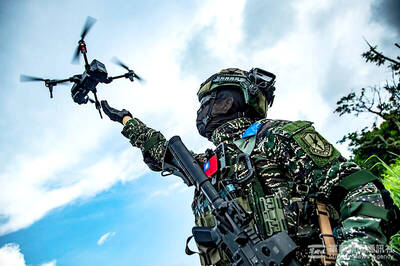
RESILIENCE: Taiwan plays a key role in semiconductors, energy, information infrastructure and advanced manufacturing, AIT Director Raymond Greene said Taiwan’s continued investment in deterrence and resilience remains vital, especially in uncrewed systems and other emerging technologies, American Institute in Taiwan (AIT) Director Raymond Greene said yesterday. Greene made the remarks at the annual National Strategic Summit on Supply Chain Resilience held by the Research Institute for Democracy, Society and Emerging Technology (DSET), a government-backed think tank. As Taiwan last year became the US’ fourth-largest trading partner and supply chain security is becoming more important, cooperation in emerging technologies continues to deepen between the two countries, he said. The US is committed to accelerating innovation, building key infrastructure, strengthening cooperation

The National Chungshan Institute of Science and Technology yesterday showcased its locally developed variants of the Vision 60 robotic patrol dog, which it plans to deploy on the nation’s outlying territories in the South China Sea. The variants were produced under the Joint Lab project — created by the institute and domestic companies — and assembled with domestically produced motors, lenses and artificial intelligence (AI) systems alongside licensed tech from the US, Missile and Rocket Systems Research Division deputy director Jen Kuo-kang (任國光) told the media event at a military base in Taipei’s Dazhi (大直) area. Taiwan has built up its strengths


 RSS
RSS