


Preparations for tomorrow's opening of the latest addition to Taipei's mass rapid trasit system -- the southern section of the Hsintien line -- have been considerably smoother than previous openings, officials said yesterday.
So much so, they said, that the line is opening three weeks ahead of schedule.
"In the past, we didn't have enough experience. Now that the city's MRT system has been in operation for over three years, the opening of the new line had fewer hitches," said Yen Pang-chieh (顏?3?, vice president of the Taipei Rapid Transit Corporation (TRTC).
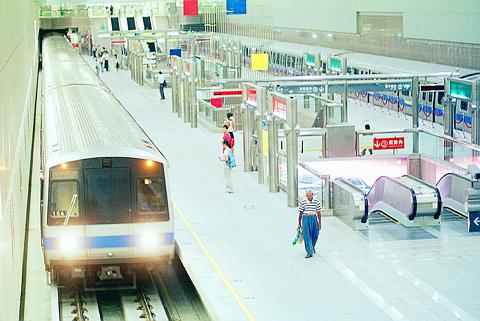
PHOTO: CHEN CHENG-CHANG, TAIPEI TIMES
"We've gradually learnt how to avoid the pitfalls that occurred in the past, and how to handle similar difficulties," Yen said.
An opening ceremony is plan-ned for 11am tomorrow at the Hsintien Station. The line was originally scheduled to open at the end of this month.
Eight new stations going south from Kuting to Hsintien will open tomorrow, which will enable passengers to ride directly from Hsintien to Tamshui station without changing trains.

MRT passengers travelling from Hsintien station to the Taipei Railway Station -- a distance of 10.5km -- will spend only 19 minutes on their journey. This cuts by half the time taken by bus passengers or vehicle drivers on the same route, city officials said.
The line passed the Ministry of Transportation and Communications' inspection procedures on Monday, and Mayor Ma Ying-jeou (馬-^?E) announced later that evening that the line was ready to open.
A few problems were discovered during the inspection, but these involved services and amenities at stations, not safety pitfalls that may affect the line's operations, corporation officials said yesterday.
The Hsintien line, which took eight years to complete, is the fourth MRT route to open since construction on the system began in 1986. The Mucha line was the first, on March 28, 1996, while the Tamshui line opened a year later. The Chungho line and the Hsintien line's northern section opened at the end of last year.
If the first east-west line, from Panchiao to Nankang, starts operation by the end of this year as planned -- thereby connecting the Mucha and Tamshui lines -- the MRT system is expected to carry over 600,000 passengers a day, rising from the current figure of 350,000 to 400,000, Yen said.
The corporation and the Taipei City Government have cooperated to encourage ridership by providing more parking spaces for cars, motorcycles and bicycles near stations, it was announced at the weekend.
City officials said the MRT scheme has improved over time.
When the Mucha line opened in 1996, free rides were offered during an initial four-week trial period during which operating hours were limited and then gradually brought up to current levels. In this way, a number of operational problems were gradually sorted out.
"We were not so sure whether the line was ready for transport service, so we kept a low profile and took a gradual approach then," Yen said.
The transport ministry's inspection team had found more faults with the previous three lines than with the Hsintien line, Yen added.
The corporation hopes to have the Panchiao-Nankang line open from the Taipei City Government station to the Lungshan Temple station by the end of this year, Yen said.
See tomorrow's newspaper for special reports on the opening of the new line, including a cut-out map.
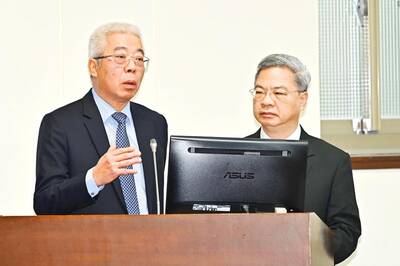
Taiwan has arranged for about 8 million barrels of crude oil, or about one-third of its monthly needs, to be shipped from the Red Sea this month to bypass the Strait of Hormuz and ease domestic supply pressures, CPC Corp, Taiwan (CPC, 台灣中油) said yesterday. The state-run oil company has worked with Middle Eastern suppliers to secure routes other than the Strait of Hormuz, through which about 20 percent of the world’s oil and liquefied natural gas typically passes, CPC chairman Fang Jeng-zen (方振仁) said at a meeting of the legislature’s Economics Committee in Taipei. Suppliers in Saudi Arabia have indicated they
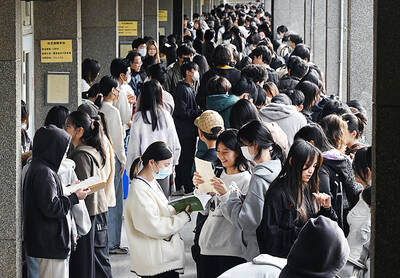
A global survey showed that 60 percent of Taiwanese had attained higher education, second only to Canada, the Ministry of the Interior said. Taiwan easily surpassed the global average of 43 percent and ranked ahead of major economies, including Japan, South Korea and the US, data from the Organisation for Economic Co-operation and Development (OECD) for 2024 showed. Taiwan has a high literacy rate, data released by the ministry showed. As of the end of last year, Taiwan had 20.617 million people aged 15 or older, accounting for 88.5 percent of the total population, with a literacy rate of 99.4 percent, the data

CCP ‘PAWN’? Beijing could use the KMT chairwoman’s visit to signal to the world that many people in Taiwan support the ‘one China’ principle, an academic said Chinese Nationalist Party (KMT) Chairwoman Cheng Li-wun (鄭麗文) yesterday arrived in China for a “peace” mission and potential meeting with Chinese President Xi Jinping (習近平), while a Taiwanese minister detailed the number of Chinese warships currently deployed around the nation. Cheng is visiting at a time of increased Chinese military pressure on Taiwan, as the opposition-dominated Legislative Yuan stalls a government plan for US$40 billion in extra defense spending. Speaking to reporters before going to the airport, Cheng said she was going on a “historic journey for peace,” but added that some people felt uneasy about her trip. “If you truly love Taiwan,

NEW LOW: The council in 2024 based predictions on a pessimistic estimate for the nation’s total fertility rate of 0.84, but last year that rate was 0.69, 17 percent lower An expected National Development Council (NDC) report expects the nation’s population to drop below 12 million by 2065, with the old-age dependency ratio to top 100 percent sooner than 2070, sources said yesterday. The council is slated to release its latest population projections in August, using an ultra-low fertility model, the sources said. The previous report projected that Taiwan’s population would fall to 14.37 million by 2070, but based on a new estimate of the total fertility rate (TFR) — the average number of children born to a woman over her lifetime — the population is expected to reach 12 million by


 RSS
RSS