


It often starts with a text message asking if you are available on weekends, looking for a part-time job or you get a simple “hello” from an unknown number. Halfway across the world, a laborer is usually pulling in 12-16 hour days, sending non-stop messages, hoping someone will take the bait.
The ultimate goal is always to take your money — victims have lost tens of billions to scams and hundreds of thousands of people are in forced labor to keep the schemes going. These workers are often housed in massive complexes scattered across Southeast Asia, where the industry has flourished.
Here is why rooting out the scamming industry is such a complex issue.
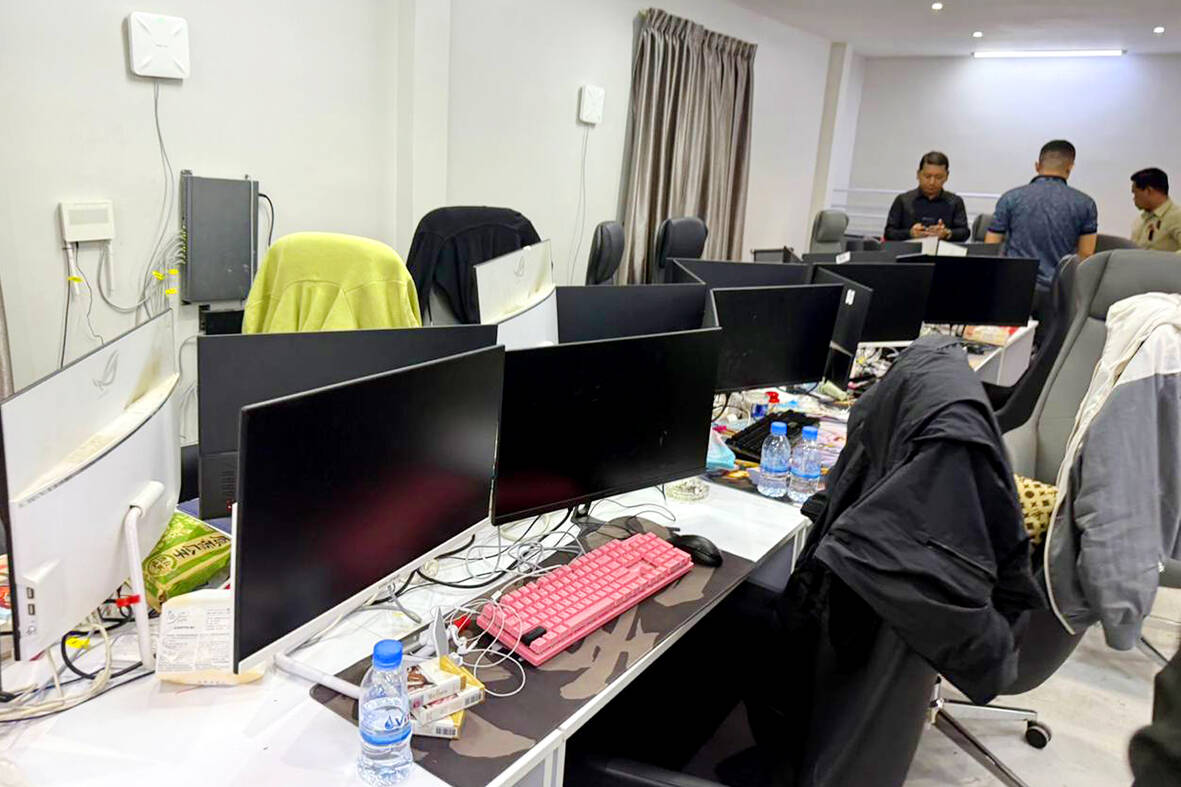
Photo: EPA 照片:歐新社
The crackdown in Myanmar
The Myanmar military last month went into one of the most well-known scam compounds — the massive KK Park, along the border with Thailand — and announced its shutdown, though civil society groups later said parts of the compound are still operating.
The workers fled, with about 1,500 laborers — hundreds of them from India but also Chinese, Filipinos, Vietnamese, Ethiopians and Kenyans, among other nationalities — crossing into Thailand. Troops then demolished several structures within the massive complex, according to Thai military officials.
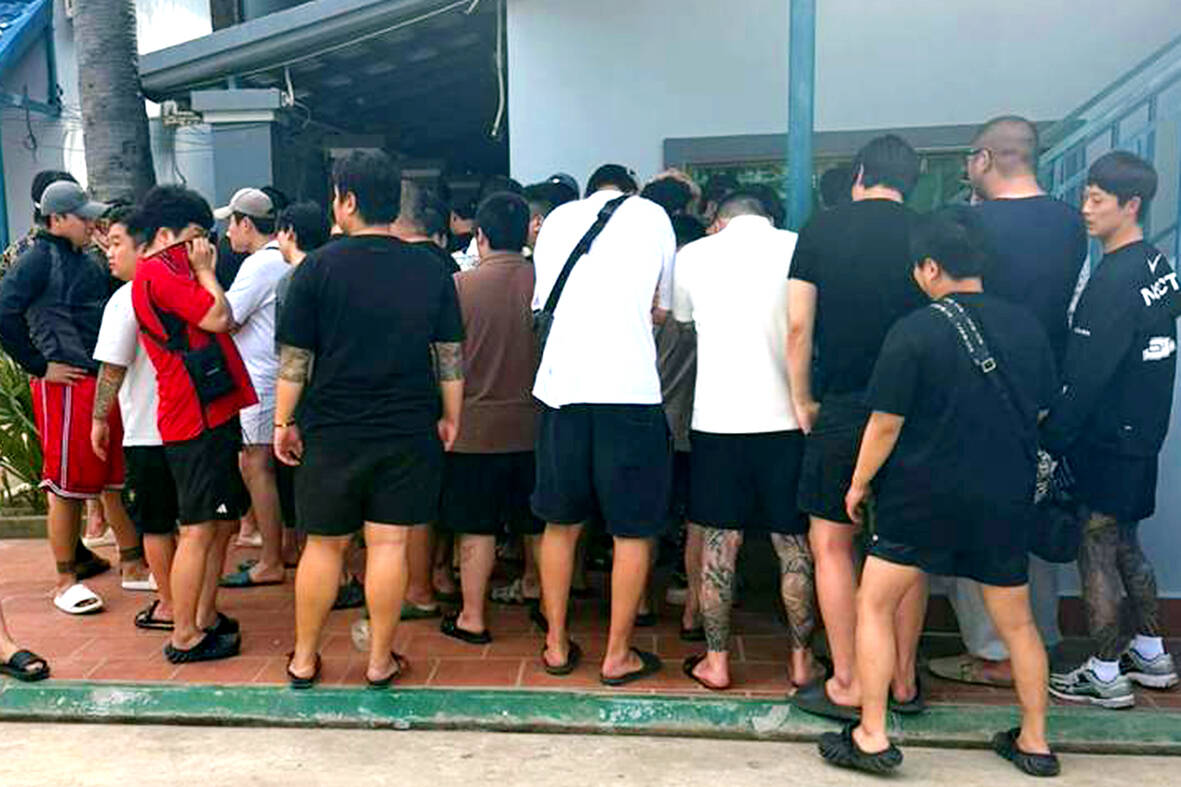
Photo: EPA 照片:歐新社
However, KK Park was just one of dozens such centers along the Thai-Myanmar border and hundreds across Southeast Asia.
Emerging from casinos and illegal gambling
Scam compounds are often located in rural areas, sprawling complexes with sleeping quarters, shops and entertainment venues for the staff.
They are constructed on a model where developers may build out a single property and then lease out the space inside to various companies.
They often operate with the protection of local elites. Smaller operations also exist — housed in one floor of legitimate office buildings, or even a rented house in an urban area.
The centers originated from casinos — both online and physical casinos that mushroomed across Southeast Asia. The United Nations Office on Drugs and Crime counted more than 340 licensed and non-licensed casinos in 2021 alone.
The casinos and attached junket tours attracted high-rollers from China, where gambling is outlawed and are operated by Chinese criminal groups.
During the pandemic, visiting such locations became difficult amid strict travel restrictions. Lacking customers, some online casinos shifted their work model to a criminal operation: defrauding targets from all over the world through digital schemes.
Relying on both trafficked and willing labor
It’s estimated that at least 120,000 people across Myanmar may be held in situations where they are forced to work on online scams, with another 100,000 people in Cambodia, according to a 2023 Office of the United Nations High Commissioner for Human Right report.
The numbers are estimates at best, but scam centers rely on a mix of trafficked and willing laborers, lured by false promises of relatively high salaries and an easy office job.
Early on, workers came from China and Chinese speaking countries, but now the UN drugs and crime office says laborers are drawn from 56 countries, from Indonesia to Liberia.
The reality is a stark contrast from their expectations — their passports are often confiscated to keep them from leaving the complex. Only very senior managers and trusted lieutenants are able to have freedom of movement, workers have said. Workers who don’t perform are beaten or face other physical punishments.
A global scourge
Scammers don’t discriminate — they target people across the world, aided by translation tools that are powered by artificial intelligence.
Scams vary in how they’re carried out, ranging from investments in cryptocurrency, to online task scams where people are asked to top-up to get their next task — with real money sometimes paid out in the earlier stages of a scam.
Many scammers build a sense of urgency when asking for an investment, saying the target will miss out if it’s not done by a certain time.
Despite government efforts to crack down and free workers trapped in scam centers, and raids that have shut down some compounds, activists say the main culprits are still at large. There are new reports of scam centers continuing to surface both in Southeast Asia and across the world.
A United Nations report in April said scammers have bilked victims out of billions of dollars through false romantic ploys, bogus investment pitches and illegal gambling schemes reported operating as far afield as Africa and Latin America.
(AP)
一切往往從一則簡訊開始──問你週末是否有空、是否在找兼職工作,或只是來自陌生電話號碼的一句「嗨」。地球另一端某個勞工可能正不分日夜工作12至16小時,不停傳送訊息,只希望有人上鉤。
這些詐騙的最終目的永遠都是要掏空你的錢──受害者被詐騙的金額已達數千億美元,而有數十萬人被迫從事勞動,以維持這些詐騙活動的運作。這些工人多半被集中安置在大型園區中,這些園區散布東南亞各地,詐騙產業就在那裡蓬勃發展。
以下說明根除詐騙產業為何如此困難:
緬甸的掃蕩行動
上個月,緬甸軍方進入位於泰國邊境、最知名的詐騙園區之一,即龐大的KK 園區,並宣布將其關閉。然而,民間團體隨後指出,該園區部分區域仍在運作。
工人們紛紛逃離,大約有1,500名勞工——其中數百人來自印度,也有中國人、菲律賓人、越南人、衣索比亞人與肯亞人等——越過邊境進入泰國。據泰國軍方表示,軍隊之後拆除了園區內的多棟建築。
然而,KK園區只是泰緬邊境數十個類似園區之一,而整個東南亞地區還有數百個類似據點。
從賭場與非法博弈中演變而來
這些詐騙園區通常設於偏遠地區,是結合宿舍、商店及娛樂設施的龐大園區。
開發商通常是興建整棟建築,再將其中的空間租給不同公司使用。
它們往往受到地方權貴的庇護。也有規模較小的據點——可能只是正規辦公大樓的一層樓,甚至藏身於都市住宅區內的一棟出租房。
這些中心最初起源於賭場——包含線上與實體賭場。這些賭場過去在東南亞如雨後春筍般興起。根據聯合國毒品與犯罪問題辦公室(UNODC)統計,光是2021年,東南亞的合法與非法賭場,就有超過340家。
這些賭場及其相關的「博奕旅遊團」吸引了來自中國的豪賭客(中國境內禁止賭博),其經營多由中國犯罪集團掌控。
在疫情期間,由於嚴格的旅行限制,前往此類場所變得困難。失去客源後,一些線上賭場改變營運模式,轉型成犯罪組織:透過網路詐騙向全球各地的目標行騙。
依賴被販運與自願的勞工
根據聯合國人權事務高級專員辦事處2023年的報告估計,緬甸至少有12萬人被迫從事網路詐騙相關工作,而柬埔寨則約有10萬人。
這些數字僅為推估,但詐騙中心通常同時仰賴被人口販運來的勞工與自願者,這些自願者是被高薪與輕鬆的辦公室工作的謊言騙來。
早期的工人多來自中國及其他華語地區,但聯合國毒品與犯罪問題辦公室指出,如今這裡的勞動力已遍及56個國家,從印尼到賴比瑞亞都有。
實際情況與他們的期待大相逕庭——他們護照往往被沒收,以防他們離開園區。根據工人說法,只有高階管理層與信任的幹部能自由進出。未達業績的員工會被毆打,或受到其他形式的體罰。
全球性的禍害
詐騙者不挑目標——他們鎖定全世界的人,並利用人工智慧翻譯工具跨語言行騙。
詐騙的手法千變萬化,從加密貨幣投資、到「網路任務詐騙」(要求受害者先儲值才能獲得下一個任務),前期甚至會支付少量「報酬」以取得信任。
許多詐騙者會製造緊迫感,聲稱若不在特定時間內投資就會錯過機會。
儘管各國政府積極取締、解救被困在詐騙園區的勞工,並查封部分據點,但維權人士指出,幕後主謀依然逍遙法外。而新的詐騙園區仍不斷出現在東南亞及世界各地。
聯合國在今年四月的一份報告中指出,詐騙者透過假戀愛、虛假投資計畫與非法博弈網站等手段,從非洲到拉丁美洲各地的受害者手中詐取了數十億美元。
(台北時報林俐凱編譯)
The debate surrounding Taipower’s recent corporate identity reboot has gone well beyond the design community. The controversy began after Taipower replaced the familiar “Taiwan Power Company” wording — widely regarded as the calligraphy of Yu You-ren (1879-1964), former Control Yuan president and master calligrapher — with a modern logotype by designer Aaron Nieh’s team, Aaron Nieh Workshop. Taipower said the change was not a wholesale replacement of old signage, but an “optimization of its identity system,” aimed at meeting the needs of digital media, electronic bills, apps, social media graphics and various small-format applications. Existing physical markings, such as building

Since 2005, the third Monday in January has come to be known as “Blue Monday.” In other words, that day is believed to be the most depressing day of the year. This concept seems logical at first. After all, Monday marks the start of the school or workweek after two days of rest and fun. Also, blue is a color that is often associated with sadness. Furthermore, in many parts of the world, January is a time when the weather is cold, rainy, and gloomy. But is there any scientific proof that this January day is truly sadder than any of

Continued from yesterday(延續自昨日) https://www.taipeitimes.com/News/lang For the most part, the idea of “Blue Monday” has been rejected as a myth. Some mental health experts also say there is a danger in labeling a certain day as the most depressing time of the entire year. Some argue that if people expect to feel sadder on the third Monday in January, this belief alone may increase their anxiety. One group that is worried about the negative effect of believing in Blue Monday is Samaritans. A mental health charity based in the UK, Samaritans is working to turn Blue Monday into “Brew Monday.” In this

A: In early May, there were concerts by Icyball, Chyi Yu, Korea’s EXO and Japan’s Anisama, but I missed them all. What a shame. B: That’s OK. There are shows coming up by various artists, including Power Station, Accusefive, Japanese singer Mika Nakashima, Chinese-Icelandic jazzer Laufey, and even Singaporean diva Stefanie Sun. A: After a 12-year hiatus, Stefanie is finally returning to Taipei again. B: In late May, there will be more shows by Crowd Lu, WeiBird, Korea’s Donghae, 2AM, EXID, and Thailand’s BUS. A: The Thai boyband is so popular. It looks like “T-pop” is catching up with J-pop


 RSS
RSS