


A: In addition to superstar Kanye West, the musical “Mamma Mia!” is coming to Taiwan again.
B: When and where?
A: The musical’s scheduled from Aug. 28 to Sept. 1 at Taipei’s National Theater.

Photo: Liberty Times 照片:自由時報
B: Ever since its debut in 1999, the show featuring 22 hits from Swedish supergroup ABBA has always been popular.
A: This year marks its 25th anniversary. Let’s go together.
A: 除了天王「肯爺」,音樂劇《媽媽咪呀!》也要來台灣啦。
B: 什麼時候?在哪?
A: 8月28日至9月1日,
將在台北國家戲劇院演出。
B: 該劇搭配了瑞典ABBA合唱團的22首金曲,自1999年首演以來一直大受歡迎!
A: 那今年剛好是25週年,我們一起去吧。
(By Eddy Chang, Taipei Times/台北時報張聖恩)
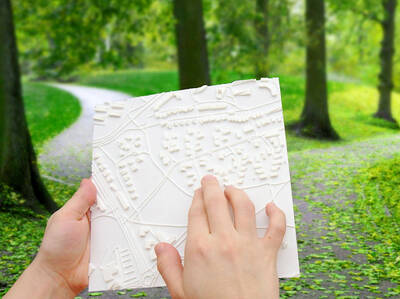
Have you ever wondered how people navigate the world when they can’t see a map? For individuals with visual impairments, conventional maps are nearly impossible to use. This is where tactile maps come in — essential tools that allow people to “see” the world through touch. A tactile map is specially designed with raised lines, textures, and symbols to represent geographical features such as roads, rivers, and buildings. Users explore it with their fingertips. However, these maps are not exclusively for people with visual disabilities. They serve as valuable multisensory learning tools that enhance spatial understanding for everyone, making

The debate surrounding Taipower’s recent corporate identity reboot has gone well beyond the design community. The controversy began after Taipower replaced the familiar “Taiwan Power Company” wording — widely regarded as the calligraphy of Yu You-ren (1879-1964), former Control Yuan president and master calligrapher — with a modern logotype by designer Aaron Nieh’s team, Aaron Nieh Workshop. Taipower said the change was not a wholesale replacement of old signage, but an “optimization of its identity system,” aimed at meeting the needs of digital media, electronic bills, apps, social media graphics and various small-format applications. Existing physical markings, such as building

Since 2005, the third Monday in January has come to be known as “Blue Monday.” In other words, that day is believed to be the most depressing day of the year. This concept seems logical at first. After all, Monday marks the start of the school or workweek after two days of rest and fun. Also, blue is a color that is often associated with sadness. Furthermore, in many parts of the world, January is a time when the weather is cold, rainy, and gloomy. But is there any scientific proof that this January day is truly sadder than any of

Continued from yesterday(延續自昨日) https://www.taipeitimes.com/News/lang For the most part, the idea of “Blue Monday” has been rejected as a myth. Some mental health experts also say there is a danger in labeling a certain day as the most depressing time of the entire year. Some argue that if people expect to feel sadder on the third Monday in January, this belief alone may increase their anxiety. One group that is worried about the negative effect of believing in Blue Monday is Samaritans. A mental health charity based in the UK, Samaritans is working to turn Blue Monday into “Brew Monday.” In this


 RSS
RSS