


對話 Dialogue
小實:馬克,你今天穿這件牛仔外套真好看!
Xiǎoshí: Mǎkè, nǐ jīntiān chuān zhè jiàn niúzǐ wàitào zhēn hǎokàn!
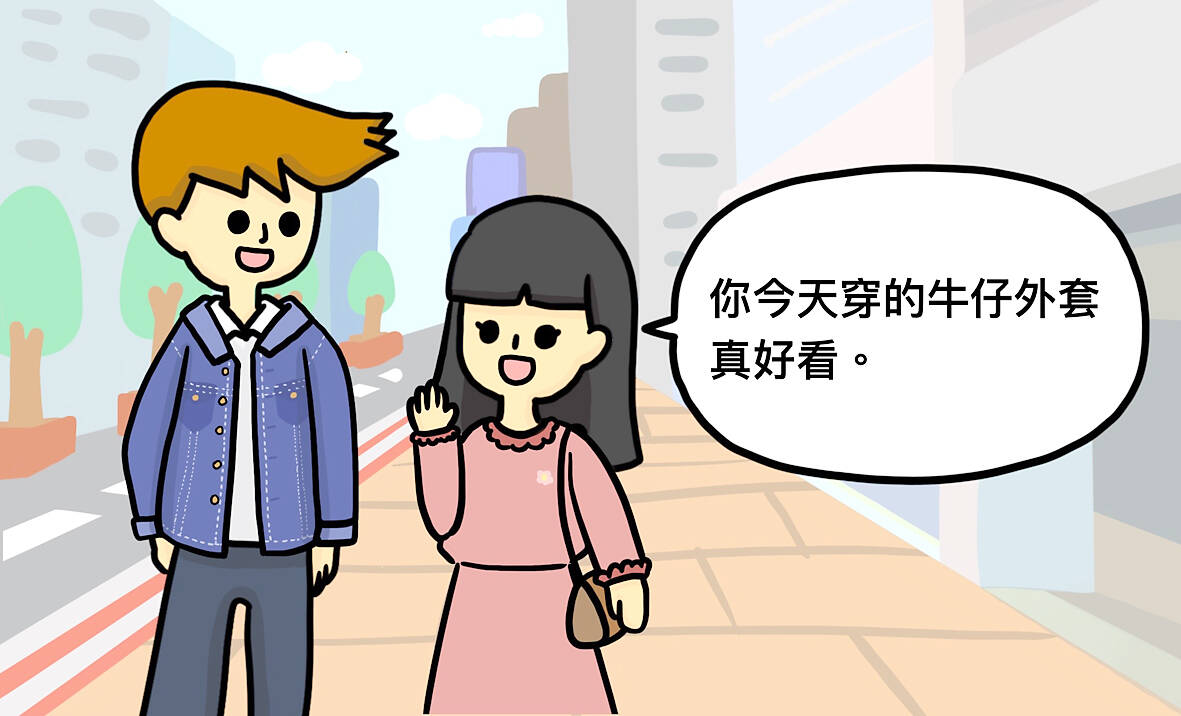
馬克:謝謝!你今天穿這件洋裝也很漂亮!
Mǎkè: Xièxie! Nǐ jīntiān chuān zhè jiàn yángzhuāng yě hěn piàoliàng!
小實:我不懂時尚,所以我都是學雜誌上的穿搭。
Xiǎoshí: Wǒ bù dǒng shíshàng, suǒyǐ wǒ dōu shì xué zázhì shàng de chuāndā.
馬克:嗯,沒關係,自己穿得舒服最重要。
Mǎkè: Ēn, méiguānxi, zìjǐ chuān de shūfú zuì zhòngyào.
小實:你有什麼穿搭的建議嗎?
Xiǎoshí: Nǐ yǒu shénme chuāndā de jiànyì ma?
馬克:嗯……我會注意配色和比例。
Mǎkè: Ēn… wǒ huì zhùyì pèisè hàn bǐlì.
小實:比例?是指上、下半身的比例嗎?
Xiǎoshí: “Bǐlì”? Shì zhǐ shàng, xiàbànshēn de bǐlì ma?
馬克:對!調整比例可以讓下半身看起來更修長。
Mǎkè: Duì! Tiáozhěng bǐlì kěyǐ ràng xiàbànshēn kànqǐlái gèng xiūcháng.
小實:原來是這樣,下次我也要想想配色和比例。
Xiǎoshí: Yuánlái shì zhèyàng, xiàcì wǒ yě yào xiǎngxiǎng pèisè hàn bǐlì.
翻譯 Translation
Xiaoshi: Mark, you look great in this denim jacket today!
Mark: Thank you! You look great in this dress today too!
Xiaoshi: I don’t know much about fashion, so I always copy the outfits in magazines.
Mark: Well, it doesn’t matter. The most important thing is to be comfortable in what you wear.
Xiaoshi: Do you have any fashion advice?
Mark: Well… I pay attention to color coordination and proportions.
Xiaoshi: Proportion? Does it mean the proportion of upper and lower body?
Mark: Yes! By adjusting the proportions can make your lower body look slimmer.
Xiaoshi: So that’s it. I will also think about color coordination and proportions next time.
單字片語 Vocabulary
1. 牛仔外套 (niúzǎi wàitào) (niúzǐ wàitào) denim jacket
2. 洋裝 (yángzhuāng) dress
3. 時尚 (shíshàng) fashion
4. 雜誌 (zázhì) magazine
5. 穿搭 (chuān dā) outfit
6. 配色 (pèisè) color coordination
7. 比例 (bǐlì) proportion
8. 上、下半身 (shàng, xiàbànshēn) upper and lower body
9. 調整 (tiáozhěng) to adjust; adjustment
10. 修長 (xiūcháng) slender, slim
教材音檔 Audio Files
教材影片 Video Files:
https://www.instagram.com/celc.nou_tw/guide/_/17999106352646292/
實踐大學華語中心提供
By Shih Chien University Chinese Language Center: https://chineseusc.com/

The debate surrounding Taipower’s recent corporate identity reboot has gone well beyond the design community. The controversy began after Taipower replaced the familiar “Taiwan Power Company” wording — widely regarded as the calligraphy of Yu You-ren (1879-1964), former Control Yuan president and master calligrapher — with a modern logotype by designer Aaron Nieh’s team, Aaron Nieh Workshop. Taipower said the change was not a wholesale replacement of old signage, but an “optimization of its identity system,” aimed at meeting the needs of digital media, electronic bills, apps, social media graphics and various small-format applications. Existing physical markings, such as building

Since 2005, the third Monday in January has come to be known as “Blue Monday.” In other words, that day is believed to be the most depressing day of the year. This concept seems logical at first. After all, Monday marks the start of the school or workweek after two days of rest and fun. Also, blue is a color that is often associated with sadness. Furthermore, in many parts of the world, January is a time when the weather is cold, rainy, and gloomy. But is there any scientific proof that this January day is truly sadder than any of

Continued from yesterday(延續自昨日) https://www.taipeitimes.com/News/lang For the most part, the idea of “Blue Monday” has been rejected as a myth. Some mental health experts also say there is a danger in labeling a certain day as the most depressing time of the entire year. Some argue that if people expect to feel sadder on the third Monday in January, this belief alone may increase their anxiety. One group that is worried about the negative effect of believing in Blue Monday is Samaritans. A mental health charity based in the UK, Samaritans is working to turn Blue Monday into “Brew Monday.” In this

1. 他兩天後回來。 ˇ He will return in two days. χ He will return after two days. 註︰從現在開始,說「多久以後」,應該用 in,不用 after,例如: He plans to finish the work in three months. I am sure we will hear from him in a few days. 請注意 in a few days、in three months 許多人誤以為是「幾天內」、「三個月內」,其實是「幾天後」、「三個月後」。 如指「某個時刻或日期或事件以後」,可用 after。例如: I will be back after four o’clock.(或 after 4 August,或 after lunch)。 2. 他要在那牆上開一扇門。 ˇ He wants to put a door in that wall. χ He wants to put a door on that wall. 註︰門不是掛在牆上,也不是靠在牆上,而是開在牆裡,應該用 in。 比較下列各句: There is a painting on the wall. Why is that plank of wood leaning against the wall? The thief made a hole in the wall. 3. 我在報上看到這個消息。 ˇ I


 RSS
RSS