


對話 Dialogue
馬克:最近這幾天總是下雨,真不方便。
Make: Zuìjìn zhè jǐ tiān zǒngshì xiàyǔ, zhēn bù fāngbiàn.
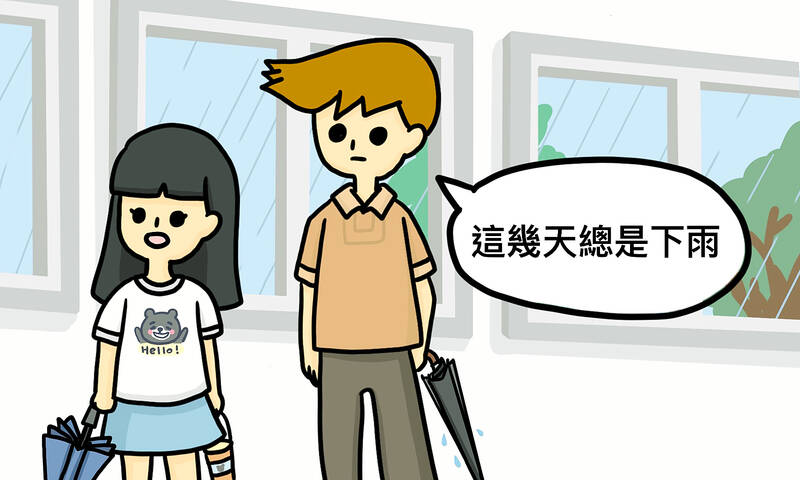
小實:對啊,因為最近是臺灣的梅雨季。
Xiaoshi: Duì a, yīnwèi zuìjìn shì Táiwān de méiyǔ jì.
馬克:「梅雨季」?那是什麼?
Make: “Méiyǔ jì”? Nà shì shénme?
小實:因為臺灣五、六月常下雨,也是梅子的成熟期,所以就叫梅雨季。
Xiaoshi: Yīnwèi Táiwān wǔ, liù yuè cháng xiàyǔ, yěshì méizi de chéngshú qí, suǒyǐ jiù jiào “méiyǔjì.”
馬克:原來是這樣,我還以為是「發霉」的「霉」!
Make: Yuánlái shì zhèyàng, wǒ hái yǐwéi shì “fāméi” de “méi”!
小實:哈哈,你覺得是因為太潮濕了,所以東西都發霉了嗎?
Xiaoshi: Haha, nǐ juéde shì yīnwèi tài cháoshī le, suǒyǐ dōngxi dōu fāméi le ma?
馬克:是啊!美國的空氣很乾燥,所以到臺灣以後,我最不喜歡的就是下雨。
Make: Shì a! Měiguó de kōngqì hěn gānzào, suǒyǐ dào Táiwān yǐhòu, wǒ zuì bù xǐhuān de jiùshì xiàyǔ.
小實:這就是為什麼很多臺灣人家裡都有一台除濕機。
Xiaoshi: Zhè jiùshì wèishénme hěnduō Táiwān rén jiālǐ dōuyǒu yìtái chúshījī.
馬克:這是好主意,我想我也應該在房間準備一台除濕機。
Make: Zhè shì hǎo zhǔyì, wǒ xiǎng wǒ yě yīnggāi zài fángjiān zhǔnbèi yìtái chúshījī.
翻譯 Translation
Mark: It’s been raining for the past few days, what a pain.
Xiaoshi: Yep, because it’s the plum rain season in Taiwan right now.
Mark: “Plum rain season”? What’s that?
Xiaoshi: It often rains in May and June in Taiwan, and this is also the time the plums ripen. That’s why it’s called the plum rain season.
Mark: Oh, I see! I always thought it was “mei” as in “mold”!
Xiaoshi: Haha, so you thought it was because everything goes moldy as it is so humid?
Mark: Yeah! The air in the United States is very dry.
After arriving in Taiwan, the thing I really don’t like is the rain.
Xiaoshi: This is why many Taiwanese have a dehumidifier at home.
Mark: That’s a good idea! I think I should have a dehumidifier in the room, too.
單字片語 Vocabulary
1. 梅雨季 (méiyǔ jì) rainy season
2. 季節 (jìjié) season
3. 成熟期 (chéngshóu qí) maturity
4. 發霉 (fāméi) to be moldy
5. 潮濕 (cháoshī) damp/ humid
6. 乾燥 (gānzào) dry
7. 除濕機 (chúshījī) dehumidifier
8. 主意 (zhǔyì) idea
教材音檔 Audio Files
教材影片 Video Files:
https://www.instagram.com/celc.nou_tw/guide/_/17999106352646292/
實踐大學華語中心提供
By Shih Chien University Chinese Language Center: https://chineseusc.com/

The debate surrounding Taipower’s recent corporate identity reboot has gone well beyond the design community. The controversy began after Taipower replaced the familiar “Taiwan Power Company” wording — widely regarded as the calligraphy of Yu You-ren (1879-1964), former Control Yuan president and master calligrapher — with a modern logotype by designer Aaron Nieh’s team, Aaron Nieh Workshop. Taipower said the change was not a wholesale replacement of old signage, but an “optimization of its identity system,” aimed at meeting the needs of digital media, electronic bills, apps, social media graphics and various small-format applications. Existing physical markings, such as building

Since 2005, the third Monday in January has come to be known as “Blue Monday.” In other words, that day is believed to be the most depressing day of the year. This concept seems logical at first. After all, Monday marks the start of the school or workweek after two days of rest and fun. Also, blue is a color that is often associated with sadness. Furthermore, in many parts of the world, January is a time when the weather is cold, rainy, and gloomy. But is there any scientific proof that this January day is truly sadder than any of

Continued from yesterday(延續自昨日) https://www.taipeitimes.com/News/lang For the most part, the idea of “Blue Monday” has been rejected as a myth. Some mental health experts also say there is a danger in labeling a certain day as the most depressing time of the entire year. Some argue that if people expect to feel sadder on the third Monday in January, this belief alone may increase their anxiety. One group that is worried about the negative effect of believing in Blue Monday is Samaritans. A mental health charity based in the UK, Samaritans is working to turn Blue Monday into “Brew Monday.” In this

1. 他兩天後回來。 ˇ He will return in two days. χ He will return after two days. 註︰從現在開始,說「多久以後」,應該用 in,不用 after,例如: He plans to finish the work in three months. I am sure we will hear from him in a few days. 請注意 in a few days、in three months 許多人誤以為是「幾天內」、「三個月內」,其實是「幾天後」、「三個月後」。 如指「某個時刻或日期或事件以後」,可用 after。例如: I will be back after four o’clock.(或 after 4 August,或 after lunch)。 2. 他要在那牆上開一扇門。 ˇ He wants to put a door in that wall. χ He wants to put a door on that wall. 註︰門不是掛在牆上,也不是靠在牆上,而是開在牆裡,應該用 in。 比較下列各句: There is a painting on the wall. Why is that plank of wood leaning against the wall? The thief made a hole in the wall. 3. 我在報上看到這個消息。 ˇ I


 RSS
RSS