


The European Space Agency’s JUICE space probe successfully took off on Friday last week for a mission to discover whether Jupiter’s icy moons are capable of hosting extra-terrestrial life in their vast, hidden oceans.
The launch on an Ariane 5 rocket from Europe’s spaceport in Kourou, French Guiana, came after a previous attempt on Thursday last week was called off due to the risk of lightning.
The spacecraft then successfully unfurled its array of solar panels, which cover a record 85 square meters.
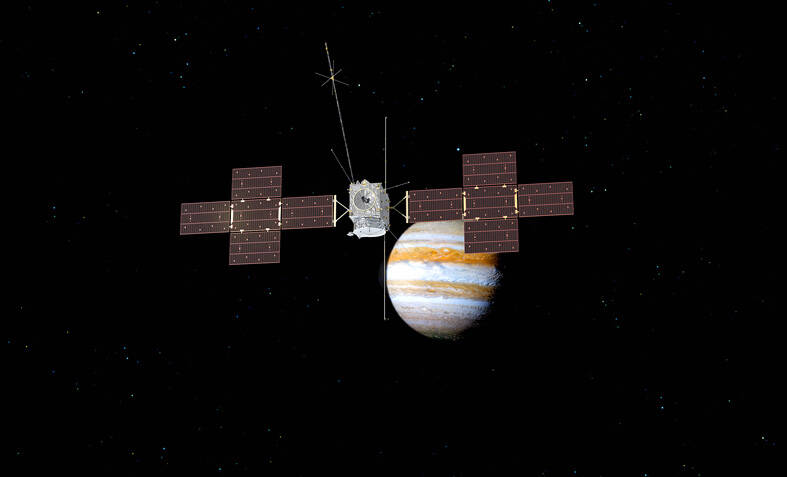
Photo: AP 照片:美聯社
It will need all the energy it can get when it nears Jupiter, where sunlight is 25 times weaker than on Earth.
It will use several gravitational boosts along the way, first by doing a fly-by of Earth and the Moon, then by slingshotting around Venus in 2025 before swinging past Earth again in 2029.
When the probe finally enters Jupiter’s orbit in July 2031, its 10 scientific instruments will analyse the Solar System’s largest planet as well as its three icy moons — Callisto, Europa and Ganymede.

Photo: AP 照片:美聯社
The moons were first discovered by astronomer Galileo Galilei more than 400 years ago but were long ignored as potential candidates for hosting life.
However, the discovery of huge oceans of liquid water — the main ingredient for life as we know it — kilometers beneath their icy shells has made Ganymede and Europa prime candidates to potentially host life in our celestial backyard.
With so many moons — at last count 95 — astronomers consider Jupiter a mini solar system of its own, with missions like JUICE long overdue.
JUICE will turn its sights on Ganymede — the Solar System’s largest moon — it surpasses Mercury — and the only one that has its own magnetic field, which protects it from radiation.
In 2034, JUICE will slide into Ganymede’s orbit, the first time a spacecraft will have done so around a moon other than our own.
NASA’s Europa Clipper mission, which is scheduled to launch in October next year, will focus on Ganymede’s sibling, Europa.
Neither mission will be able to directly detect the existence of alien life. They instead hope to establish whether the moons have the right conditions to harbor life.
(AFP)
歐洲太空總署的JUICE太空探測器成功於上週五升空,其任務是探索冰凍的木星衛星,在冰層下所隱藏廣闊、隱蔽的海洋,是否能孕育外星生命。
亞利安5號火箭於法屬圭亞那庫魯的歐洲太空中心升空,原先訂於上週四的發射因有閃電之風險而取消。
隨後太空船成功展開了太陽能電池板陣列,其面積達創紀錄的85平方公尺。
到飛近木星時,就會需要所能獲得的全部能源,木星的陽光比地球上的弱25倍。
它將在途中運用數次重力助推,第一次是飛越地球和月球,然後是2025年繞金星飛行以獲重力彈弓效應,之後是2029年再次掠過地球。
探測器最後在2031年7月進入木星軌道時,它的10台科學儀器將分析太陽系最大的行星—木星,及其三顆冰凍的衛星—木衛四(卡利斯多,Callisto)、木衛二(歐羅巴,Europa),以及木衛三(甘尼米德,Ganymede)。
這些衛星是400多年前由天文學家伽利略首次發現,但長久以來一直未被認為可能存有生命。
然而,在冰殼下數公里處所發現,由液態水—我們所知生命的主要成分—構成的巨大海洋,使得木衛三與木衛二成為我們自家星系中最可能孕育生命的星球。
木星有非常多衛星—目前已知數目為95顆—天文學家認為木星自成一個迷你太陽系,像JUICE這樣的探索任務早就該進行了。
JUICE將飛向木衛三—太陽系中最大的衛星,其體積大於水星,也是唯一擁有自己磁場的衛星,可保護它免受輻射。
2034年,JUICE將滑入木衛三的軌道,這會是太空飛行器首次繞行我們自己月球以外的衛星。
計劃於2024年10月發射的美國太空總署「木衛二快船」任務,將聚焦於木衛三的手足木衛二。
這兩項任務都無法直接探測外星生命是否存在。相反地,它們希望確定這些木星衛星是否具備孕育生命的合適條件。
(台北時報林俐凱編譯)

The debate surrounding Taipower’s recent corporate identity reboot has gone well beyond the design community. The controversy began after Taipower replaced the familiar “Taiwan Power Company” wording — widely regarded as the calligraphy of Yu You-ren (1879-1964), former Control Yuan president and master calligrapher — with a modern logotype by designer Aaron Nieh’s team, Aaron Nieh Workshop. Taipower said the change was not a wholesale replacement of old signage, but an “optimization of its identity system,” aimed at meeting the needs of digital media, electronic bills, apps, social media graphics and various small-format applications. Existing physical markings, such as building

Since 2005, the third Monday in January has come to be known as “Blue Monday.” In other words, that day is believed to be the most depressing day of the year. This concept seems logical at first. After all, Monday marks the start of the school or workweek after two days of rest and fun. Also, blue is a color that is often associated with sadness. Furthermore, in many parts of the world, January is a time when the weather is cold, rainy, and gloomy. But is there any scientific proof that this January day is truly sadder than any of

Continued from yesterday(延續自昨日) https://www.taipeitimes.com/News/lang For the most part, the idea of “Blue Monday” has been rejected as a myth. Some mental health experts also say there is a danger in labeling a certain day as the most depressing time of the entire year. Some argue that if people expect to feel sadder on the third Monday in January, this belief alone may increase their anxiety. One group that is worried about the negative effect of believing in Blue Monday is Samaritans. A mental health charity based in the UK, Samaritans is working to turn Blue Monday into “Brew Monday.” In this

A: In early May, there were concerts by Icyball, Chyi Yu, Korea’s EXO and Japan’s Anisama, but I missed them all. What a shame. B: That’s OK. There are shows coming up by various artists, including Power Station, Accusefive, Japanese singer Mika Nakashima, Chinese-Icelandic jazzer Laufey, and even Singaporean diva Stefanie Sun. A: After a 12-year hiatus, Stefanie is finally returning to Taipei again. B: In late May, there will be more shows by Crowd Lu, WeiBird, Korea’s Donghae, 2AM, EXID, and Thailand’s BUS. A: The Thai boyband is so popular. It looks like “T-pop” is catching up with J-pop


 RSS
RSS