


British Prime Minister Liz Truss took office last month with hopes and promises of reinvigorating the British economy and putting it on the path to long-term success.
It did not go to plan.
Instead, Truss’ tenure was scarred by turmoil as her economic policies threatened the country’s financial stability, driving the pound to record lows, sparking chaos on bond markets and increasing mortgage costs for millions of people.
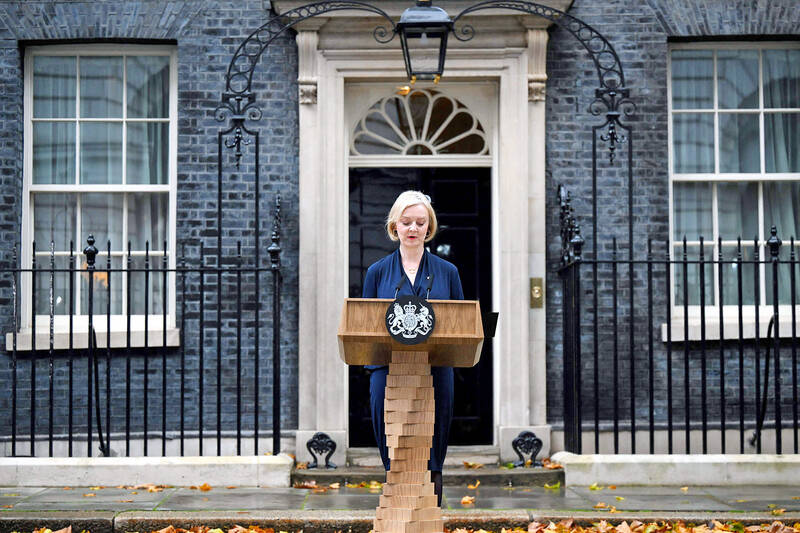
Photo: AFP 照片:法新社
Though Truss took office amid a cost-of-living crisis, the war in Ukraine and the lingering effects of the COVID-19 pandemic, her decision to announce £105 billion ($US116 billion) of tax cuts and spending increases without providing details on how she would pay for it unnerved investors, who warned of soaring public debt.
That undermined confidence in the government’s ability to pay its bills and raised questions about the economic credentials of a new prime minister who took office after a deeply divisive contest for leadership of the governing Conservative Party.
The disarray surrounding the economic plan weakened Truss’ authority as prime minister, and ultimately led to her decision to resign on Thursday last week.
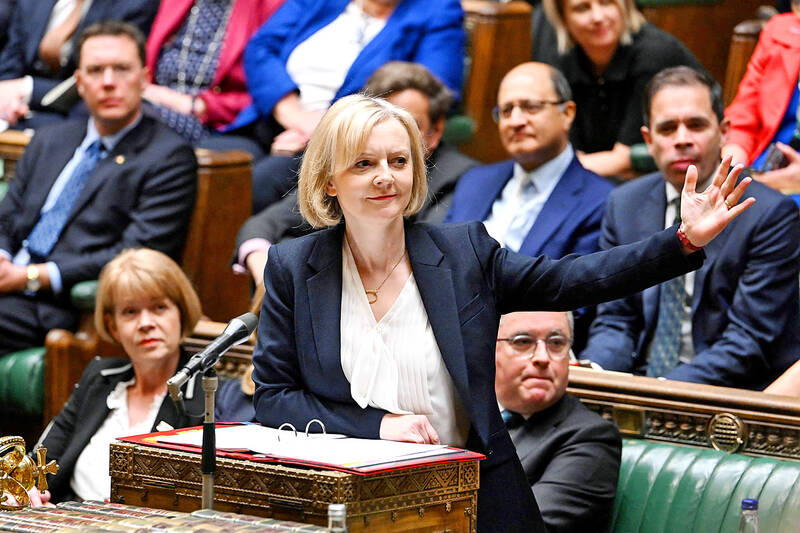
Photo: AFP 照片:法新社
WHAT HAPPENS NOW?
The party said it would select a new leader and prime minister by Oct. 28. Truss will remain prime minister until then.
To avoid the need for a lengthy election campaign that could have left the country without an effective government for weeks, party leaders decided that lawmakers would have greater say in the choice and without weeks of hustings around the country.
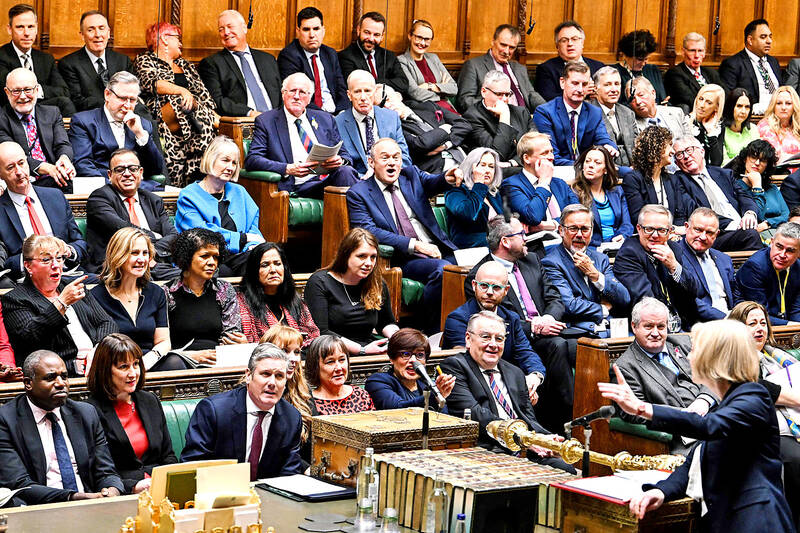
Photo: AFP 照片:法新社
Under the expedited process, challengers for the leadership had to garner the support of 100 other Conservative lawmakers — out of a total 357 — by Monday afternoon. That meant a maximum field of three for lawmakers to vote on. The last-placed candidate would then be eliminated and the top two candidates will face an online vote of the party membership.
Conservative leaders are hoping that this lightning contest will produce a consensus candidate who can unite the party behind the tax and spending priorities that Treasury chief Jeremy Hunt has already outlined.
WHAT ARE THE BIG HURDLES?
The first challenge will come just days after the new prime minister takes office, when Hunt delivers his fiscal plan to the House of Commons on Oct. 31.
Truss triggered the crisis that led to her downfall when she and Hunt’s predecessor unveiled plans for sweeping tax cuts without saying how they would pay for them and without providing independent analysis of their impact on government finances.
Since taking office last week, Hunt has reversed most of those cuts and promised to cut government debt as a percentage of economic output in the coming years. He has also warned that painful spending cuts will be needed during what is likely to be a “difficult’’ winter.
Opposition parties and some Conservative lawmakers are already pushing for increased spending in areas such as healthcare, welfare benefits, state pensions and free school lunches to shield the poorest in society from spiraling prices.
WHY DOESN’T THE UK HAVE A GENERAL ELECTION?
Legally, the government is not required to call an election until December 2024, five years after the Conservatives won a landslide victory under then-prime minister Boris Johnson.
However, opposition parties and some members of the public are demanding an immediate election after the uproar of recent months. Truss was forced out of office after less than two months on the job and she followed Johnson, who resigned after his authority was undermined by a series of scandals.
The damage done by Truss and Johnson has cratered support for the Conservatives, with some analysts suggesting they would lose many seats if an election were held today. Because of this, the new prime minister is expected to resist calls for an early election, and instead try to use the next two years to rebuild confidence before going to voters.
David Lawrence, a research fellow at the Chatham House think tank in London, said people are likely to be focused on the cost-of-living crisis and soaring energy bills this winter, and that gives the Conservatives time to try to change the narrative.
(AP)
英國首相莉茲·特拉斯上個月就任,滿懷希望與承諾要重振英國經濟,讓它邁向長久繁榮。
事情並未如其所願。
相反地,特拉斯任內風波不斷而傷痕累累,因其經濟政策威脅到英國金融的穩定、將英鎊拉至歷史低點、引發債券市場混亂,並讓數百萬人抵押貸款的成本增加。
特拉斯就任時雖正值物價危機、烏克蘭戰爭和COVID-19疫情揮之不去的影響,但她決定宣布減稅1,050億英鎊(1,160億美元)及增加支出,卻未詳細說明經費來源為何,這讓擔心公共債務飆升的投資人感到不安。
這削弱了人們對政府支付帳單能力的信心,並引發了對新首相經濟問題處理能力的質疑。新首相是執政的保守黨經過嚴重分歧的激烈角逐後所產生的黨魁。
經濟計畫方面的混亂削弱了特拉斯作為首相的權威,並最終導致她決定在上週四辭職。
現在情況如何?
保守黨表示,將在十月二十八日前選出新黨魁,即首相。在此之前特拉斯將繼續擔任首相。
為了避免需要長時間的競選活動──這可能會讓政府空轉數週──黨的領導人決定立法者在選擇方面擁有更大的決定權,且不會在全國進行數週的造勢。
在此快速的程序下,黨魁角逐者必須在週一下午之前,在三百五十七名保守黨議員中獲得一百位的支持。這表示每位議員最多可投票給三個人。排名最後的候選人將被淘汰,前兩名候選人將接受黨員的線上投票。
保守黨領導人希望這場閃電競賽將產生一個共識候選人,他可以團結該黨,支持財政大臣傑瑞米‧杭特已概述的稅收與支出優先事項。
要克服的困難是什麼?
第一個挑戰將在新首相上任幾天後出現,屆時杭特將於十月三十一日向下議院提出他的財政計畫。
特拉斯及杭特之前的財政大臣公佈了全面減稅的計畫,但沒有說明款項將如何支付,也沒有提供對政府財政影響的獨立分析,這引發了導致特拉斯垮台的危機。
自杭特上週上任以來,他已經扭轉了大部分減稅計畫,並承諾在未來幾年內削減政府債務佔經濟產出的比例。他還警告說,在可能是「艱難」的冬天,將需要痛苦地削減開支。
反對黨和一些保守黨議員已在推動增加醫療保健、健康福利、國家養老金和免費學校午餐等領域的支出,以保護社會上最貧窮的人免受物價上漲的影響。
英國為何沒有大選?
從法律上講,直到二○二四年十二月,也就是保守黨首相鮑里斯‧強森領導下取得壓倒性勝利五年後,政府才需要舉行選舉。
但在最近幾個月的騷動之後,反對黨和一些公眾要求立即舉行選舉。特拉斯上任不到兩個月就被迫下台,跟強森下場相同,強森在一系列醜聞削弱了其權威後辭職。
特拉斯和強森所造成的傷害使保守黨的支持率下降,一些分析人士表示,如果今天舉行選舉,他們將失去許多席次。正因為如此,新首相預計將抵制提前選舉的呼籲,而是試圖在未來兩年內重建信心,然後再走向選民。
倫敦智庫查塔姆研究所研究員大衛‧勞倫斯表示,人們可能會關注今年冬天的生活成本危機和飆升的能源費用,這讓保守黨有時間嘗試改變這種說法。
(台北時報林俐凱編譯)

The debate surrounding Taipower’s recent corporate identity reboot has gone well beyond the design community. The controversy began after Taipower replaced the familiar “Taiwan Power Company” wording — widely regarded as the calligraphy of Yu You-ren (1879-1964), former Control Yuan president and master calligrapher — with a modern logotype by designer Aaron Nieh’s team, Aaron Nieh Workshop. Taipower said the change was not a wholesale replacement of old signage, but an “optimization of its identity system,” aimed at meeting the needs of digital media, electronic bills, apps, social media graphics and various small-format applications. Existing physical markings, such as building

Since 2005, the third Monday in January has come to be known as “Blue Monday.” In other words, that day is believed to be the most depressing day of the year. This concept seems logical at first. After all, Monday marks the start of the school or workweek after two days of rest and fun. Also, blue is a color that is often associated with sadness. Furthermore, in many parts of the world, January is a time when the weather is cold, rainy, and gloomy. But is there any scientific proof that this January day is truly sadder than any of

Continued from yesterday(延續自昨日) https://www.taipeitimes.com/News/lang For the most part, the idea of “Blue Monday” has been rejected as a myth. Some mental health experts also say there is a danger in labeling a certain day as the most depressing time of the entire year. Some argue that if people expect to feel sadder on the third Monday in January, this belief alone may increase their anxiety. One group that is worried about the negative effect of believing in Blue Monday is Samaritans. A mental health charity based in the UK, Samaritans is working to turn Blue Monday into “Brew Monday.” In this
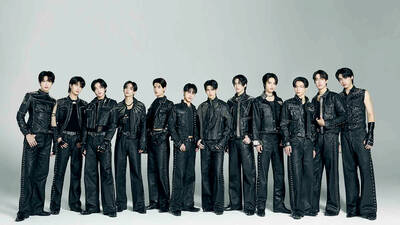
A: In early May, there were concerts by Icyball, Chyi Yu, Korea’s EXO and Japan’s Anisama, but I missed them all. What a shame. B: That’s OK. There are shows coming up by various artists, including Power Station, Accusefive, Japanese singer Mika Nakashima, Chinese-Icelandic jazzer Laufey, and even Singaporean diva Stefanie Sun. A: After a 12-year hiatus, Stefanie is finally returning to Taipei again. B: In late May, there will be more shows by Crowd Lu, WeiBird, Korea’s Donghae, 2AM, EXID, and Thailand’s BUS. A: The Thai boyband is so popular. It looks like “T-pop” is catching up with J-pop


 RSS
RSS