


More than 5 billion of the estimated 16 billion mobile phones possessed worldwide will likely be discarded or stashed away in 2022, experts said Thursday last week, calling for more recycling of the often hazardous materials they contain.
Stacked flat on top of each other, that many disused phones would rise 50,000 kilometers, more than 100 times higher than the International Space Station, the waste electrical and electronic equipment (WEEE) research consortium found.
Despite containing valuable gold, copper, silver, palladium and other recyclable components, almost all these unwanted devices will be hoarded, dumped or incinerated, causing significant health and environmental harm.
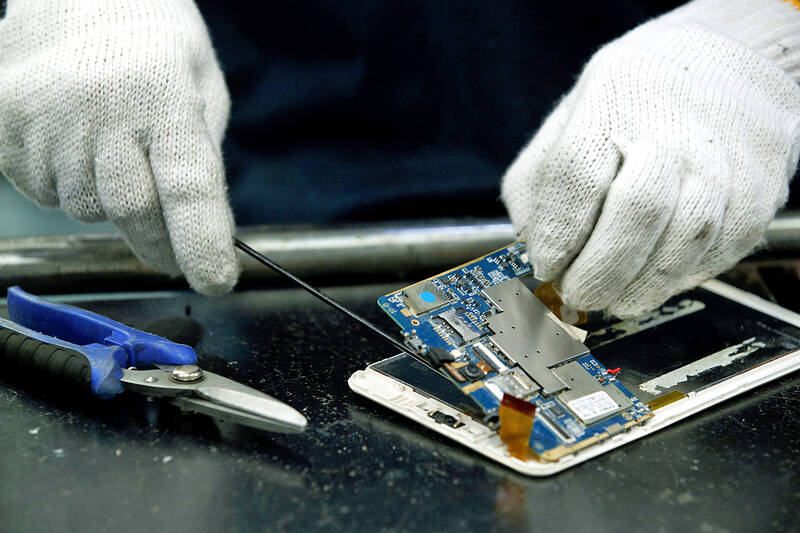
Photo: EPA-EFE 照片:歐新社
“Smartphones are one of the electronic products of highest concern for us,” said Pascal Leroy, director-general of the WEEE Forum, a not-for-profit association representing 46 producer responsibility organizations.
“If we don’t recycle the rare materials they contain, we’ll have to mine them in countries like China or Congo,” Leroy told AFP.
Defunct cellphones are just the tip of the 44.48 million tonne iceberg of global electronic waste generated annually that is not recycled, according to the 2020 global e-waste monitor.
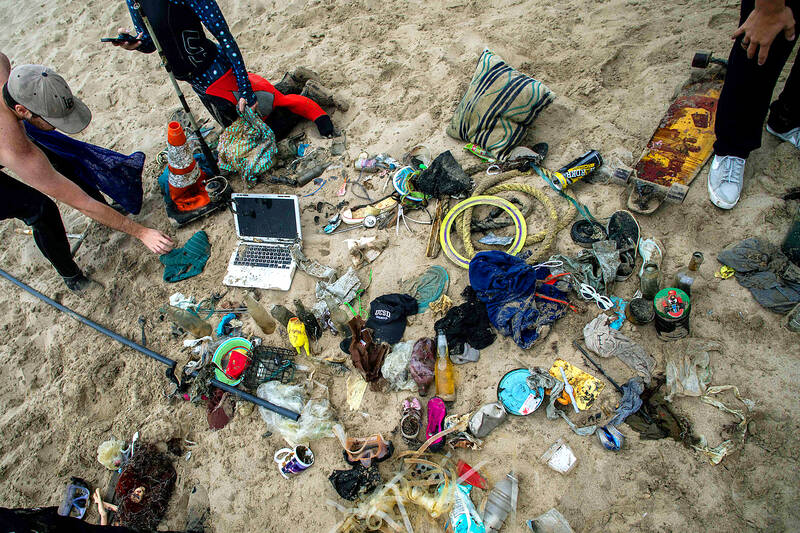
Photo: AFP 照片:法新社
Many of the 5 billion phones withdrawn from circulation will be hoarded rather than dumped in the trash, according to a survey in six European countries from June to September 2022.
This happens when households and businesses forget cellphones in drawers, closets, cupboards or garages rather than bringing them in for repair or recycling.
Up to five kilos of e-devices per person are currently hoarded in the average European family, the report found.
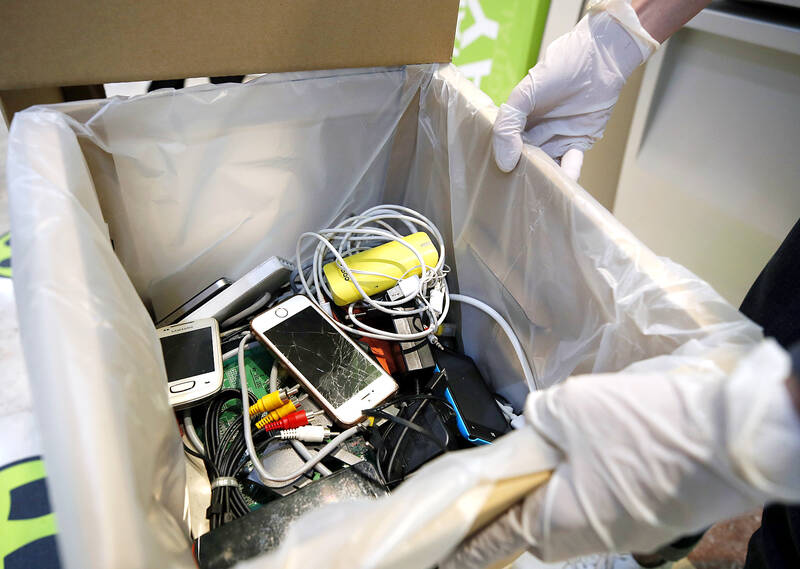
Photo: EPA-EFE 照片:歐新社
According to the new findings, 46 percent of the 8,775 households surveyed considered potential future use as the main reason for hoarding small electrical and electronic equipment.
Another 15 percent stockpile their gadgets with the intention of selling them or giving them away, while 13 percent keep them due to “sentimental value”.
Societal challenge
“People tend not to realize that all these seemingly insignificant items have a lot of value, and together at a global level represent massive volumes,” said Pascal Leroy.
“But e-waste will never be collected voluntarily because of the high cost. That is why legislation is essential.”
This month the European Parliament passed a new law requiring USB-C to be the single charger standard for all new smartphones, tablets and cameras from late 2024.
The move is expected to generate annual savings of at least 200 million euros (US$195 million) and cut more than 1,000 tonnes of EU electronic waste every year.
According to Kees Balde, senior scientific specialist at the United Nations Institute for Training and Research (UNITAR), legislation in Europe has prompted higher e-waste collection rates in the region compared to other parts of the world.
“At the European level, 50 to 55 percent of e-waste is collected or recycled,” Balde told AFP. “In low-income countries, our estimates plunge to under 5 percent and sometimes even below 1 percent.”
At the same time, thousands of tonnes of e-waste are shipped from wealthy nations — including members of the EU — to developing countries every year, adding to their recycling burden.
At the receiving end, financial means are often lacking for e-waste to be treated safely. Hazardous substances such as mercury and plastic can contaminate soil, pollute water and enter the food chain, as happened near a Ghanaian e-waste dumpsite.
(AFP)
專家上週四表示,二〇二二年全球人口所擁有的計160億支手機中,有超過50億支可能會被丟棄或束之高閣,呼籲加強回收這些手機所含的危險物質。
廢電子及電器設備處理指令(WEEE)研究聯盟發現,將這麼多的廢棄手機堆疊起來,會有五萬公里高,比國際太空站離地面的距離還高一百多倍。
儘管這些不要的設備含有有價值的金、銅、銀、鈀及其他可回收成分,但幾乎全都會被囤積、丟棄或焚化,而對健康和環境造成重大危害。
「智慧手機是最令我們擔心的電子產品之一」,代表四十六個生產者責任組織的非營利協會 WEEE 論壇總幹事巴斯卡‧李若伊說。
「如果不回收這些手機裡的稀有材料,我們將不得不到中國或剛果等國家去開採」,李若伊對法新社表示。
根據全球電子廢棄物監測機構二〇二〇年的數據,報廢的手機只是全球每年產生的4,448萬噸未回收電子廢棄物的冰山一角。
根據二〇二二年六月至九月在六個歐洲國家進行的一項調查,這五十億支不再使用的手機,其中有很多會被囤積起來,而不是丟進垃圾桶。
家庭和企業將手機遺忘在抽屜、衣櫥、櫥櫃或車庫,而不是將它們拿去修理或回收,就是這種囤積的情況。
該報告發現,目前歐洲一般家庭中每人囤積的電子設備高達五公斤重。
根據這項新發現,在接受調查的8,775戶家庭中,46%的家庭之所以囤積小型電器及電子設備,主要是因為覺得未來可能會用到它。
另有15%的人囤積他們的小裝置是為了要出售或是送人,而13%的人是因為「情感價值」而保留它。
社會挑戰
「人們往往沒有意識到,所有這些看似微不足道的物品都具有很大的價值,並且在全世界的數量非常巨大」,李若伊說。
「但由於成本高昂,人們永遠不會自願收集電子垃圾。這就是立法必不可少的原因」。
本月,歐洲議會通過了一項新法律,要求二〇二四年底之後所推出的智慧手機、平板電腦與相機,都必需以USB-C做為單一充電器標準。
此舉預計每年可節省至少兩億歐元(1.95 億美元),並在歐盟每年減少一千多噸電子垃圾。
根據聯合國訓練研究所(UNITAR)高級科學專家基斯‧巴德的說法,與世界其他地區相比,歐洲的立法促使其電子垃圾回收率更高。
「在歐洲,50-55%的電子垃圾被收集或回收」,巴德告訴法新社。「在低收入國家,我們估計低至5%以下,有時甚至低於1%」。
與此同時,每年有數千噸電子垃圾從富裕國家——包括歐盟成員國——運往發展中國家,增加了他們的回收負擔。
電子廢棄物的接收方,通常缺乏安全處理電子廢物的經濟手段:汞和塑膠等有害物質會污染土壤、污染水並進入食物鏈,就像迦納電子廢棄物垃圾場附近發生的那樣。
(台北時報林俐凱編譯)


★ Bilingual Story is a fictionalized account. 雙語故事部分內容純屬虛構。 Lucas was already on the ground before he fully understood what was happening. “Hurry! Kneel down!” someone shouted. The asphalt was warm against his knees. Around him, dozens of people lay flat in the narrow street outside Jenn Lann Temple in Dajia. Some pressed their hands together in prayer. Others closed their eyes. Lucas had only come to look at the temple. An hour earlier he had stepped into the noisy courtyard out of curiosity. Inside the main hall, people held incense sticks, bowed three times,

You might think knitting is only for grandmas, but surprisingly, many young people are embracing so-called “grandma hobbies.” On social media platforms, activities such as home cooking, embroidery and gardening are becoming popular among teenagers and young adults who are drawn to their relaxing and creative nature. “Grandma hobbies” typically refer to activities that are slow-paced, handmade and nostalgic. Common examples include knitting scarves, baking cookies, sewing clothes and growing plants. These hobbies were once part of everyday life for many women in previous generations, but today they provide an escape from the fast-paced digital world. The appeal

A: Isn’t the 2026 Coachella Valley Music and Arts Festival — a massive music event held every April — about to open in California? B: Yeah the festival is set to take place over two weekends, from April 10 to 12 and 17 to 19, US time. A: I heard this year’s main stage headliners include Sabrina Carpenter, Justin Bieber, Karol G and EDM DJ Anyma. B: The K-pop army is also making an appearance, with legendary group BigBang, SHINee member Taemin and girl group Katseye debuting for the first time. A: Isn’t Coachella also live-streamed on its YouTube

Visitors walking down the streets of London and other major English cities might notice a curious sight. Many of the old __1__ have some of their windows boarded up. What’s even stranger is that there doesn’t appear to be any consistent pattern as to which windows get covered. This architectural __2__ dates back over 300 years during a time when “coin clipping” was a common crime in England. Back then, silver coins had simple designs with __3__, unmarked edges. Without any pattern extending to the coins’ rims, it was difficult to tell if the edges had been __4__. This


 RSS
RSS