


A massive fire ripped through a slum in Bangladesh’s capital of Dhaka on Wednesday, leaving thousands of people homeless. Hundreds of shanties were destroyed in the Rupnagar slum in the city’s Mirpur area, witnesses said.
As many as 150 firefighters scrambled to get access to enough water and battled for three hours to bring the flames under control, said fire service official Zillur Rahman.
There were no immediate reports of casualties. The cause of the fire was not immediately known. Video footage showed heavy plumes of smoke billowing all around the congested slum area.
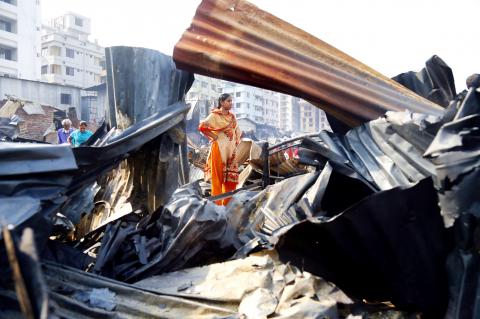
Photo: EPA-EFE
照片:歐新社
Lax regulations and poor enforcement have often been blamed for large fires in the South Asian nation that have killed hundreds of people in recent years.
At least 25 people were killed in March last year when fire broke out in a 22-storey commercial building in Dhaka’s upscale area of Banani.
In February last year, an inferno in a centuries-old neighborhood of Dhaka killed 71 people and injured dozens.
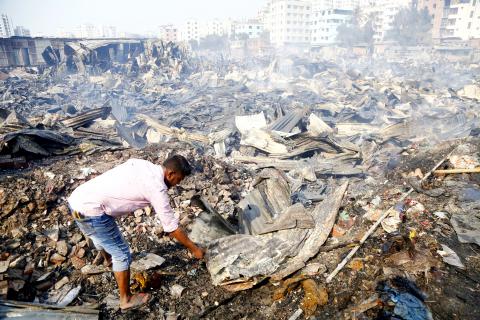
Photo: EPA-EFE
照片:歐新社
(Reuters)
孟加拉首都達卡的一處貧民窟,本週三慘遭大火肆虐,導致數千人無家可歸。據目擊者指出,有數百間簡陋的小屋,在這場發生於該城米爾布爾地區魯普納加的大火中均被燒毀。
消防局官員拉赫曼說,多達一百五十名消防員緊急尋找足夠的水源進行灌救,奮戰了三小時才把火勢控制住。
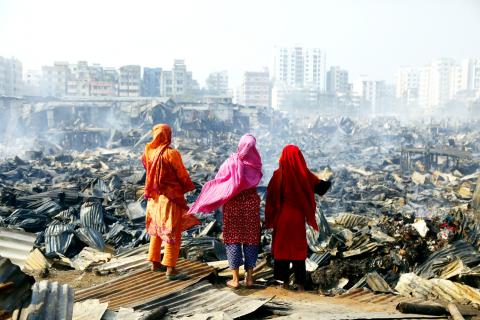
Photo: EPA-EFE
照片:歐新社
目前還沒傷亡人數的立即報告,起火原因尚不得而知,影像則顯示強烈的滾滾濃煙籠罩著擁塞的貧民窟地區。
法規鬆散與執法不力,常被視為該南亞國家發生大火的原因,而這些火災近年來已造成數百人喪生。
至少有二十五人於去年三月時,在達卡高檔的巴納尼地區,一棟二十二層商業大樓所發生的大火中喪生。
而去年二月時,達卡一處數百年歷史的社區亦冒出熊熊烈火,不幸造成七十一人死亡及數十人受傷。
(台北時報張聖恩譯)

Have you ever wondered how people navigate the world when they can’t see a map? For individuals with visual impairments, conventional maps are nearly impossible to use. This is where tactile maps come in — essential tools that allow people to “see” the world through touch. A tactile map is specially designed with raised lines, textures, and symbols to represent geographical features such as roads, rivers, and buildings. Users explore it with their fingertips. However, these maps are not exclusively for people with visual disabilities. They serve as valuable multisensory learning tools that enhance spatial understanding for everyone, making

The debate surrounding Taipower’s recent corporate identity reboot has gone well beyond the design community. The controversy began after Taipower replaced the familiar “Taiwan Power Company” wording — widely regarded as the calligraphy of Yu You-ren (1879-1964), former Control Yuan president and master calligrapher — with a modern logotype by designer Aaron Nieh’s team, Aaron Nieh Workshop. Taipower said the change was not a wholesale replacement of old signage, but an “optimization of its identity system,” aimed at meeting the needs of digital media, electronic bills, apps, social media graphics and various small-format applications. Existing physical markings, such as building

Since 2005, the third Monday in January has come to be known as “Blue Monday.” In other words, that day is believed to be the most depressing day of the year. This concept seems logical at first. After all, Monday marks the start of the school or workweek after two days of rest and fun. Also, blue is a color that is often associated with sadness. Furthermore, in many parts of the world, January is a time when the weather is cold, rainy, and gloomy. But is there any scientific proof that this January day is truly sadder than any of

Continued from yesterday(延續自昨日) https://www.taipeitimes.com/News/lang For the most part, the idea of “Blue Monday” has been rejected as a myth. Some mental health experts also say there is a danger in labeling a certain day as the most depressing time of the entire year. Some argue that if people expect to feel sadder on the third Monday in January, this belief alone may increase their anxiety. One group that is worried about the negative effect of believing in Blue Monday is Samaritans. A mental health charity based in the UK, Samaritans is working to turn Blue Monday into “Brew Monday.” In this


 RSS
RSS