


Chiayi City’s Dongnanyu Syuanhuang Temple undertook a pilgrimage to Alishan’s Shoujhen Temple for the sixth consecutive year on Friday, setting off at 10 in the morning. When the group arrived at a 7-11 convenience store in Jhongpu Township in Chiayi County at around 1pm, they were joined by a stray dog, who would keep up with the pilgrims, sometimes lagging behind, sometimes running ahead, but at all times wary of them, keeping its distance and not allowing them to get near or pet it.
The little stray kept on like this, trotting along with the pilgrims as if it were an emissary of the gods, but after walking over 10km along the mountain road in this way, the pilgrims noticed that the dog, whom they’d nicknamed “Langlang” by this point, was showing signs of tiredness. They swept Langlang up and put him on the back of the truck accompanying the pilgrimage, giving him the chance to rest up and catch his breath. As night fell and the temperature dropped, people cobbled together a reflective coat that would keep Langlang warm.
Perhaps because he was now well-rested and his stomach full, Langlang’s strength returned. Having been treated kindly by the temple pilgrims, Langlang was now quite content to let them pet him and carry him along with them, and in no time Langlang had officially become accepted as part of the pilgrimage group. By the time the group arrived at their destination at midday on Saturday, he was a paid-up member of the team.
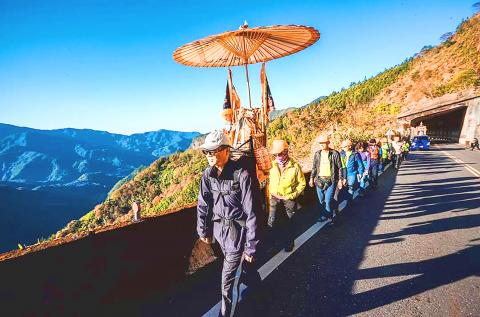
Photo courtesy of the DongnanYu syuanHuang Temple
照片:東南獄玄隍殿提供
According to Wu Tien-chieh, the director of the Dongnanyu Syuanhuang Temple, the pilgrims had marched up the mountain, taking turns to carry the temple deity, and during the entire 160km journey there and back they had not stopped to rest once, with the exception of the time spent at the Shoujhen Temple and times to eat meals. Everyone in the pilgrimage had shown real devotion and commitment, Wu said, and nobody flagged at all. This year, he said, over 70 people had attended, 20 more than the 50 or so who had gone along the previous year, and this year they had the addition of a canine pilgrim, Langlang.
The group returned on Sunday, and somebody had already decided they would adopt Langlang, the dog who joined them on their trek up the mountain.
(Translated by Paul Cooper, Taipei Times)
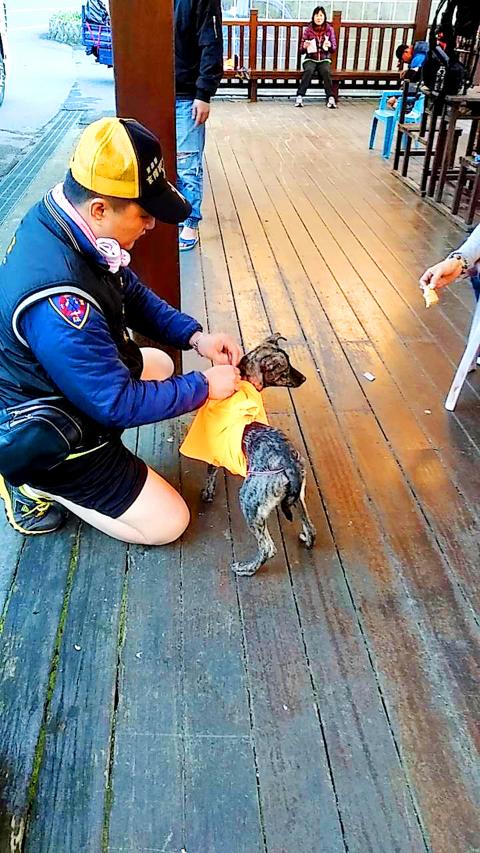
Photo courtesy of the DongnanYu syuanHuang Temple
照片:東南獄玄隍殿提供
嘉義市東南嶽玄隍殿今年連續第六年徒步上山到阿里山受鎮宮謁祖會香,週五上午十點出發,大約下午一點抵達嘉義縣中埔鄉頂六統一超商時,突然有一隻流浪狗加入會香隊伍、跟前跟後,但仍保有「浪浪」警覺性,不讓香客撫摸。
宛如「神命」般,這隻黑色流浪狗就這樣跟著進香隊伍一路前進,走了大約十幾公里的山路後,有信眾發現「浪浪」出現體力不支現象,趕緊將牠抱上隨行卡車,讓牠休息喘口氣,由於入夜山上氣溫降到個位數,大家還幫牠穿上反光背心保暖。
可能休息、吃飯後體力恢復,並感受東南嶽玄隍殿信眾的善意,「浪浪」願意讓信眾們撫摸、抱著,於是「浪浪」正式成了會香隊的成員,於週六中午十二點抵達目的地受鎮宮,也乖乖著夾在上香人群中。
東南嶽玄隍殿總執事吳典杰表示,東南嶽玄隍殿信眾們輪流背著玄天上帝神像朝山,來回一百六十公里,全程除了在受鎮宮會香、用餐外,都沒有停下腳步,不眠不休,考驗著成員的毅力與耐力,但大家不以為苦,今年有七十多人參與,比去年的五十多人增加二十人,另加一隻「浪浪」。
謁祖會香預計週日中午返回東南嶽玄隍殿,已經有信眾預約認養跟著大家朝山的「浪浪」。
(自由時報)

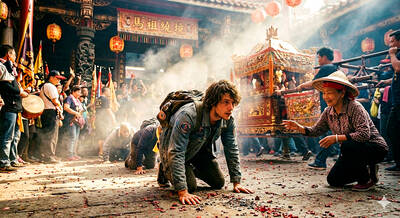
★ Bilingual Story is a fictionalized account. 雙語故事部分內容純屬虛構。 Lucas was already on the ground before he fully understood what was happening. “Hurry! Kneel down!” someone shouted. The asphalt was warm against his knees. Around him, dozens of people lay flat in the narrow street outside Jenn Lann Temple in Dajia. Some pressed their hands together in prayer. Others closed their eyes. Lucas had only come to look at the temple. An hour earlier he had stepped into the noisy courtyard out of curiosity. Inside the main hall, people held incense sticks, bowed three times,

A: Apart from the musical The Phantom of the Opera, off-Broadway classic “I Love You, You’re Perfect, Now Change” and musical-themed concert “Broadway Hits Live” are also touring Taiwan. B: Musical-themed concert? That sounds interesting. A: Set for April 18 and 19, the show will feature a group of Broadway vocalists and dancers — with British singer Keala Settle as a special guest. B: So the audience can enjoy all the timeless hits from various shows at one concert. . . I like that. A: And there’s more: Andrew Lloyd Webber’s classic musical Jesus Christ Superstar will finally visit Taiwan for the first time

Visitors walking down the streets of London and other major English cities might notice a curious sight. Many of the old __1__ have some of their windows boarded up. What’s even stranger is that there doesn’t appear to be any consistent pattern as to which windows get covered. This architectural __2__ dates back over 300 years during a time when “coin clipping” was a common crime in England. Back then, silver coins had simple designs with __3__, unmarked edges. Without any pattern extending to the coins’ rims, it was difficult to tell if the edges had been __4__. This

Despite being a basic tool, pens come in a wide variety of forms. Classic styles include fountain pens, which deliver liquid ink smoothly through metal tips. Another common type is the ballpoint pen, which is easy to use. There are even special felt pens that are especially popular among artists. __1__ They have a small hole at the top. So why is it there in the first place? Could it actually be a design flaw? __2__ Since 1991, companies such as BIC have been producing ballpoint pens with holes in their caps for two main reasons: quality control


 RSS
RSS