


The Indian discipline of yoga, involving spiritual and physical practices, is followed in myriad forms today by millions of people worldwide, with an entry in UNESCO’s intangible cultural heritage list.
Friday was International Yoga Day.
The word “yoga” has its origins in the ancient Sanskrit language and means “to attach, join, harness, yoke.”
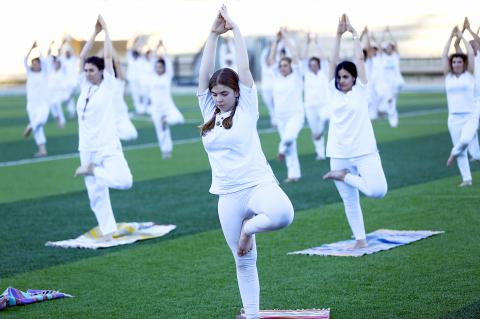
Photo: EPA
照片:歐新社
Yoga first appeared in ancient texts such as the sacred Hindu epic the Bhagavad Gita, written between the fifth and second centuries BC.
It is born of an “awareness of the unsatisfactory character of the human condition,” says India specialist Tara Michael, author of the book Yoga published in France in 1980. The practice emerged as a way of transcending this suffering. However in its present-day use, yoga is often no more than a form of exercise, Michael says.
Yoga became known in the West towards the end of the 19th century as it was undergoing a major revival in India under the Hindu teacher Swami Vivekananda. This philosopher-monk stressed yoga’s rational and scientific qualities in a bid to make the discipline compatible with the West.

Photo: AFP
照片:法新社
Modern Western references such as the Oxford English Dictionary define yoga as a “spiritual and ascetic discipline” which includes “breath control, simple meditation, and the adoption of specific bodily postures.”
Indian metaphysics captured the imagination of counter-cultural movements of the 1960s and 1970s, as epitomized by the relationship between The Beatles and the Indian guru Maharishi Mahesh.
Yoga as a spiritual practice was popularized at this time with the more athletic and dynamic methods developed in the 1980s and 1990s, says Mark Singleton from the School of Oriental and African Studies in London.
It is difficult to say just how many people practice yoga around the world today, although some estimate it could be up to around 200 to 300 million.
Studies have shown its benefits for dealing with anxiety, depression and sleep disorders, with yoga considered more effective than a simple physical activity but less than psychotherapy.
Since coming to power in 2014, India’s Prime Minister Narendra Modi has used yoga as an emblem of India’s flourishing in the world, pushing for the UN resolution that has — since 2015 — consecrated June 21 as International Yoga Day.
UNESCO added yoga to its list of intangible cultural heritage in 2016 in recognition of its influence on Indian society, “from health and medicine to education and the arts.”
(AFP)
瑜伽這門印度的修習,是心靈和身體的修練,全世界有數百萬人參與,有非常多種樣式。瑜珈也被聯合國教科文組織登錄為非物質文化遺產。
上週五即為「國際瑜伽日」。
「瑜伽」一詞來自古梵語,意思是「附著、加入、駕馭、套上枷鎖」。
瑜伽一詞是在古代典籍中首次出現,例如西元前五世紀至前二世紀間寫成的印度教經典──史詩《博伽梵歌》。
印度專家塔拉‧米克爾在其一九八○年於法國出版的《瑜伽》一書中說,瑜珈誕生於「對人類境況不滿的體認」,做瑜珈是為了要超越這種痛苦。然而米克爾說,現今「瑜伽」通常指的不過是一種運動形式。
十九世紀末,瑜伽經印度導師辨喜(又譯為斯瓦米‧維韋卡南達)的復興而發揚光大,傳播到西方而廣為人知。辨喜這位哲學家僧侶強調瑜伽的理性和科學特質,以使瑜伽跟西方文化接軌。
現代西方的參考文獻,例如《牛津英語詞典》,將瑜伽定義為「心靈及苦修之學門」,其內容包括「呼吸控制、簡單冥想,以及採用特定的身體姿勢」。
印度的形而上學深深吸引了一九六○及七○年代的反文化運動,其中以披頭四樂團成員追隨印度大師瑪哈禮希‧瑪赫西最具代表性。
倫敦大學亞非學院的馬克‧辛果頓表示,瑜伽作為一種心靈實踐,在一九八○和九○年代由於開發出更具運動性和動感的方法,而變得普及。
現今全世界有多少人做瑜伽,很難計算出來,雖然有人估計可能高達兩億至三億人。
研究顯示做瑜伽有益於治療焦慮、憂鬱和睡眠障礙──瑜伽的功效被認為大於簡單的身體活動,但小於心理治療。
印度總理納倫德拉‧莫迪自二○一四年上台以來,便將瑜伽作為印度在世界蓬勃發展的象徵,推動聯合國做出決議──自二○一五年起,將六月二十一日訂為「國際瑜伽日」。
聯合國教科文組織在二○一六年將瑜伽列為非物質文化遺產,以表彰它「從健康及醫學到教育及藝術」對印度社會的影響。
(台北時報林俐凱編譯)

Have you ever wondered how people navigate the world when they can’t see a map? For individuals with visual impairments, conventional maps are nearly impossible to use. This is where tactile maps come in — essential tools that allow people to “see” the world through touch. A tactile map is specially designed with raised lines, textures, and symbols to represent geographical features such as roads, rivers, and buildings. Users explore it with their fingertips. However, these maps are not exclusively for people with visual disabilities. They serve as valuable multisensory learning tools that enhance spatial understanding for everyone, making

The debate surrounding Taipower’s recent corporate identity reboot has gone well beyond the design community. The controversy began after Taipower replaced the familiar “Taiwan Power Company” wording — widely regarded as the calligraphy of Yu You-ren (1879-1964), former Control Yuan president and master calligrapher — with a modern logotype by designer Aaron Nieh’s team, Aaron Nieh Workshop. Taipower said the change was not a wholesale replacement of old signage, but an “optimization of its identity system,” aimed at meeting the needs of digital media, electronic bills, apps, social media graphics and various small-format applications. Existing physical markings, such as building

Since 2005, the third Monday in January has come to be known as “Blue Monday.” In other words, that day is believed to be the most depressing day of the year. This concept seems logical at first. After all, Monday marks the start of the school or workweek after two days of rest and fun. Also, blue is a color that is often associated with sadness. Furthermore, in many parts of the world, January is a time when the weather is cold, rainy, and gloomy. But is there any scientific proof that this January day is truly sadder than any of

Continued from yesterday(延續自昨日) https://www.taipeitimes.com/News/lang For the most part, the idea of “Blue Monday” has been rejected as a myth. Some mental health experts also say there is a danger in labeling a certain day as the most depressing time of the entire year. Some argue that if people expect to feel sadder on the third Monday in January, this belief alone may increase their anxiety. One group that is worried about the negative effect of believing in Blue Monday is Samaritans. A mental health charity based in the UK, Samaritans is working to turn Blue Monday into “Brew Monday.” In this


 RSS
RSS