


The UN climate change talks ended late on Saturday night in Poland with a deal agreed on how to put the 2015 Paris agreement into action, but with other contentious problems left to be resolved next year.
Countries thrashed out the complex details of how to account for and record their greenhouse gas emissions, which will form the basis of a “rulebook” on putting the Paris goals into action.
However, difficult questions such as how to scale up existing commitments on cutting emissions, in line with stark scientific advice, and how to provide finance for poor countries to do the same, were put off for future years.
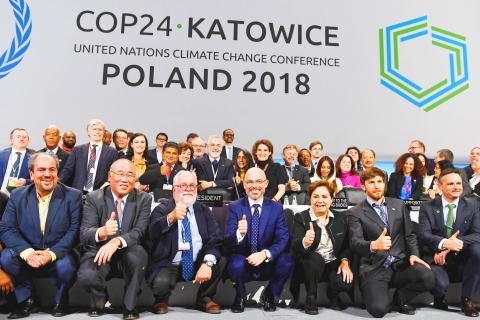
Photo: EPA
照片:歐新社
In the final hours, agreement was held up by a debate over the market in carbon credits, awarded to countries for their emissions-cutting efforts and for their carbon sinks, such as forests, which absorb carbon dioxide.
The key deadline is 2020, when countries must show they have met targets set a decade ago for cutting their emissions, and when they must affirm new, much tougher targets.
After years in which the world’s carbon emissions appeared to be stabilizing, they are on the rise again. Coal use continues and oil is still the engine of much of the world’s economy. Clean energy is coming on-stream at a faster rate than many predicted, and the costs of it have come down rapidly, but its adoption needs to be speeded up.
Infrastructure, such as energy generation plants, transport networks and buildings, is a central issue: infrastructure built now to rely on high-carbon energy effectively locks in high emissions for decades to come. Some people are also saying we need to invest in projects to remove carbon from the atmosphere, and a new focus of the talks is helping countries to adapt to the effects of climate change.
The US, Russia, Saudi Arabia and Kuwait joined forces to prevent the conference fully embracing the Intergovernmental Panel on Climate Change’s (IPCC) findings, watering down a statement to a weak commendation of the timing of the scientists’ report. Australia joined with the US in a celebration of coal, and Brazil signalled its climate scepticism under Brazilian president-elect Jair Bolsonaro by withdrawing its offer to host next year’s talks.
However, the EU, a handful of other developed countries and scores of developing nations including the poorest and most vulnerable affirmed that they would strive to meet the IPCC’s advice on limiting warming to no more than 1.5 degrees Celsius.
The UN will meet again next year in Chile to thrash out the final elements of the Paris rulebook and begin work on future emissions targets. The crunch conference will come in 2020, when countries must meet the deadline for their current emissions commitments and produce new targets for 2030 and beyond that go further towards meeting scientific advice.
(The Guardian)
聯合國氣候變化談判上週六晚間在波蘭閉幕,與會各國對落實二○一五年巴黎氣候協議的方式達成共識,但其他爭議性的問題,則有待明年解決。
各國討論出溫室氣體排放的計算和記錄等複雜細節,這將是巴黎氣候協定實施細則「規則手冊」的基礎。
然而,如何擴大現有的減排承諾,以因應科學的嚴峻警告,以及如何為貧窮國家提供資金以實現此目標等難題,都被擱置、留待來年解決。
在會議結束前幾小時,對碳信用額市場的歧見讓協議遲遲無法拍板定案。「碳信用額」是用來獎勵各國減少碳排放和增加可吸收二氧化碳的「碳匯」(例如森林)。
關鍵的最後期限是二○二○年,屆時各國必須達到十年前訂下的減少碳排放的目標,並且必須確立新的、更嚴格的目標。
世界的碳排放似乎穩定了許多年,現在又再度上升。世界仍繼續使用煤炭,石油也仍是世界大部分地區經濟成長的驅動力。清潔能源正以超出許多人預期的速度發展,其成本已迅速下降,但對清潔能源的採用也需要加快速度。
核心問題是基礎設施,例如能源發電廠、交通網路和建築:現在所建設的基礎設施,是仰賴高碳排放的能源,這使得未來數十年將受高碳排放的桎梏。也有人說,應投資去除大氣中的碳,且談判的新焦點會幫助各國適應氣候變化所造成的影響。
美國、俄羅斯、沙烏阿拉伯和科威特則聯合起來,不讓峰會完全採用跨政府氣候變化專門委員會(IPCC)的調查結果,在聲明中將其重要性淡化,只是肯定該份報告的適時發布。澳洲與美國一起歌頌煤炭,巴西則撤回其提出舉辦明年談判的提議,表現出總統當選人雅伊爾‧博爾索納羅對氣候變化的懷疑態度。
然而,歐盟和少數其他已開發國家,以及許多發展中國家,包括一些最貧困和最脆弱的國家則表示,他們會竭力達到IPCC所建議的目標,將暖化限制在攝氏一點五度以下。
聯合國明年將在智利再度舉行會議,討論巴黎氣候協議實行細則的最終內容,並著手制訂未來的碳排放目標。關鍵會議將於二○二○年召開,屆時各國必須達成目前所承諾的碳排放目標,並制訂二○三○年及之後的新目標,以進一步達到科學研究所建議的程度。
(台北時報林俐凱編譯)


★ Bilingual Story is a fictionalized account. 雙語故事部分內容純屬虛構。 Lucas was already on the ground before he fully understood what was happening. “Hurry! Kneel down!” someone shouted. The asphalt was warm against his knees. Around him, dozens of people lay flat in the narrow street outside Jenn Lann Temple in Dajia. Some pressed their hands together in prayer. Others closed their eyes. Lucas had only come to look at the temple. An hour earlier he had stepped into the noisy courtyard out of curiosity. Inside the main hall, people held incense sticks, bowed three times,

You might think knitting is only for grandmas, but surprisingly, many young people are embracing so-called “grandma hobbies.” On social media platforms, activities such as home cooking, embroidery and gardening are becoming popular among teenagers and young adults who are drawn to their relaxing and creative nature. “Grandma hobbies” typically refer to activities that are slow-paced, handmade and nostalgic. Common examples include knitting scarves, baking cookies, sewing clothes and growing plants. These hobbies were once part of everyday life for many women in previous generations, but today they provide an escape from the fast-paced digital world. The appeal

A: Isn’t the 2026 Coachella Valley Music and Arts Festival — a massive music event held every April — about to open in California? B: Yeah the festival is set to take place over two weekends, from April 10 to 12 and 17 to 19, US time. A: I heard this year’s main stage headliners include Sabrina Carpenter, Justin Bieber, Karol G and EDM DJ Anyma. B: The K-pop army is also making an appearance, with legendary group BigBang, SHINee member Taemin and girl group Katseye debuting for the first time. A: Isn’t Coachella also live-streamed on its YouTube

Visitors walking down the streets of London and other major English cities might notice a curious sight. Many of the old __1__ have some of their windows boarded up. What’s even stranger is that there doesn’t appear to be any consistent pattern as to which windows get covered. This architectural __2__ dates back over 300 years during a time when “coin clipping” was a common crime in England. Back then, silver coins had simple designs with __3__, unmarked edges. Without any pattern extending to the coins’ rims, it was difficult to tell if the edges had been __4__. This


 RSS
RSS