


Researchers warned last Tuesday of a “troubling” accumulation of micro-plastics in sea ice floating in the Arctic ocean, a major potential source of water pollution as global warming melts the sheets of frozen water.
A team from the Alfred Wegener Institute for Polar and Marine Research (AWI) found 17 different plastic types in ice samples gathered during three Arctic expeditions on board the research icebreaker Polarstern in 2014 and 2015. They included plastic from shopping bags and food packaging, from ship paint, fishing nets, nylon and polyester found in synthetic fabrics and cigarette filters.
One sample contained the highest concentration of micro-plastics ever found in sea ice — up to 12,000 particles per liter of frozen water. This was two to three times higher than any past measurement, the research team wrote in the journal Nature Communications.
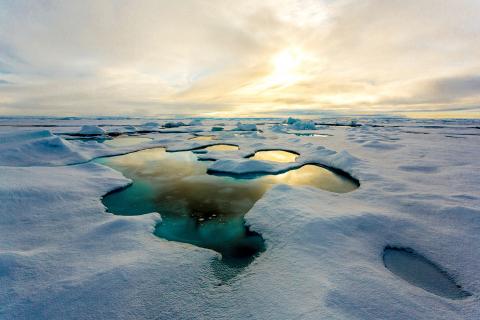
Photo: AFP
照片:法新社
The discovery suggests micro-plastics “are now ubiquitous within the surface waters of the world’s ocean,” sea ice physicist Jeremy Wilkinson of the British Antarctic Survey said in a comment on the study. “Nowhere is immune,” he said via the Science Media Centre in London.
Sea ice grows from the freezing of seawater directly underneath the existing ice, thus incorporating floating micro-plastics as it grows downward, he explained. This means the plastics were present as the ice was growing, and drifting, in the Arctic Ocean.
Of particular concern was the particles’ small size. Some were only 11 micrometers across — about a sixth the diameter of a human hair, the team said. This “means they could easily be ingested by Arctic micro-organisms, such as small crustaceans on which fish feed,” said study coauthor Ilka Peeken, an AWI biologist. “No one can say for certain how harmful these tiny plastic particles are for marine life, or ultimately also for human beings.”
Micro-plastics are less than five millimeters long, about the size of a sesame seed. They come in the form of “micro-beads” used in face scrubs and toothpaste, or are created when larger pieces are degraded by the sun, temperature changes, mechanic abrasion, or ocean wave action.
For the study, Peeken and a team used a spectrometer to bombard the ice cores with infrared light. They analyzed the radiation reflected by the plastic pieces to determine their likely origins. Samples from the Canada Basin, fed by water from the northeast Pacific via the Bering Strait, were high in polyethylene used in packaging material, leading the authors to conclude these particles came mainly from the so-called Great Pacific Garbage Patch — a swirling plastic dump in the ocean now bigger than France, Germany and Spain combined.
The contribution of micro-plastics to ocean pollution is unclear. According to environmental group WWF, 8.8 million tonnes of plastic enters the oceans every year, the equivalent of a garbage truck dumping a full load every minute. On current trends, warns the UN, there will be more plastic than fish in the sea by 2050. Other studies have recently warned that humans are unconsciously ingesting micro-plastics from shellfish, tap water and bottled water.
(AFP)
研究人員上週二發布警示,指出在北極海漂流的海冰裡,塑膠微粒累積已達到「令人擔憂」的程度。隨著全球暖化導致大片冰蓋融解,塑膠微粒會是重大的潛在水汙染來源。
來自阿爾弗雷德‧韋格納極地與海洋研究所(AWI)的一組研究團隊,於二○一四年和二○一五年登上研究型破冰船「北極星號」,在三次北極探勘中蒐集了海冰樣本。團隊在這些海冰樣本中發現十七種不同類型的塑膠,包括購物袋和食物包裝用的塑膠素材、船隻的塗漆、魚網、可在合成織物中發現的尼龍與聚酯纖維,以及香菸濾嘴。
其中一個樣本含有目前在海冰中發現塑膠微粒的最高濃度──一公升的結冰海水中含有高達一萬兩千個塑膠顆粒。研究團隊在期刊《自然通訊》中寫道,這個濃度比過去的測量結果高出了二到三倍。
英國南極調查局的海冰物理學家傑瑞米‧威金森評論這份研究時指出,該項發現顯示出塑膠微粒「目前已遍布於世界上的海洋表層。」他透過倫敦的科學媒體中心表示:「無處得以倖免。」
威金森解釋,海冰的增長來自於海水直接在現存的海冰底下結凍,向下增厚的海冰遂因此納入漂流的塑膠微粒。這意味著,當海冰形成,並且漂流在北極海上時,確實有塑膠存在。
這些塑膠顆粒微小的尺寸特別讓人憂心。研究團隊指出,有些顆粒僅有十一微米寬──大約是人類頭髮直徑的六分之一。這份研究的共同作者伊爾卡‧佩肯指出,這「代表塑膠顆粒能夠輕易地被北極海的微生物吃下去,例如魚類賴以為食的小型甲殼亞門動物。」佩肯也是AWI的生物學家,她表示:「沒有人能確定這些微小塑膠顆粒的有害程度,對於海洋生物或是最終對於人類而言,到底會有多嚴重。」
塑膠微粒長度小於五公釐,尺寸約為一顆芝麻大小。它們來自洗面乳或牙膏裡會用到的「清潔柔珠」,或是因為較大的塑膠受到陽光照射、溫度變化、機械磨損、或是海洋波浪而被分解所產生。
為了這份研究,佩肯與研究團隊使用一台光譜儀,不斷向海冰核心發射紅外線光束。他們分析塑膠碎片反射出的放射線,以測定塑膠的可能來源。在加拿大海盆採到的樣本中,他們發現用於包裝材料的大量聚乙烯,由於海水主要是由太平洋東北部經白令海峽流入當地,因此作者群推斷這些顆粒主要來自於所謂的「大太平洋垃圾帶」──這個在海洋中不斷自旋的塑膠垃圾堆積場,今日面積已大於法國、德國加上西班牙的總和。
塑膠微粒對海洋汙染的影響至今仍然無法確定。根據環保團體世界自然基金會指出,每年有八百八十萬噸的塑膠進入海洋,相當於每分鐘都有一台垃圾車滿載塑膠廢棄物倒入海中。聯合國也發出警示,照目前趨勢來看,到二○五○年時海裡的塑膠會比魚還多。其他近期研究也警告人類在不知情的情況下從貝類、自來水,以及瓶裝水中吃下塑膠微粒。
(台北時報章厚明譯)


★ Bilingual Story is a fictionalized account. 雙語故事部分內容純屬虛構。 Lucas was already on the ground before he fully understood what was happening. “Hurry! Kneel down!” someone shouted. The asphalt was warm against his knees. Around him, dozens of people lay flat in the narrow street outside Jenn Lann Temple in Dajia. Some pressed their hands together in prayer. Others closed their eyes. Lucas had only come to look at the temple. An hour earlier he had stepped into the noisy courtyard out of curiosity. Inside the main hall, people held incense sticks, bowed three times,

You might think knitting is only for grandmas, but surprisingly, many young people are embracing so-called “grandma hobbies.” On social media platforms, activities such as home cooking, embroidery and gardening are becoming popular among teenagers and young adults who are drawn to their relaxing and creative nature. “Grandma hobbies” typically refer to activities that are slow-paced, handmade and nostalgic. Common examples include knitting scarves, baking cookies, sewing clothes and growing plants. These hobbies were once part of everyday life for many women in previous generations, but today they provide an escape from the fast-paced digital world. The appeal

A: Isn’t the 2026 Coachella Valley Music and Arts Festival — a massive music event held every April — about to open in California? B: Yeah the festival is set to take place over two weekends, from April 10 to 12 and 17 to 19, US time. A: I heard this year’s main stage headliners include Sabrina Carpenter, Justin Bieber, Karol G and EDM DJ Anyma. B: The K-pop army is also making an appearance, with legendary group BigBang, SHINee member Taemin and girl group Katseye debuting for the first time. A: Isn’t Coachella also live-streamed on its YouTube

Visitors walking down the streets of London and other major English cities might notice a curious sight. Many of the old __1__ have some of their windows boarded up. What’s even stranger is that there doesn’t appear to be any consistent pattern as to which windows get covered. This architectural __2__ dates back over 300 years during a time when “coin clipping” was a common crime in England. Back then, silver coins had simple designs with __3__, unmarked edges. Without any pattern extending to the coins’ rims, it was difficult to tell if the edges had been __4__. This


 RSS
RSS