


The Taiwanese artist Chen Cheng-po was born in Chiayi in 1895, the year China ceded Taiwan to Japan in the Treaty of Shiminoseki. During the period of Japanese rule, Western-style education and exhibitions were introduced into Taiwan by its new colonial masters, and oil painting, sculpture and the traditional Japanese nihonga style were to gradually replace the Chinese literati ink painting style that had held sway through the Ming and Qing dynasties.
Chen studied under Kinichiro Ishikawa in the painting division of the Taiwan Governor-General’s Language School — present day University of Taipei and National Taipei University of Education — before going on to graduate from the Tokyo School of Fine Arts, now Tokyo University of the Arts. From there he went to Shanghai to teach art, finally returning to live in Taiwan, forced to leave during the wave of anti-Japanese sentiment in China that resulted from the Shanghai Incident. Chen’s travels between China, Taiwan and Japan allowed him to explore and synthesize Chinese and Western elements, and he was to become a major figure in the Taiwanese art movement.
Academic oil painting at that time was very much influenced by the French Impressionists, with their emphasis on painting en plein air and rendering scenes with an accurate depiction of natural light. Chen pushed his art beyond the rigorous academic training he had received, opting for a naive style and seemingly unstudied rendering of perspective to create space, imparting his works with a unique energy, dynamism and emotional weight.
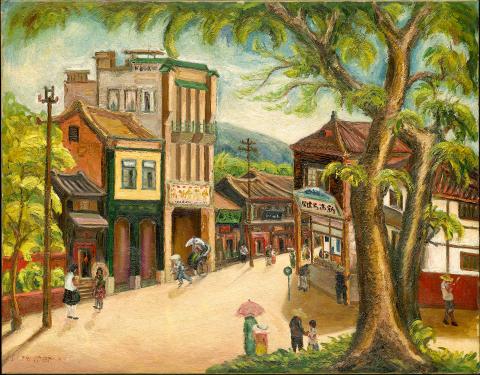
Photo courtesy of the Chen Cheng-po Cultural Foundation
圖片:陳澄波文化基金會提供
This painting, named Chiayi Street Scene and painted by Chen in 1934, depicts, in his unique rich palette and artistic voice, the place of his birth. Southern Taiwan’s bright sunlight bounces off the yellows of the ground, providing a contrast with the lush leaves and branches of the foreground trees. Passersby shield themselves under straw hats or parasols against the harsh sun beating down on them and the buildings lining the streets on which they walk, casting stark shadows on the ground below. This seemingly random street scene effortlessly presents life lived by ordinary people of the time, from their attire to the rickshaws to the appearance of the neighborhood itself, with the store signs, the new year couplets and the telegraph poles, and the Western-style buildings side-by-side with roofs in the southern Chinese architectural style providing further visual interest.
World War II ended, the Japanese surrendered, and the Chinese Nationalist (KMT) government assumed control over Taiwan. Chen, like many others among the Taiwanese elite, welcomed them in. Then, in 1947, came what was to become known as the 228 Incident. Chen was arrested by KMT government forces, taken into the streets of Chiayi, and summarily executed.
(Translated by Paul Cooper, Taipei Times)
台灣前輩畫家陳澄波在一八九五年出生於台灣嘉義,亦即甲午戰爭後中國將台灣割讓予日本的馬關條約簽訂之同年。日治時期經由日本引進西式學院教育及展覽體制,使油畫、雕塑、膠彩畫等媒材逐漸取代明清以降之文人水墨畫而成為學院主流。
陳澄波於台灣總督府國語學校(為台北市立大學及國立台北教育大學之前身)就讀期間師事石川欽一郎,畢業後於一九二四年考入東京美術學校,學成後舉家遷至上海擔任美術教授,一九三三年因中日一二八事變後之中國反日浪潮而返台定居。陳澄波穿梭於兩岸及日本,在風格上勇於探索、融會中西,而為台灣美術運動的重要人物。
當時學院的油畫風格源自法國的印象派,注重戶外寫生,在自然的光線下捕捉真實的光影。陳澄波經歷嚴謹的學院訓練而超越之,選擇以「素人」般的樸拙粗獷,以及古樸的透視法營造空間,使其作品充滿了特有的活力、動態與熱情。
本幅油畫《嘉義街景》為陳澄波先生於一九三四年繪製之作品,以他特有的濃郁色彩與熱情,來描繪其故鄉嘉義。亮黃色的土地反射南台灣的艷陽,與畫面近景枝葉森然的大樹形成對比。熾烈的陽光在地上投出人與建物鮮明的影子,路上行人或撐傘,或戴斗笠以遮陽。這看似尋常隨意一瞥的場景,非常自然地呈現了當時的庶民生活,包括裝束、人力車、街坊樣式、店鋪招牌、春聯、電線杆等,以及西式洋樓與傳統閩南式屋頂並列的視覺趣味。
二次世界大戰結束後日本投降,國民政府接收台灣,陳澄波如多數台籍菁英般熱烈歡迎,然而卻在一九四七年二二八事件中遭拘禁,未經審判而被當街槍決。
(台北時報林俐凱)


A: Apart from the musical The Phantom of the Opera, off-Broadway classic “I Love You, You’re Perfect, Now Change” and musical-themed concert “Broadway Hits Live” are also touring Taiwan. B: Musical-themed concert? That sounds interesting. A: Set for April 18 and 19, the show will feature a group of Broadway vocalists and dancers — with British singer Keala Settle as a special guest. B: So the audience can enjoy all the timeless hits from various shows at one concert. . . I like that. A: And there’s more: Andrew Lloyd Webber’s classic musical Jesus Christ Superstar will finally visit Taiwan for the first time
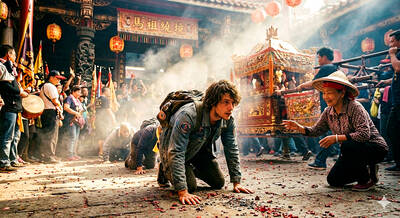
★ Bilingual Story is a fictionalized account. 雙語故事部分內容純屬虛構。 Lucas was already on the ground before he fully understood what was happening. “Hurry! Kneel down!” someone shouted. The asphalt was warm against his knees. Around him, dozens of people lay flat in the narrow street outside Jenn Lann Temple in Dajia. Some pressed their hands together in prayer. Others closed their eyes. Lucas had only come to look at the temple. An hour earlier he had stepped into the noisy courtyard out of curiosity. Inside the main hall, people held incense sticks, bowed three times,

Despite being a basic tool, pens come in a wide variety of forms. Classic styles include fountain pens, which deliver liquid ink smoothly through metal tips. Another common type is the ballpoint pen, which is easy to use. There are even special felt pens that are especially popular among artists. __1__ They have a small hole at the top. So why is it there in the first place? Could it actually be a design flaw? __2__ Since 1991, companies such as BIC have been producing ballpoint pens with holes in their caps for two main reasons: quality control

Visitors walking down the streets of London and other major English cities might notice a curious sight. Many of the old __1__ have some of their windows boarded up. What’s even stranger is that there doesn’t appear to be any consistent pattern as to which windows get covered. This architectural __2__ dates back over 300 years during a time when “coin clipping” was a common crime in England. Back then, silver coins had simple designs with __3__, unmarked edges. Without any pattern extending to the coins’ rims, it was difficult to tell if the edges had been __4__. This


 RSS
RSS